

| Names: | Vainemoinen 
Vallamoinen 
Veinämöineen 
Viänämöinen
Väenämöenen 
Väinämys
Väinemöinen
Väinetari
Väinämö 
Väinämöine
Väinämöinen     
Väinämöönen
Väinö
Vännämönen
Väänimäinen
Väänämöinen
Äinemöinen (no region known) |
|---|
Väinämöinen, a "divine bard" of sorts, is the most important figure in runosongs. He is also the mythic "founder" of the whole runosong and tietäjä institution. There's been debate over if he should be categorized as a hero or a god. Even though there is no evidence of altars or sacrifices having been made to him, he is without a doubt of divine nature.
He is the "smith of songs" and has many shamanistic features. He is sometimes seen as the older brother to Ilmarinen and Joukahainen, being the eldes son of Kaleva.
In one runosong, the birth of Väinämöinen's father is described thus: he grew tired of being in the womb of Kunottara for 30 summers, so with one lift of a finger, he freed himself, emerging in full warrior gear with a saddled horse. In another, similar runosong, it is Väinämöinen who frees himself after 30 summers from the womb of a "Maiden of North" who was impregnated by waves. While this epithet often refers to Louhi, there are also runosongs where Louhi appears even as a wife for Väinämöinen himself, so that might not be the case.
Kaleva is seen as a primordial giant. According to the theory of Mikko Heikkilä, the name Kaleva would have the same origin as Hlér (Norse giant and personification of the sea). However, this is just a theory and not necessarily the truth.
Väinämöinen was there in the very beginning, before there was land or sky, but only the primordial sea. As seen in creation, he went on the sea with a boat, but wind and tire destroyed it. He fell into the sea, only his knee above surface. There did a wigeon make its nest, laying eggs, which makes Väinämöinen feel like his knee is burning. He moves it, and the eggs fall, breaking and creating the world.
When he has a runosinging battle with Joukahainen, Väinämöinen reveals that he was the one who formed the bottom of the sea, created mountains, and set stars on the sky. There are two common versions of how this battle ends: either it is stopped by the mythical saviour from the sea, or Väinämöinen sings Joukahainen into a bog and only releases him when he promises his sister as a wife for Väinämöinen. I guess in this latter version, they're not brothers.
It has been said that Väinämöinen was born in darkness, when the celestial lights did not exist yet. In addition to runosinging, he is also a master at smithing and swordfighting. He released the Sun from a rocky hill (the mountain in axis mundi) by forging, and he went to Ilmarinen asking him to forge a sword and a spear. On his belt, Väinämöinen has a fiery sword.
Väinämöinen tried to get Tuulikki, a forest goddess, as his wife. However, she was being crafty: she said she'd only agree if Väinämöinen proved to her he was a hero. She tells Väinämöinen to fulfill multiple impossible tasks, such as tying an egg. He clears them all, but when she tells him to make a boat out of her swingle without hitting an axe to a rock, Väinämöinen hurts his knee. It starts bleeding to the extent that this tale has been dubbed the "Finnish flood myth".
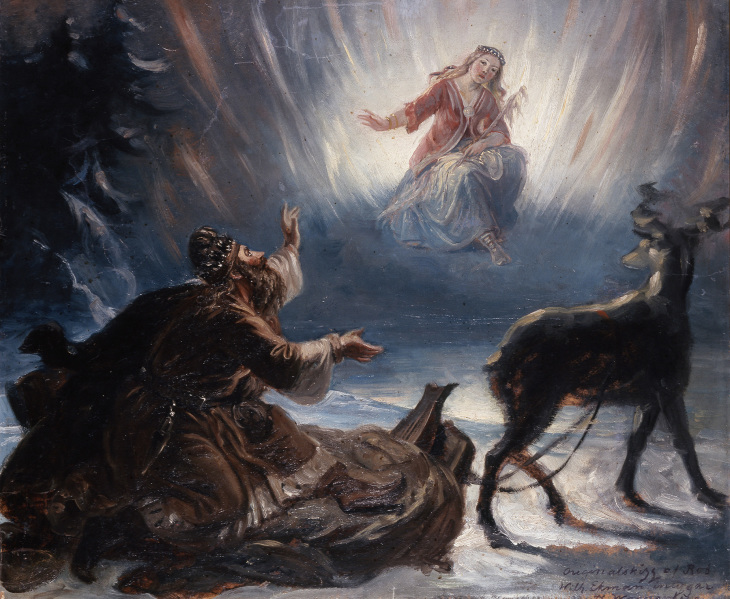
Väinämöinen travelled from house to house, looking for someone who had the skills to stop the bleeding. Eventually, he found an old man who is a skilled shaman-like figure who is able to help him. This runosong, Väinämöisen polvenhaava "Väinämöinen's knee wound", is the most widespread myth of Väinämöinen. In other bloodstopping incantations, it is also said that Väinämöinen's son is able to stop Väinämöinen's bleeding, and also made healing ointment.
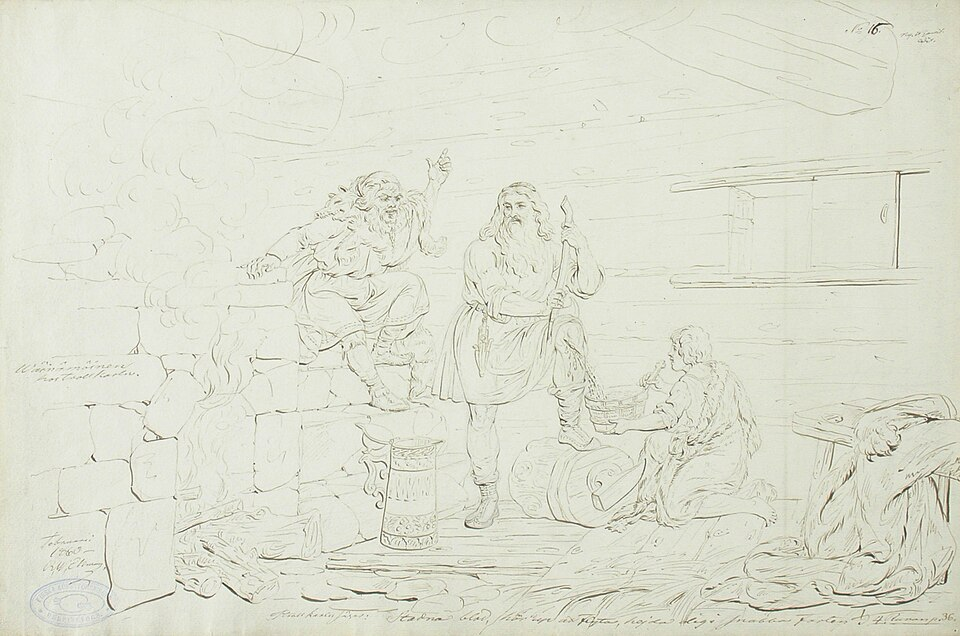
Väinämöinen cannot finish building his boat, as he still needs three powerful, secret magic words (luote). He asked his brother Joukahainen to fetch the required words from the great shaman Antero Vipunen, but Joukahainen informed him that Antero was long since dead and buried. It is possible he died in a trance after getting stuck in that state. Väinämöinen had no choice but to descend into the Underworld (katabasis) to gain the knowledge from his spirit. As Antero was sometimes seen as a giant, it was described that Väinämöinen was swallowed by him at his grave. Inside the stomach of Vipunen, Väinämöinen started forging and this hurt Vipunen. He spit Väinämöinen out, revealing the words he needed.
This is likely not the original version of the myth. It's possible that in an earlier version, it was Lemminkäinen who travelled to the Underworld to meet his shaman father. However, Lemminkäinen being the son of a dead shaman wouldn't be the original version either! It seems that before Vipunen was thought of as a dead shaman and a giant, the name actually belonged to Ukko. Thus, Lemminkäinen (whose name is connected to fertility and fire) would be the son of the fertility god.
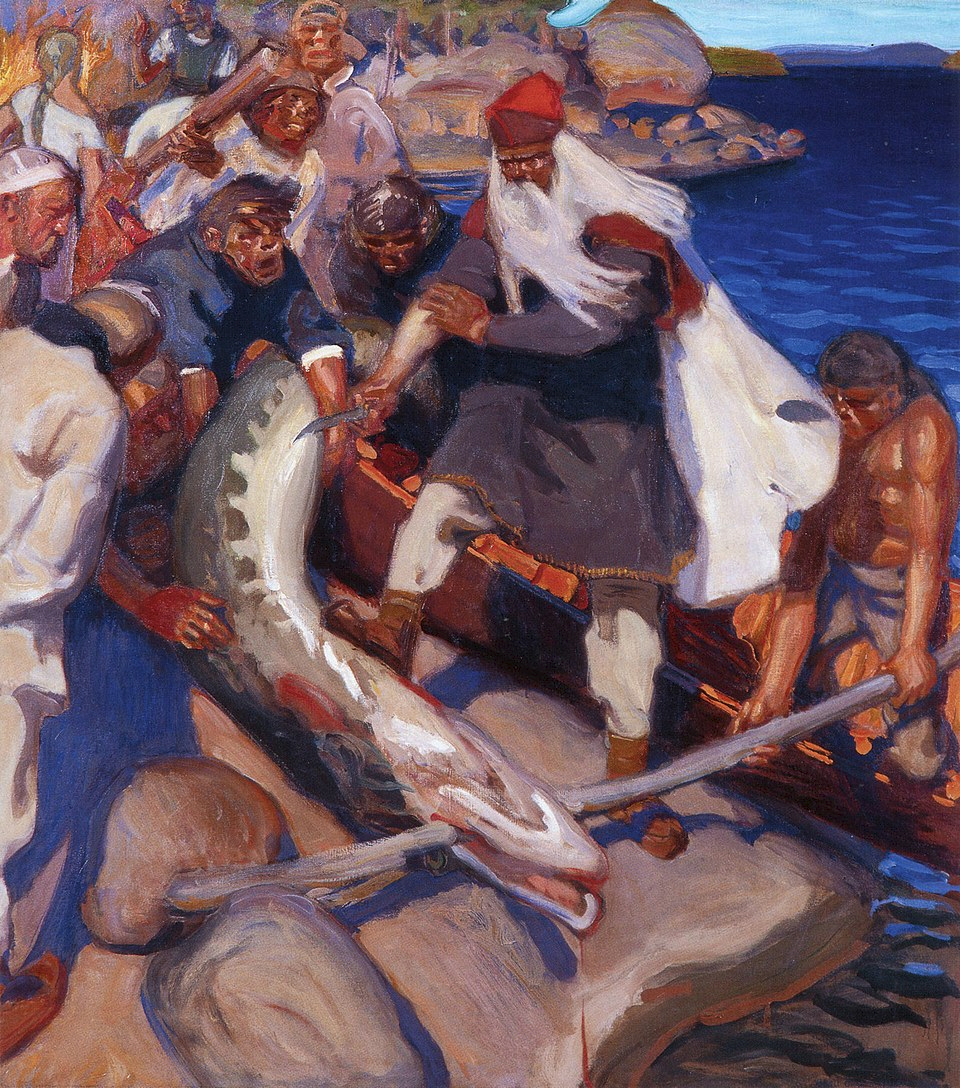
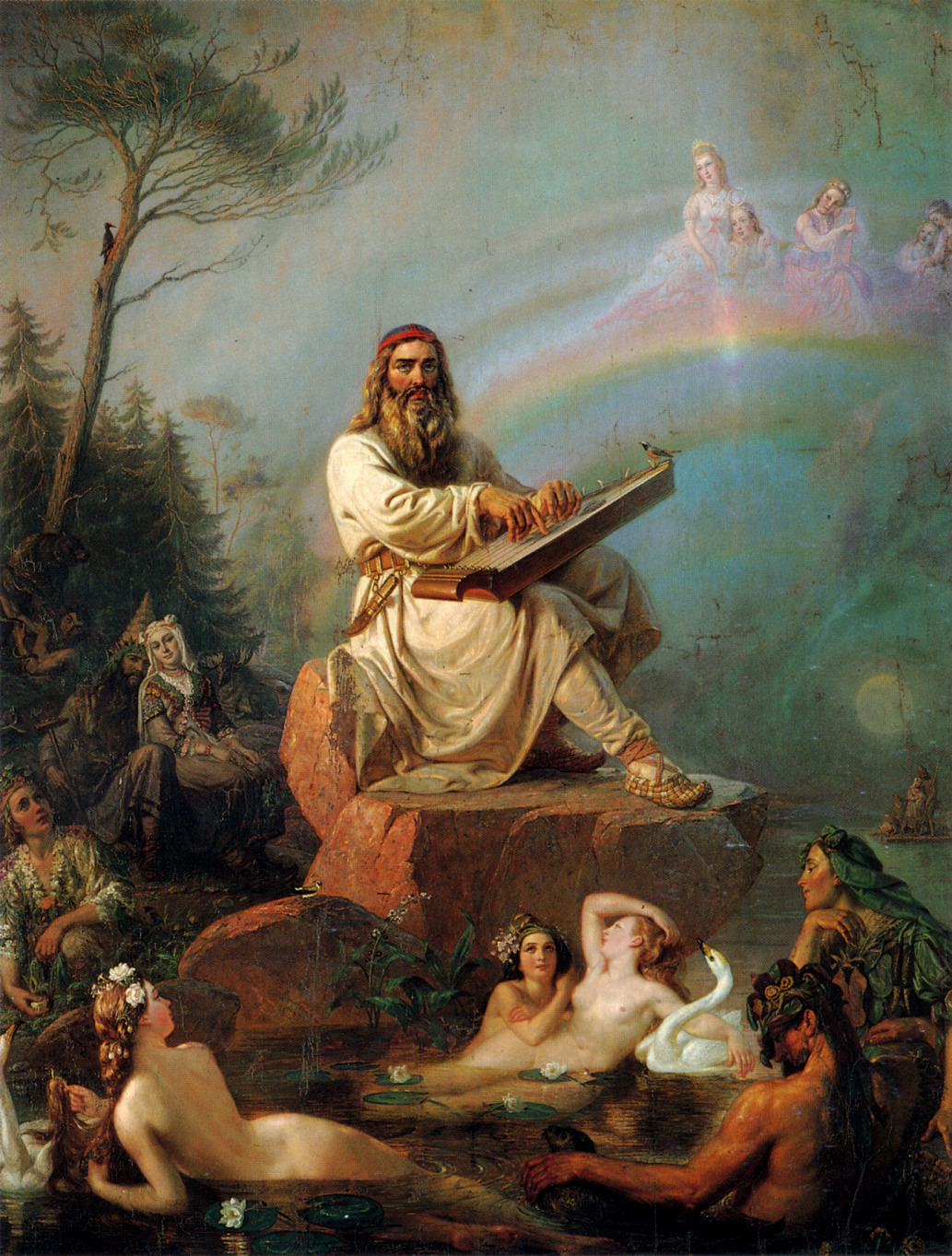
After healing and finishing his boat, Väinämöinen went to sail and filled his boat with men and women, young and old. The elderly were not good at rowing, so the young ones were made to row. After three days, the boat hit something. After inspection, Väinämöinen saw that they had hit the jaw bone of a pike. He thought that this would be good material for a harp-like instrument, kantele. He gave the instrument strings from the horsehair of a stallion (or hair of a maiden of the Underworld) and made the elderly play it. However, this was not good, so he made the youngsters play. This was not good either, so Väinämöinen himself decided to play. It was so wonderful that people, animals, birds, fishes, even gods like Mielikki and Vellamo came to listen to Väinämöinen playing. Even Väinämöinen himself could help but cry, tears as large as eggs falling down his cheeks.
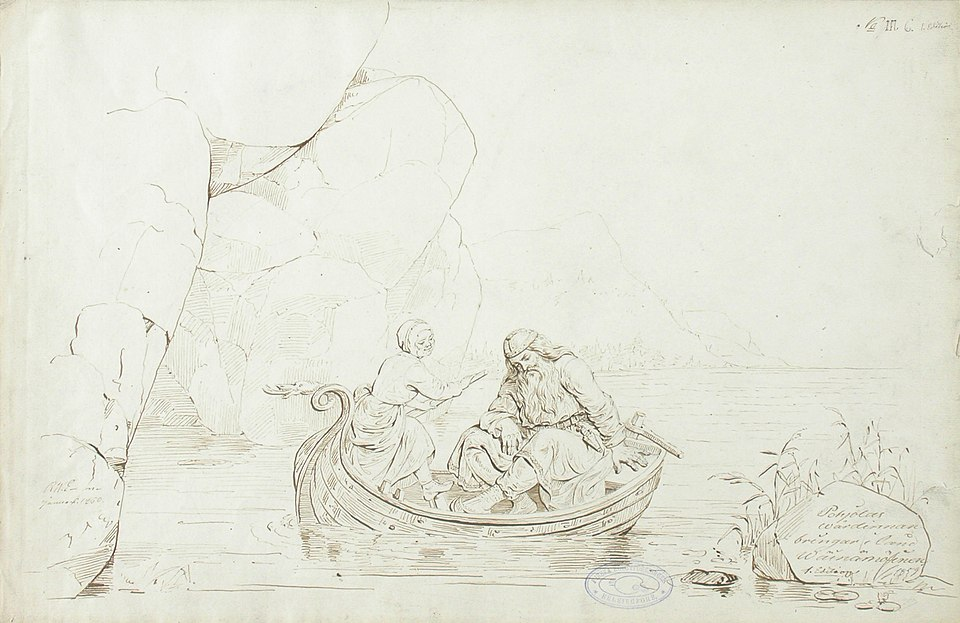
Väinämöinen decided to go to the Underworld, Pohjola, after finishing his boat. The sons of Pohjola urged him to cross the river of Pohjola without using his hands, so Väinämöinen whistled, summoning a wind which took him to the shore. A son of Pohjola took his boat and told him to come in, to the yard of Pohjola, into the house, to drink mead. There, the son of Pohjola challenged Väinämöinen to a sword fight and striked first, but the strike was a failure. Väinämöinen's strike, on the other hand, was successful (he might or might have not cut off the head of the son of Pohjola). For this, the son of Pohjola (called Pohjolan pitkä poika "tall son of Pohjola" or Lappalainen kyyttösilmä "slant-eyed Sámi") took revenge by making an arrow out of sparrow feathers and when he saw Väinämöinen on the sea, either by boat or riding a stallion make of straws, he shot an the arrow at him. In some depictions, he shot multiple arrows, nearly collapsing the sky and earth. Väinämöinen fell into the river of the Underworld where he floated for either three days or six years (depends on the runosong). Louhi heard his cries, recognizing them to be those of an old hero, and helped him into her house and offered him food.
There is a runosong in which Väinämöinen arrived at Pohjola and wanted to get Louhi as his wife, and she was the one who gave him impossible tasks. However, the hero proposing to a maiden of the Underwrold is usually Lemminkäinen. Still, there are runosongs that consider Louhi to have become the wife of Väinämöinen (though this is not the case in all runosongs, I must emphasize).
Sometimes, Joukahainen is seen as a resident of Pohjola, and he would be the one to shoot at Väinämöinen. However, again, this is not possible in all versions, but it would make sense in those for the son of Pohjola to be someone else.
For reasons that are lost, Väinämöinen and Joukahainen went to Pohjola to steal the Sammas. This runosong is from the Forest Finns. The mystery of what Sammas or Sampo exactly is is a thing that has multiple books written about it, so I'm afraid I cannot explain it simply. One meaning for the word is the "world pillar". It is not clear what Väinämöinen and others would benefit from stealing it, but it is able to provide wealth, and its theft possibly enabled the chance for farming. The term "world pillar" is also used to refer to Ukko.
So, Väinämöinen and Joukahainen went to Pohjola and snatched the Sammas into their boat. Joukahainen told Väinämöinen to start singing his incantations but Väinämöinen refused, as the gates of Pohjola were still too close. When he finally started singing, the Sammas itself jumped up to the sky. Joukahainen jumped after it, striking it with his sword and cutting off two of its toes. One fell into the water, making seas salty. The other fell on land, causing wild hay to grow. If he had been able to cut off the third one, crops would grow on their own without the need for farming.
The account seems a bit confused, as if the Sammas itself was a bird. In Karelian versions, Louhi transforms into a kokko eagle and goes to chase after the heroes' boat, and it's her toes that are cut. It is quite interesting, this bird-transformation ability is actually given to Lemminkäinen's mother (Päivätär?) in Savo. On the other hand, the Forest Finns believed that a storm was a storm bird from Pohjola, and they tried to chase it away by making stabbing movements at the sky (incidentally also something that is described in the theft of Sampo narratives). Therefore, it is also possible that it was the storm bird who took the Sammas from the boat, and maybe Joukahainen cut off its toes which caused pieces of the Sammas to fall? Maybe.
Once, when Väinämöinen (in one version, Ilmarinen) was sailing, a fish jumped into his boat. He tried to cut the fish in order to eat it, but the fish jumped out back into the water. Then it revealed itself to be a water maiden, stating: "I didn't come to you to be salmon slices and eaten. I came to be your spouse!"
This water maiden is only known as a "maiden of Vellamo" (Vellamon neito) and "Koskelan komia vaimo" (handsome woman of Koskela ("rapid-place")). Maybe she is the same as the akka salmen korvallinen ("wife by a strait") who brushed her hair, a bristle of the brush falling into the water and creating a snake. This role is typically given to Maatar; however, there are runosongs that show that Väinämöinen's wife had a role in creating tooth pain (literally "tooth worm"). She was cleaning the sea with a broom, and on the third day of doing that, she caught some litter with the broom and started chewing on it, becoming pregnant with the tooth worm.
It seems that Väinämöinen copulated with this water maiden, even though their relationship was not considered valid by the church (obvious Christian influence here). Once, an abandoned child was found. As its father could not be found, and thus the child could not be named and made a member of the community, Väinämöinen as a judge ordered for the child to be taken into the forest and killed with a blunt strike from a tree. This is when the two-week-old child magically gained the ability to speak, asking why did he need to be killed for being fatherless when it was Väinämöinen himself who was his father.
Due to Christian influence, this tale later became to be seen as symbolism for the arrival of Christianity, the baby being Jesus and Väinämöinen, otherwise humiliated by being accused of incest, for example, leaves and escapes into a whirlpool. However, that is not the original setting of the runosong.
Väinämöinen's son is connected to water by having created water's healing properties and by being a helper of the mythical saviour in the sea, though he is also sometimes called Frost.
And as you can imagine, there are versions where Louhi is the wife of Väinämöinen and they have a son who Louhi later sends to the north to fetch her inheritance. She is afraid the son died as he doesn't seem to be coming back, but the son is a great tietäjä in his own right and returns, having been able to defeat all adversaries with his shamanistic powers.
In the abovementioned narrative, Louhi makes herself pregnant with waves and gives birth to a black dog to be the son's helper. Louhi is indeed usually known as the mother of wolves and dogs, although impregnated by the wind instead. Now, we get to a weird part. Usually, it is said that the northern maiden (= Louhi) gave birth to a dog. Then, it's said that a blind nothern maiden gave birth to it. Väinämöinen is blind: he is also known as Ulappalan umpisilmä "the closed eye of Ulappala ("open sea-place")" and Väinälän vähänäköinen "the little seeing one of Väinälä". Some versions of the origin of dogs says that it was the blind man of Ulappala himself who gave birth to the dog! Then again, there are runosongs which also state that the dog has one mother and seven fathers.
In my opinion, the wife of Väinämöinen connected to water is the same as Kuohutar.
Fire was created in the sky, but it came to earth by falling as a spark that crashed through the ground and Underworld into a lake in the Underworld (Aluenjärvi). There, a fish swallowed it. Väinämöinen tried to catch and cut open this fish, but was not able to as the fish was too hot, burning Väinämöinen.
Sauna steam (löyly) and tar are called the sweat of Väinämöinen. He is asked to help in all kinds of incantations: to protect in war, to help with a horse's sprained ankle, to ski after a bear so it would become tired, to help with giving birth, etc.
According to a Forest Finnish tale, Louhi once tried to prevent a luonnotar from returning to her home in Polaris. Väinämöinen, whose home is in the stars, helped the maiden to escape to the Milky Way and made her the protector of the Moon and the Sun. She seems to be a Moon Maiden. Väinämöinen gives her signs in the stars when it's okay for her to cause lunar and solar eclipses.
| Väinämöinen | Typically considered to come from väinä "stream pool, slow part in a river" or väineä "slow". Because Väinämöinen shares many features with Norse Odin (including runosinging, compare to Odin's galdr abilities), Janne Saarikivi suggested a connection to the early Germanic name of Odin, *wātenos. |
|---|
❅ Birth of Kaleva
❅ Creation myth
❅ Berry Song (The Origin of a Son of Fire/Sun)
❅ The Release of the Celestial Lights
❅ The Forging of Ilmarinen
❅ Runosong competition against Joukahainen
❅ The Fishing of a Maiden of Vellamo
❅ The Knee Wound of Väinämöinen
❅ The Son of Väinämöinen
❅ The Song of Vipunen
❅ The Playing of the Kantele
❅ The Song of Lemminkäinen (+ Väinämöinen's trip to Pohjola)
❅ The Shooting of Väinämöinen
❅ The Theft of Sammas
Only in Finnish, sorry. This is the source material.