


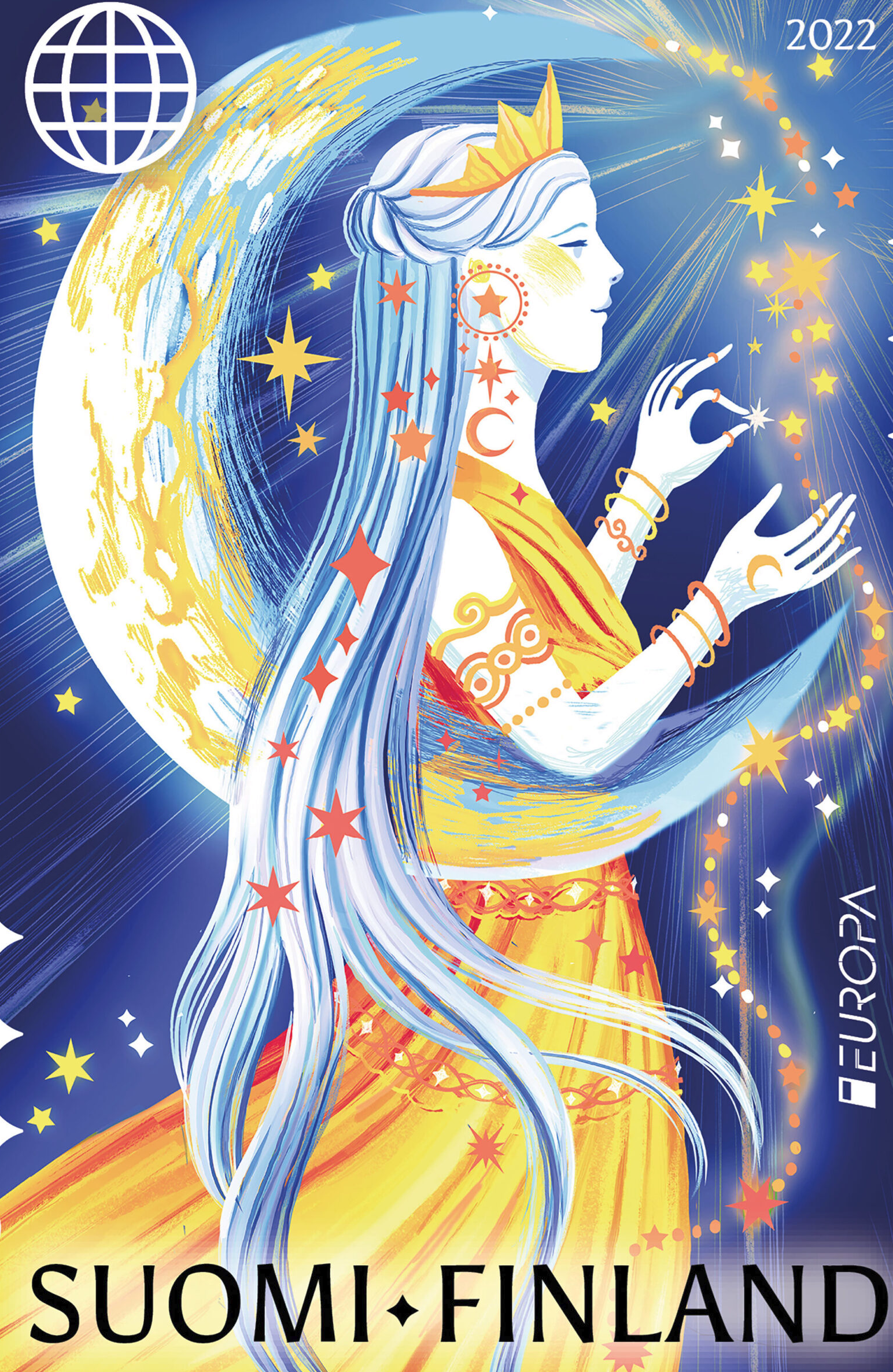
| Names: | Kater  Kuutar (and  ?) ?)Kuuto Laatter A Moon Maiden is also called Katriina and Hepleija Jenuveeva, but I don't have a specific evidence that would prove these lines refer to Kuutar specifically and not some possible other Moon Maiden. And I don't want to write fanfiction here but remain historically accurate to I will not make definitive statements about this. |
|---|---|
| Colour: | Gold |
Kuutar is the luonnotar (nature goddess) of the Moon.
Kuutar is, along with Päivätär, mentioned as a mother of wasps. Päivätär's connection to wasps is understandable as wasps are seen as sparks of fire, and Päivätär is the creator of fire. Kuutar's role in this is much more difficult to explain. Kainuians seemed to have agreed, as the name got forgotten and morphed into various forms such as Kater, Kuuto and Laatter in these wasp incantations. I believe Kuutar as a separate goddess was not here at all, but is being used as a synonym for Päivätär in this instance. After all, due to Christian influence, both Päivätär and Kuutar got associated with Virgin Mary.
What is unmistakenly Kuutar's own attribute, is weaving. If Kuutar got wasps associated with her from Päivätär, Päivätär got weaving associated with her from Kuutar. Long before Christianity, various groups around Europe saw a spinning girl on the Moon. With Christianity, this morphed so that it was the Virgin Mary spinning on the Moon. A Moon spinner appears in various ways in Finnish myths as well, even if not always referred to with the name Kuutar. Gold is also clearly her colour; even outside of weaving, in a hunting incantation, she is being offered the "eternal gold of the Moon".
In a runosong from Central Finland, the name used for the Moon's weaver is Katriina. She has the same epithet as Kuutar, however. She might be a mortal girl who falls asleep in the forest and is taken up to the sky by "two God's men and two Devil's men". The father of the maiden was looking for her, finding her weaving with gold and silver in the stars. He asks for her to come down, but she says she can't: she's still got a lot of weaving to do.
Another runosong uses the same lines of weaving gold and silver. In it, a crying maiden falls down from the sky. Her reason of crying is that her golden thread got cut. Maidens in the sky, weaving maidens... these are all descriptions of luonnottaret. In a similar vein, the Forest Finns knew another Christianized name for the Moon's weaver, Hepleija Jenuveeva. She lived in the Polaris, at the top of the world pillar, which seems to me like an obvious reference to a luonnotar. Once, Louhi attempted to catch her so she couldn't return home. With the help of Väinämöinen, she was able to escape to the Milky Way where she became the protector of the Sun and the Moon. She had long, long hair: lunar and solar eclipses were caused by her having a sauna bath day, and when she brushed her long locks, they could cover the celestial lights.
The section above is not by any means the only reference to a Moon Maiden's long hair. Runosongs mention how Kavet "freed the moon from a ring" and released the "long-haired one from trouble". Sometimes, a ring of light might appear around the Moon. This was seen as "Kuumet" (demon, ghost?) imprisoning it in iron, and Kavet freed the Moon from it. In runosongs, Kavet's action of releasing the Moon has a magical connection to childbirth. Runosongs ask help from Kavet in childbirth: "Once, you freed the Moon. Why don't you free me (/my child) as well?"
New moon was considered especially prosperous time. Runosongs ask the new moon to give the singer health, and even food and riches. It's good to greet the new moon while holding money or bread.
| Kuutar | Comes from kuu "the Moon". This word originates from Proto-Uralic *kuŋe. |
|---|---|
| Kater, Kuuto, Laatter | Mistakenly formed alternatives from Kuutar; Laatter likely morphed into this form for alliteration, as the next word on the line starts with the syllable "la-". |
| -tar, -tär | Feminine suffix. |
Only in Finnish, sorry. This is the source material.