


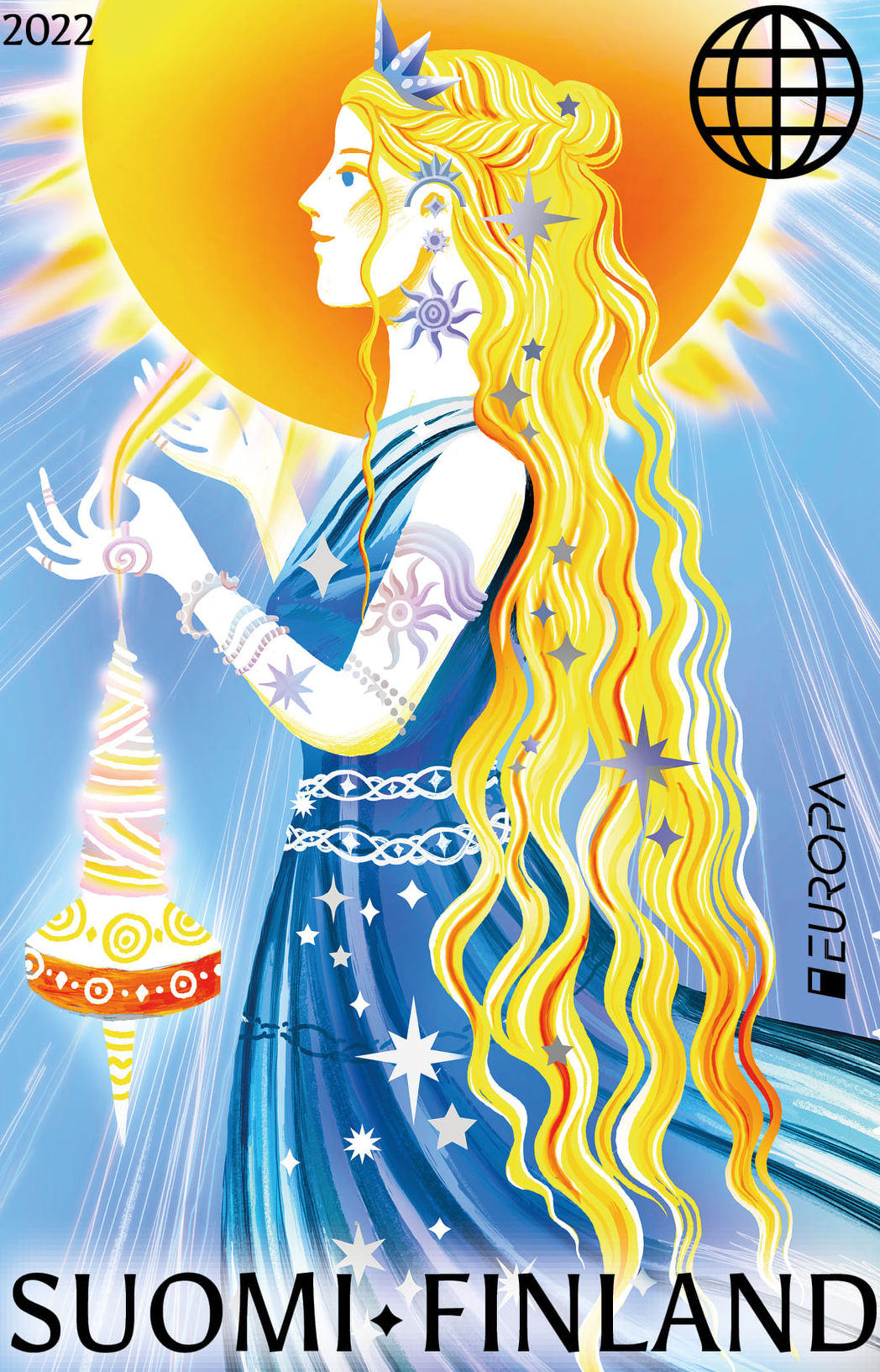
| Names: | Auringotar   Aurinnatar Päivytär Päivätär Pääjätär  |
|---|---|
| Colour: | Gold, silver Karelian runosongs specifically connect Päivätär to silver, but Finnish ones also call her golden. |
| Animal: | Wasps |
| Children: | Fire, and therefore entities with fire in them: Panu, wasps, even Lemminkäinen According to Siikala: Väinämöinen, Ilmarinen and Joukahainen through a virgin birth despite Väinämöinen's father being described. Väinämöinen has the epithet "Son of the Sun". |
| Domain: | Sun, Päivälä |
Päivätär is the luonnotar (nature goddess) of the Sun.
In runosongs, Päivätär is called the creator of fire. The personification of fire is called Panu, yet at the same time he is called a son of the underworld (Tuonen poika). In some instances, he is called red-beard. Fire is also the essence of wasps: not only are wasps called Päivätär's sons, a wasp is also referred to as Son of the Sun (Päivän poika) who was married off in the Underworld. This lines with Lemminkäinen, who goes to propose to a maiden in the Underworld and is called "son of Vipunen", just like fire is also called "son of Vipunen". As the creator of fire, Päivätär seems to then appear as a "mother" to various beings with the essence of fire.
The most common bearer of the epithet Pätösen poika ("Son of the Sun") is actually Väinämöinen. Väinämöinen is called the brother of Joukahainen, and sometimes Ilmarinen is also added to the trio. Some Karelian poems describe a maiden named Maaria (Virgin Mary) or Iro (Saint Irene) giving birth to these three sons, with Virankannos then baptizing them. Apparently Anna-Leena Siikala had a theory that the original bearer of this role had been Päivätär. Interestingly still, Väinämöinen is also regularly called the son of Kaleva, a warrior-like primordial giant. Then again, a sea giant was able to impregnate Louhi with just waves, so maybe some non-sexual insemination could've been possible here as well; especially since the sea giant in question might just be Kaleva himself, if looked at from a certain perspective.
Some of the earliest runosongs to mention Päivätär state that she "released the Son of the Sun". If this isn't a reference to Lemminkäinen's resurrection, I don't what it would mean. Christian imagery got mixed in later, "Son of the Sun" equated with Jesus. In runosongs from Kainuu, it is Väinämöinen who released the Sun itself from a rock, so it's probably not related to that either.
The connection between Päivätär and Lemminkäinen seem to further hold up in Karelia, where Lemminkäinen could be presented as Päivätär's son who she warns against going to a divine banquet. Then again, some versions have formed so that it is Päivätär holding the banquet, forbidding Lemminkäinen to be invited. Not that I wish to dwell on this much as this version does not exist in Finland.
Kuutar is mentioned along with Päivätär as a mother of wasps; however, I believe this to be an instance where Kuutar and Päivätär are treated as synonyms. It does bring further confusion into the scene, but it doesn't seem like weaving was initially very central for Päivätär, unlike for Kuutar to whom its her main role. It seems like the two have influenced each other, Kuutar being added as the wasp's mother and Päivätär being added as a weaver of silver thread.
Päivätär and Kuutar were famously replaced by Virgin Mary during Christian times, but they weren't the only ones. The goddess of pain, Kivutar, also got this treatment. Therefore, when pains are driven away into "Kivutar's mitten", in Savo, an additional line appears where they are also banished below Päivätär's head.
The creator of wasps is also called Angervatar and Angervotar in North Ostrobothnia, and Angervannotar in Kainuu (from angervo "a plant of the genus Filipendula"). The name does sound similar to Auringotar, but I cannot say with any certainty whether it is connected or not. In Kainuu, the "mother of fire" is also called Umo, Uumo and Tuuva, one runosong also including the name Umotar in an incantation about a cowshed snake. Kaarle Krohn's theory was that this would be related to the word uhma "defiance, threat". It is possible that Umo though could also refer to Lemmäs, and the context in which these names appear would surely imply so.
Another unclear name is Päistäryys (from päistär "a shive") from South Savo. She is given the epithets of Päivätär (pätevä "adept") but the hunting incantation in question is quite unclear and mentions a bunch of names, including Mielikki and Louhi. It's a bit difficult to say if Päivätär was intended with this line about Päistäryys.
Still interested? Check out my essay On Päivätär, Louhi, bees, and hornets.
| Päivätär, Päivytär | Comes from päivä "the Sun". This word originates from Proto-Uralic *päjwä. |
|---|---|
| Auringotar | Comes from aurinko "the Sun". The origin of this word is unknown, and it can't be found from other Finno-Ugric languages apart from Finnish (unlike päivä). Theories include origin in Proto-Finnic *audër "haze", further origin unknown, or being a loan from Baltic languages (compare to Lithuanian aušra "dawn"). Even (a bit silly imo) theory of it meaning "bliss ring" (auvo+rinki) has been proposed. |
| Pääjätär | Morphed when the line Päivättären pään alunen "(a thing) below Päivätär's head" got mixed up, the word pää "head" influencing Päivätär's name, turning it to Pääjätär. |
| -tar, -tär | Feminine suffix. |
❅ Berry Song (The Origin of a Son of Fire/Sun)
❅ The Birth of Panu (Fire Son)
❅ The Release of the Celestial Lights
❅ Origin of Fire
❅ The Death of Lemminkäinen
❅ The Song of Lemminkäinen (+ Väinämöinen's trip to Pohjola)
Only in Finnish, sorry. This is the source material.