


| Names: | Iilmarinen 
Illamoinen 
Ilmalainen 
Ilman ukko 
Ilmanrinta  
Ilmari 
Ilmarinen
Ilmarinta
Ilmarunen
Ilmola
Imnarinen
Jumala |
|---|---|
| Location: | Sky |
Ilmarinen, the successor of the original Uralic sky god, got partially replaced by Ukko in some aspects later on.
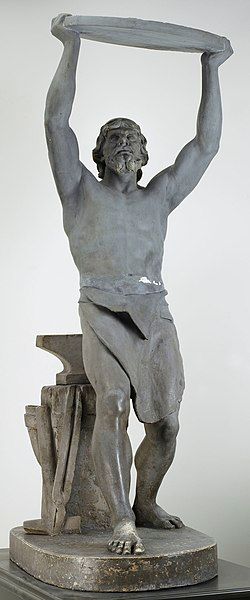
In the older Uralic cosmology, the sky god was not very active and simply provided stability for the world in the background. Before the invention of metalworking, the dome of the sky was thought to be made of stone, but later came to be seen as forged from metals. Thus, the sky god became the forger of the sky: this is Ilmarinen's primary role.
From mythologies of some other Uralic peoples we can see why Ilmarinen is not often prayed to: prayers were not directed towards the passive sky god, but rather towards his wife and sons, and other deities on earth and in the Underworld rather than on the sky. For Finns, this "family" has fully broken apart though (if it originally even was a family), as the relevant "sons" are typically those of the primordial giant Kaleva, and the "wife" has become Päivätär who is not in any context presented as Ilmarinen's wife (indeed, she has more of a connection with Ukko than Ilmarinen). Thus, Finnish mythology does not provide precise equivalents to these Uralic deities.
With agriculture, and foreign influence from Indo-Europeans, it became increasingly important to pray for suitable weather and fertility, and these prayers were addressed to the fertility god on the sky, Ukko, not Ilmarinen. Ilmarinen's role was not expanded; rather, it was seen as more reasonable to add in a new deity instead. Ilmarinen came to be seen as a wind god primarily, not a fertility or weather one. In this way, some features of the original Ilmarinen likely "branched off" into Ukko instead. I would like to point out that while Ukko is called both Jumala and... well, Ukko, both of those titles have also been granted to Ilmarinen in some instances in runosongs.
From a comedic perspective, I imagine the introvert sky god Ilmarinen suddenly getting prayers addressed to him, and rather named another guy as a fellow sky god to take care of all of that than suddenly have to become more active himself.
As stated, Ilmarinen's primary role is to be a smith. He was there at the very beginning: not only did he forge the sky, but the island at the center of the world could've also been born from a drop of gold that fell from his pot in the middle of the sea. He conducted his initial forging in a doorless and windowsless forge and was born before the celestial lights existed, much like Väinämöinen. While Finnish runosongs make no mention of this, Karelian runosongs describe him as the forger of the sampo, the world pillar. Of course this is possible, but the world pillar is also symbolically seen as the fertility god Ukko himself (or his phallus), so it doesn't add up in all versions of the myths. Then again, Karelian runosongs also refer to the sampo as the sky, so this could explain some of it.
According to Johan Cajanus in 1663, Ilmarinen is one of the sons of the primordial giant Kaleva. Runosongs make no mention of this, nor do they ever give Ilmarinen the epithet "son of Kaleva". Still, Cajanus must have had the basis for his claims somewhere as there are Karelian runosongs that portray Väinämöinen, Ilmarinen and Joukahainen as three brothers (in order of age). From a certain perspective, this could even suggest that he is a son of Päivätär, truly giving him a demotion. It seems that the distant sky god Ilmari was, in runosong tradition, brought closer as the divine wind god-smith Ilmarinen. Still, in 1728 Ostrobothnia, Ilmarinen was put above Väinämöinen as a god (Väinämöinen was not given that title.)
To me, Ilmarinen's role is more of the cosmic sky god and wind god variant, while Ukko is focused on weather and fertility.
In runosongs, fire was created in the sky, but a spark of it fell down to earth when Ilmarinen was forging with three kokko (fire eagle) feathers. The kokko has also been seen as the original cause of thunder (before the appearance of the human form weather god Ukko). Maybe then, this is meant to display fire originally coming from the sky to earth with a lightning strike. Still, after this, the spark of fire comes down crashing through earth and the underworld, the description resembling more of a meteroite.
As three luonnottaret dripped white, red and black milk from their breasts, it dripped down and got mixed into a swamp. The son of Tuoni, Hölmä, then discovered the result: iron ore. He took it to Ilmarinen, who proceeded to create iron. He made iron swear it wouldn't hurt us humans, its "brothers", but a wasp brought snake poison into the iron's quenching water, causing for it to break its promise. He has also generally been described as forging items for humans and gods, including Väinämöinen's sword, as well as women's everyday objects.
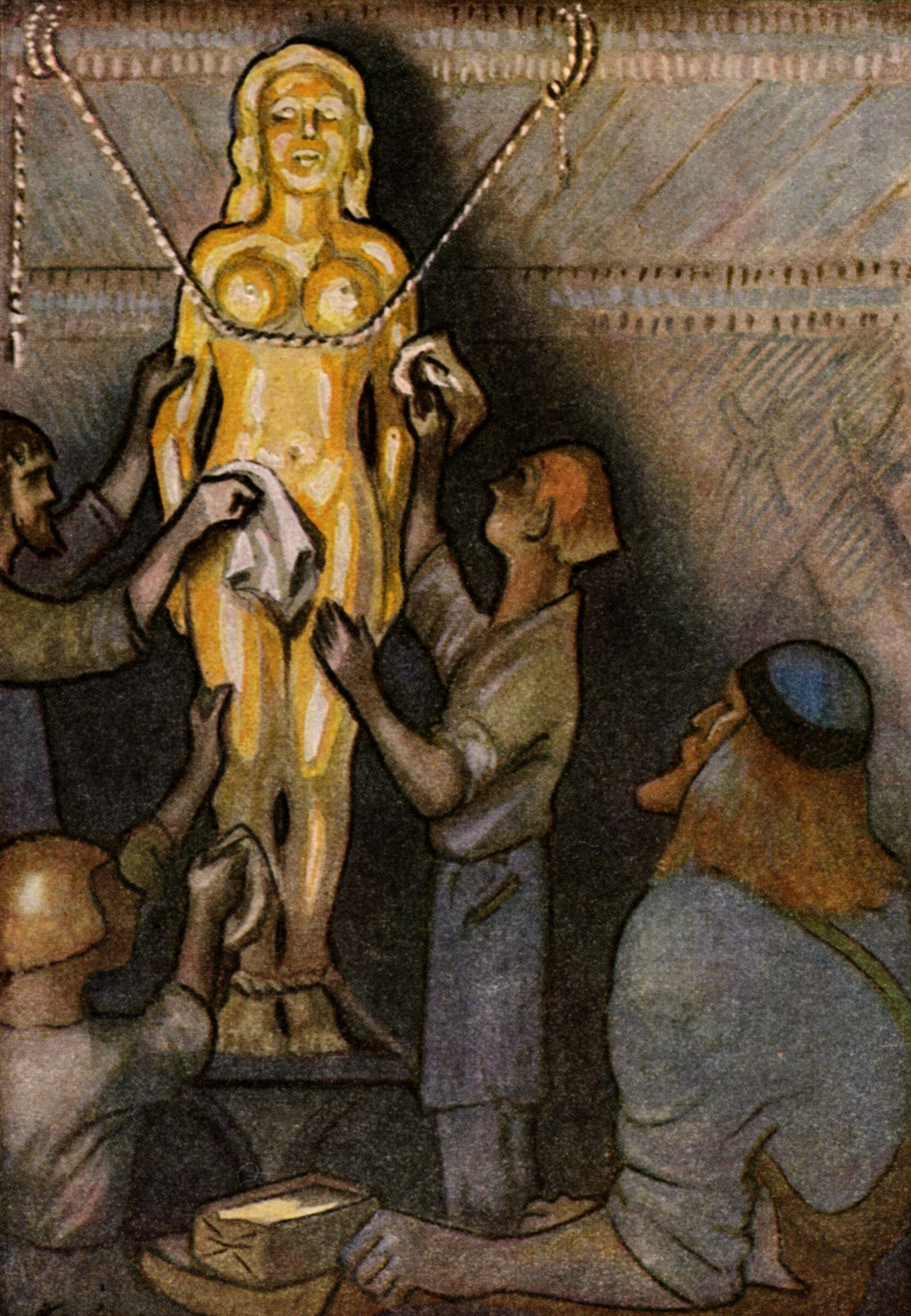
Although this role is sometimes given to other figures in runosongs (such as Väinämöinen, Kullervo or Kaleva), the usual protagonist of the forging of the golden maiden is Ilmarinen. As Ilmarinen is forging for many days, he creates a sword, but is not satisfied. He tried again and creates a stallion, but is not satisfied. He starts working the bellows himself instead of his servants, and is able to create a golden maiden, finally making him happy. However, the maiden is cold to lie next to. This story has been used to show that a marriage made for money can be emotionally cold.
Medieval sources claim that once upon a time somewhere in northeastern Europe and northwestern Siberia, there were indigenous peoples who worshipped a statue of a golden woman. 16th century poet and diplomat Giles Fletcher stated that there was a rock with the shape resembling a woman boaring a child in her hands which was used in Samoyedic paganism. Maybe there is no connection, but it's interesting that golden woman statues exist in both western and eastern Uralic history/mythology.
Just like Väinämöinen is sometimes put as the forger of the golden maiden, Ilmarinen is sometimes put as the protagonist of the stories where typically Väinämöinen fishes a water maiden, or travels to the Underworld to Antero Vipunen.
| Ilmarinen, variants | From Proto-Finnic *ilma "sky". |
|---|
❅ Berry Song (The Origin of a Son of Fire/Sun)
❅ The Island at the Center of the World
❅ Origin of Beer
❅ Origin of Iron
❅ The Forging of Ilmarinen
❅ Origin of Fire
❅ The Fishing of a Maiden of Vellamo
❅ The Song of Vipunen
Only in Finnish, sorry. This is the source material.