


| Names: | Of Tuulikki:
Annikki    Tuulikki Tyytikki and/or
Of Tuometar: Taometar Tuometar Tuonetar
Of son of Tapio: Pinneus Pinneys and/or
|
|---|---|
| Domain: | Forest, Metsola |
Runosongs speak of a figure who "gives squirrels". In 1551, Mikael Agricola called the one giving squirrels Nyrckes, while in 1789, Christfrid Ganander called the Mother of Squirrels Tyytikki. Thanks to 19th century stuff, including the Kalevala, people tend to think the giver of squirrels is Nyyrikki, son of Tapio. I think this is inaccurate. Regardless of what some Karelian runosongs may imply, the names ending in -kki are feminine. I have no doubt in that Tyytikki, Nyyrikki, etc, giver of squirrels, is the daughter of Tapio.
Still, a son of Tapio does exist in runosongs as well, so he will be here as well. Another thing to be noted is that Nyrckes also resembles some Karelian names for Mielikki, but that is not my focus here.
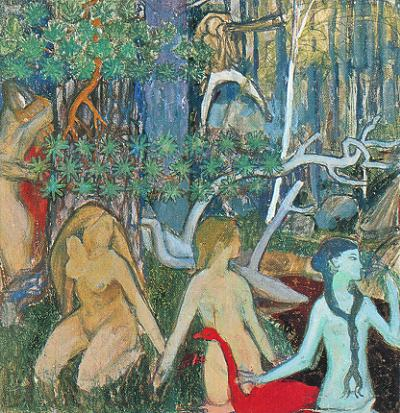
As already stated, Tuulikki is the Mother of Squirrels, addressed in hunting incantations. A more widely known name connected to the epithet "daughter of Tapio" is Tuometar ("Lady bird cherry"). I cannot say if this figure should be seen as the same one, or different from Tuulikki.
Tuulikki also has a myth appearance: Once, when she was sitting on a rainbow in the sky, Väinämöinen tried to propose to her. I guess she wasn't interested; she made Väinämöinen complete all kinds of impossible tasks to "prove he's a hero". While at it, Väinämöinen hurt his knee and seemingly forgot about Tuulikki.
The name Tuometar appears mainly in bear-related songs, possibly as the mother of the bear, or one of the mothers. According to one theory, Tuometar is actually the same as Hongatar. In some runosongs, Tuometar is replaced by Saint Catherine, and the same is done to Tuulikki in the abovementioned story of proposal. In either case, Tuometar is interestingly called Päivälän miniä ("daughter-in-law of Päivälä (sun-place, heavens)").
Mentions of a son of Tapio are rare: one North Ostrobothnian (or Kainuian? Unclear) bird hunting incantation asks for him not to hold onto the forest animals but let them run free, so the hunter could catch them.
The nature of hunting incantations is, by their core, sexual. The forest is feminized, seen as a maiden or a Lady who needs to grow fond of the hunter, become sexually aroused by him and therefore grant him prey. As hunters tend to be men traditionally, it is no wonder that the original, most important hunting goddess was the Lady of the Forest, with a daughter also being mentioned, while male form forest gods like male Tapio and his son are much rarer, later innovations.
It does raise the question: why was a son of Tapio introduced in the runosongs at any point in the first place? Some Karelian songs, due to Christian influence, equate him with Philip the Apostle. I do find it more fun to go with a bit of a queer reading though and imagine a hunter who maybe didn't feel like wooing a maiden.
| Annikki | Formed due to the influence of Saint Anne. |
|---|---|
| Tuulikki, Tyytikki | While tuuli means "wind", her name might not be so simple. According to Martti Haavio's theory, the original form of the name is *Lyyδikki, ultimately from Old Norse hluti "lot, fate". The Finnish word lyyli "luck, religious offer" would then also be connected to the same family of words. |
| Tuometar | From tuomi "bird cherry". The form Tuonetar does not seem to refer to Tuoni (the Underworld) but seems like a simple mistake formed from tuomi. |
| -tar, -tär, -kki | Feminine suffixes. |
| Pinneus, Pinneys | While I have no professional source for this, I personally think it's related to "holding onto" something: the following line goes älä pidä, älä pinnei (something along the lines of "don't hold onto (something)") and the unclear verb pinnei here seems to be connected to the name. |
| Names: | Hillervo and/or Tellervo Tillervo |
|---|
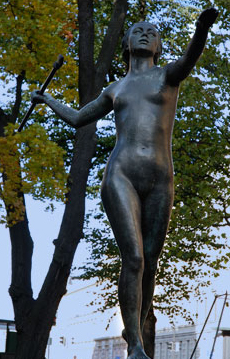
Another figure with the epithet "daughter of Tapio", is Tellervo. She is mostly only mentioned in bear hunting incantations. However, there is an interesting possibility: she is the same as Hillervo, the Mother of Otters.
In 1789, Ganander stated that Hillervo was the Mother of Otters and Juoletar was her husband. Juoletar is, however, an explicitly feminine name, and might have been listed as a Lady in Karelia as well. It is possible that Juoletar was the original Mother of Otters, with Hillervo being the Mother of Polecats, but as polecats disappeared from Finland, this distinction became unclear and Hillervo became the Mother of Otters as well, and Juoletar her "husband". Assigned lesbians by Ganander?
After further investigating, I believe Juoletar is the Mother of Otters, but Hillervo mentioned could indeed come from Tellervo. Read more about it here.
| Hillervo | Theorized to come from killeri "trap", hilleri "polecat", or hilla "cloudberry". |
|---|
Only in Finnish, sorry. This is the source material.