


Page 1 ❅ Page 2
Let's start with my, probably quite controversial, view on the sky fertility god. This is my gospel I wish to share far and wide.
After having looked into etymology, neighbouring religions, and runosongs, I am certain and convinced that Ukko and Virankannos are one and the same deity.
For the longest time, people have written about the "thunder god Ukko". In my opinion, this is inaccurate. What we are looking at is a sky god, a fertility god, who controls weather; thunder is only one part of it. Ukko means "Lord", although Yahweh is referred to with the Germanic loanword Herra. This kind of language is not uncommon for deities, as the Germanic fertility god is also called Freyr = "Lord".
The original sky god for Finns was, no doubt, the forger of the sky, Ilmarinen. However, in pre-agrarian Finno-Ugric cultures, the sky god wasn't as important and mostly existed as a passive force. This changed with the adoption of agriculture, and the sky and weather became extremely important for the fields. Instead of giving Ilmarinen new roles, Finns added a new sky god into the pantheon. He was often called Jumala. The etymology of this word is uncertain, though it has been theorized to come from Indo-Iranian *dyuman = "celestial". It has been used for Ilmarinen as well and could then predate the existence of Ukko; in either case, it later became to be mainly about Ukko. Runosongs often address Ukko, taivahan jumala ("Lord, God of the Sky") and Ukko ylijumala ("Lord, High God", as in high in the sky). It is no surprise that with the arrival of Christianity, the people were convinced by missionaries that their Jumala was in fact the same as Yahweh. Because of this, Ukko later gained many features of the Christian God in runosongs, which were not originally a part of his domain.
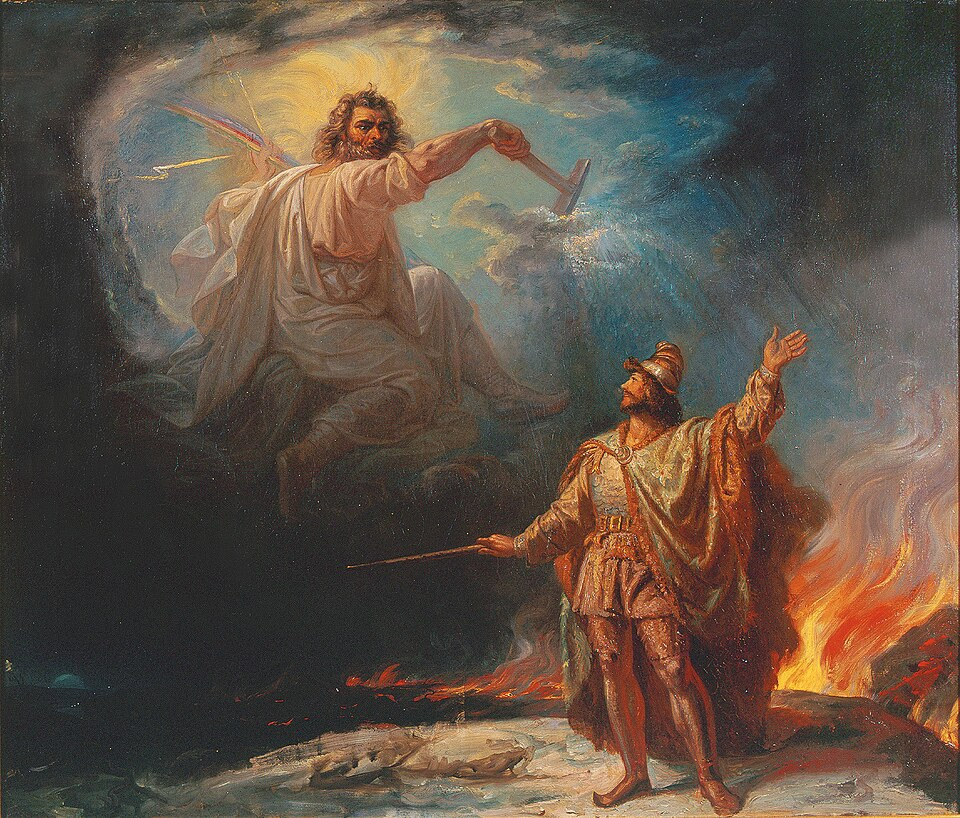
Virankannos was first mentioned by Mikael Agricola in 1551 as a "protector of oats". This has confused researchers, as oats are not a very important type of grain in Finland. About a century ago, E.N. Setälä and Uno Harva presented a great theory of the meaning of his name: "the one who holds up the world". This kind of role is given to fertility gods in not only Freyr but also the Sámi fertility god Veralden Olmai. Veralden Olmai has long since been connected to Freyr, but connecting Virankannos to this group opens a whole new world of understanding his role.
Virankannos is a general fertility god in the sky. His name is connected to the concept of the world pillar (in Finnish: sammas) and, as far as fertility gods are concerned, the world pillar tends to symbolize the ferility god's phallus. Every major researcher I've read to this point has, however, still treated Ukko and Virankannos as separate. In my opinion, there is no reason for this.
Mikael Agricola also mentioned Ukko in a series of confusing lines. In the 1700s, these were interpreted as describing how thunder god Ukko and his thunder goddess wife Rauni fought, causing thunder. This stuck around, and many Finns still think this was the case. However, it is not what the lines are about. Martti Haavio and Unto Salo have wisely arrived at the correct conclusion: Rauni is a name of Ukko himself, not his wife, and the description is not of a fight but fertility-increasing sexual intercourse. They were both still incorrect in that Haavio considered this Rauni-ukko to be separate from thunder god Ukko, and from Virankannos, while Salo thought that Rauni-ukko is the thunder god Ukko. The truth is that Rauni-ukko, Ukko and Virankannos all refer to one being: the fertility god in the sky.
Haavio believed that Rauni comes from Freyr, or rather, an older version of this name. Not every researcher agrees with this view, but this is fine. Whether it comes from Freyr or not doesn't change the fact that it is connected to Ukko and Virankannos in runosongs. The form in runosongs is Röönikkä or Ryönikkä.
In the Forest Finnish runosong Iso sika ("Great Pig"), it is said that Ukko, Visakanta (= Virankannos) and Ryönikkä arrived to slay a giant pig. Just because multiple names are mentioned doesn't mean that they're all separate beings: Finnish runosongs utilize a wide variety of synonyms and epithets. It is therefore my strong belief that this runosong is referring to Ukko, Virankannos and Ryönikkä (= Rauni) as epithets and names for one being.
Not that this is the extent of my evidence. If we take a peek into Karelian runosongs, we gain valuable new information: they use Palvanen and Palvonen as epithets for both weather controlling Ukko and Virokannas (= Virankannos). The runosong Iso härkä ("Great Ox") mentions the names Ukko, Virokannas and Palvanen/Palvonen with each other just like in the Great Pig runosong from the Forest Finns. In addition, a precious runosong from Ladoga Karelia straight up lays it down for us: it calls Virankannos with the title Ukko ylijumala. It seems very conclusive to me.
There are mysterious terms Juminkeko ("Jumi's pile"), Jumin kurikka ("Jumi's mallet") and Jumihäät ("Jumi wedding") in folklore. Jumi has been referred to in various ways, such as "the Devil's blind brother", but this is obviously not the original context. In 1758, Pastor J. Wegelius called Jumi the "god of marriage", but no such information exists anywhere else. Jumihäät were a socializing party event of the youth apparently held in his honour. Juminkeko and Jumin kurikka have referred to a large tree root system, but also a rock pile in the middle of the field (which was supposed to increase fertility). These rock piles also have other names, one of them being mulkkukivi "dick stone". These piles obviously symbolized a phallus. Ukko is also mentioned having a weapon, kultainen kurikka "golden mallet". A connection between fertility gods and phallic imagery was explained already.
The etymology of Jumi is... you guessed it, unclear. It has been thought to come from Jumala. In Latvian mythology, there is a fertility deity called Jumis (feminine form Jumala), and the Finnish term "to be in jumi" means "to be stuck" which isn't entirely unfitting for sexual intercourse.
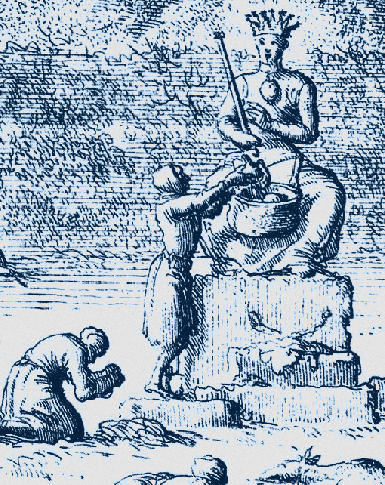
One thing still confused me at this point: why then do the Sámi, a fellow Finno-Ugric group, have separate thunder and fertility gods? The explanation came to me as I read more about Sámi mythology: only the Western Sámi, who have been in closest contacts with the Norse, consider the thunder and fertility gods separate (Horagalles and Veralden Olmai). Eastern Sámi groups, like those in Finland, make no such division: to them, the sky, thunder and fertility god is one and the same: Tiermes. He is also called Áddjá and Äijih; names which are the equivalents of Ukko.
It seems then that the idea of a separate thunder and fertility god was caused, for both Finns and Sámi, by Norse influence. Originally, for both groups, there was no question that these beings are one and the same. Therefore, features of both Thor and Freyr were incorporated into Ukko Virankannos. It's not hard to understand, as the Norse also thought that Thor protected farmers and therefore had a connection to the harvest.
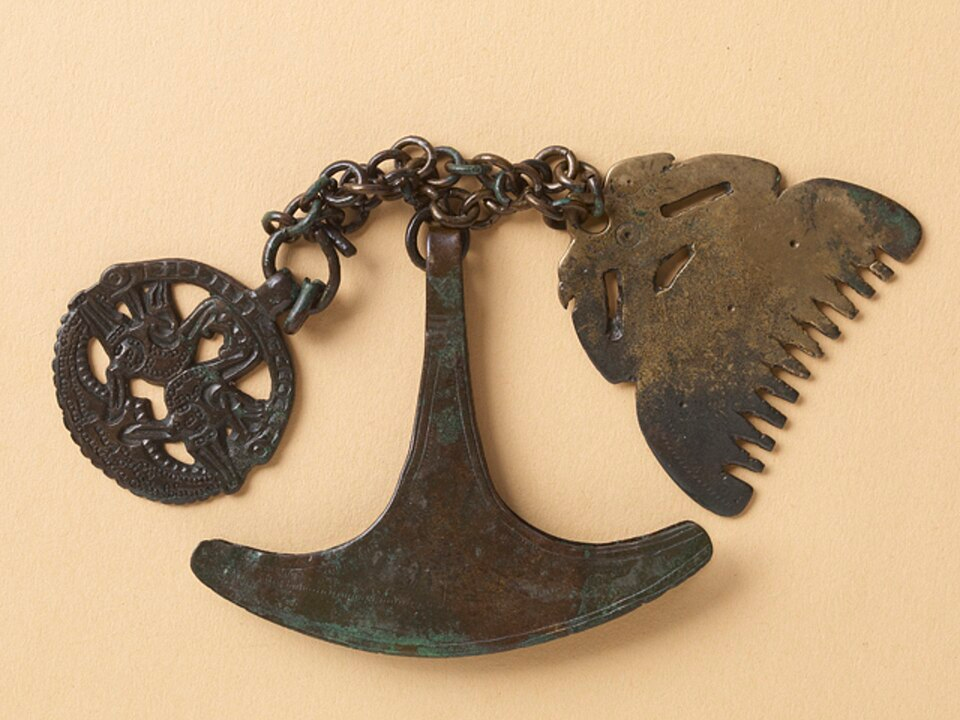
What about Ukko's wife? She remains unnamed. Multiple researches, first being Christfried Ganander, assumed that Ukko's spouse was Maatar, the earth goddess. This is understandable considering how common the idea of an earth mother and a sky father is in religions. However, Harva pointed out an important thing: this is actually never explicitly stated in runosongs but has only been assumed because the two are mentioned alongside each other in one incantation. The evidence is then not conclusive.
The vegetation haltija Sämpsä Pellervoinen is said to have had sexual intercourse with "his mother" to increase fertility, and this mother is thought to be Maatar. Since Maatar is the earth mother though, it's a bit unclear to me if she's supposed to be Sämpsä's mother specifically or just a general mother of us all. In either case, the incest elements are believed to have been added into the myth later due to foreign influence: Finnish myths don't generally see incest in a good light, not even among deities.
In the name Virankannos, the first half means the "world". Ingrian runosongs mention a mysterious Vironvipu, "world's lever/sweep". Setälä concluded that this is a reference to the world pillar, and I agree. There is also a giant named Vipunen in runosongs. He is a dead shaman who Väinämöinen travels to in the Underworld to get knowledge from. However, in some versions of the runosong, the protagonist is Lemminkäinen, and he seems to have been the original protagonist. Lemminkäinen is called Vipunen's son, and so is fire. But why would fire be connected to some mortal shaman?
In rare versions of the Song of Vipunen, he is called Kanderva and Viroinen. Setälä connected Kanderva to Virankannos, and Anna-Leena Siikala connected Viroinen to Virankannos. Lemminkäinen, symbolizing fire, the Sun and ferility, would've then originally been the son of the fertility god in the sky. When he descends into the Underworld to propose to an Underworld maiden, he is doing what countless other deitities have done in religions around the world, be it Ishtar's descent, Persephone's kidnapping, or Freyr sending his servant to fetch him a jötunn from Jötunheimr. Lemminkäinen, fire & warmth & fertility, descends and is killed... but he is also resurrected. In Finland, he is resurrected by his shaman mother.
Lemminkäinen becoming a shaman with a shaman father and a shaman mother is likely later development; Matti Kuusi and Siikala believed so too. Antero Vipunen has splintered off from Virankannos into a separate entity, creating some confusion in Lemminkäinen's parentage. But since Lemminkäinen and fire is the son of Vipunen, or Virankannos, we should also remember that it is the sun goddess Päivätär who created fire. I'm not saying that Päivätär has to be Ukko's (quite horny) wife, she is generally referred to as a virgin after all. But at least the fire element in Lemminkäinen came from her.
Lemminkäinen's shaman mother resurrects him with mead, a drink made from honey. In the Kalevala, this is presented that a bee brings Lemminkäinen's mother healing honey from God. As wasps are also referred to as sparks of fire, Päivätär is considered the mother of wasps as well. Wasps and bees are quite similar looking and could then be switched around; they are usually mentioned alongside each other, as well as hornets. Maybe the origin in Lemminkäinen's shaman mother using honey to resurrect him could then be in Päivätär as the ruler of these insects.
No wonder the whole idea of Ukko the thunder god bothered me. I felt like I almost hated Ukko... until I realized all this. Now, I see him very positively. He has been considered the "chief god" of the Finnish pantheon, but this is false: there is no such hierarchy among Finnish deities. Usually the attempts to present Ukko as the "supreme god" originate from Christian thinking: 19th century Christian Finns wanted to present ancient Finnish pagans as "good pagans", proto-monotheists who were on their way to inventing monotheism and would've reached that point on their own even without missionary "help". This was in order to show Finns as a great, intelligent, civilized people in opposition to the dirty, heretic polytheists. No wonder, the early researchers truly believed that Christianity is the truth and wanted to make their ancestors look better. I do not believe that Christianity is true, however, so I can easily say that this is not true. Although I'm not sure if I'd use the term "polytheist" either; I might prefer animist to a certain degree.
In order of appearance.
Page 1 ❅ Page 2