


| Names: | Huotola 
Saari        
Saariala (no region known) |
|---|
Saari "Island" is the island at the center of the world. Often, it is described that at the center of it is a village, Saaren kylä "village of Saari". At the center of it, is a cabin and a yard either holding the Sammas "the world pillar", or the world tree (an oak typically). In either case, below, it is connected to the world mountain in the Underworld, and above, to the sky. On the branches of the oak is the kultakätkyt "golden cradle" which can be used to travel between the upper and middle layers of the world. There are a few sources that suggest that this "golden cradle" is the rainbow, though the rainbow can also be understood as the bow of the sky god (Ukonkaari "Ukko's arch").
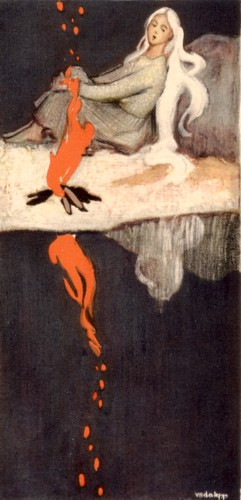
Saari is famously the home of luonnottaret "nature goddesses". It's been said that the home of the Moon Maiden used to be at the top of the world pillar before she went to the Moon. A trio or quartet of unnamed luonnottaret weave golden clothing in the cabin. When Osmotar brewed the first ever beer, it happened on Saari. This island could've born out of a swallow's egg breaking, or from a drop of molten gold which fell from Ilmarinen's pot.
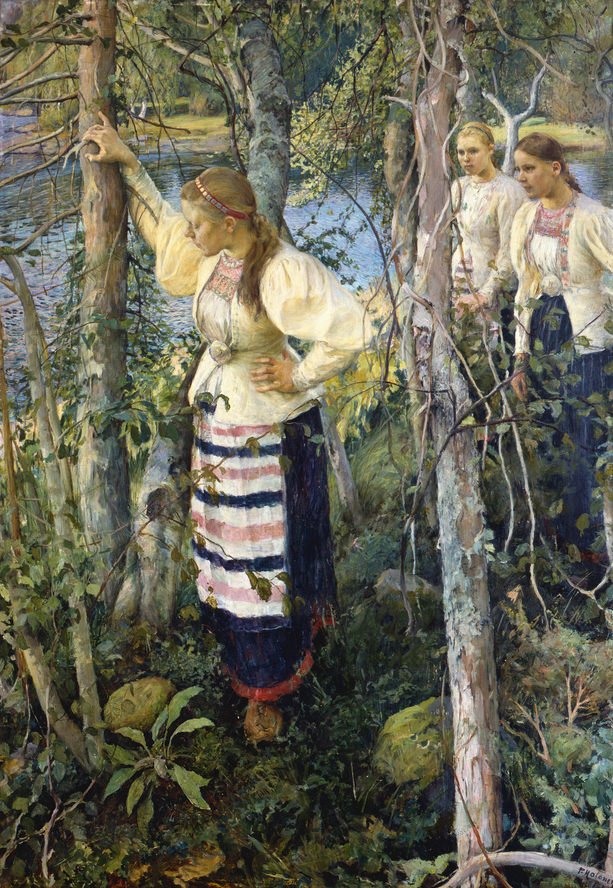
These luonnottaret are said to have reaped a meadow on this "misty island" (saari terhenninen), at the end of a misty cape/headlands (nenässä utusen niemen) specifically. A "fiery giant" came from the Underworld, stole their hays and burned them, sowing their ashes to the gates of Pohjola. This results in the growing of the Great Oak: a tree so big it reaches to the heavens and blocks the Sun and the Moon from shining. While this sounds like a description of the world tree, the Great Oak is actually harmful because it covers the celestial lights and must then be cut down.
Famously, a divine banquet was held on Saari, or Saariala, once. Finnish runosongs say that Ahti, Kauko and Veitikka got drunk in this banquet, but other information is limited. Ahti is mentioned as a rich land-owner who wanted someone to wake up Sämpsä to make Ahti's fields more fertile. In Ingrian runosongs, he is called Ahti Saarelainen "Ahti the Islander; Ahti of Saari". Ingrian runosongs suggest that during this banquet, someone spilled beer on Kauko's cape and Kauko then killed him, having to escape after the act. It's a bit difficult to make heads or tails out of, as the story got very much mixed with Lemminkäinen's. It is also said that once upon a time, Ahti went on a sea voyage and got surprised by winter which froze or chilled Ahti to the sea. If this Ahti has anything to do with the water god Ahti is uncertain.
In White Karelia, the divine banquet of Saariala is also called a banquet of "Päivölä", which sounds more like a name for the heavens. In North Savo, Ahti's home is called "Huotola", which likely comes from Luotola. In Kainuu, variants of this (Vuotola and Lietola) appear as terms for the Underworld. It is no surprise then that by the 19th century, Karelian runosingers had disagreements over where this banquet was held, Saariala or Päivölä or Pohjola... And if the hostess was Louhi, Päivätär, or someone completely different.
The "eldest of Saari" in Kainuu is called Saint Daria, which is obviously a later morph caused by Christian influence. She invites the bear to a "manly banquet" where it will be given mead (this is in context of bear hunting). It is, unfortunately, not a very common epithet, so we can't know exactly whose name was supposed to be there. Based on Karelian runosongs, it could refer to Maiden of Grass (the first human), or Ahti (Saarelainen).
See also runosongs describing Saari.
| Saari, variants | From saari "island". |
|---|---|
| Huotola | Possibly from luoto "islet", but if the origin of the word is in the Underworld, luode "northwest" origin is also possible. |
| -la, -lä | Denotes a place. |