


| Names: | Lemmingäinen   
Lemminkainen
Lemminkäinen |
|---|---|
| Father: | Antero Vipunen, possibly originally Ukko |
| Mother: | A shaman mother, possibly originally Päivätär |
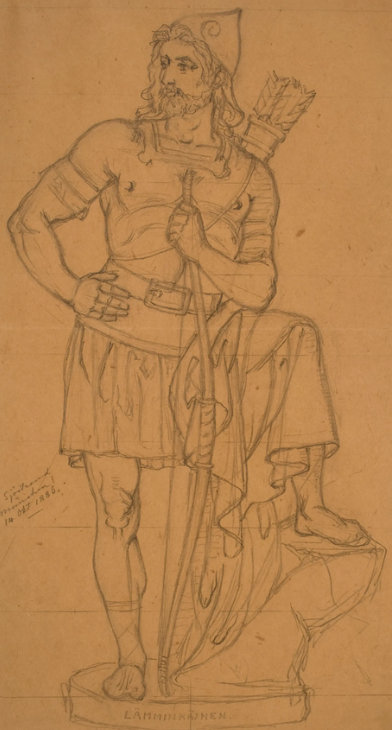
Lemminkäinen is a mysterious shaman hero who travels to the Underworld under different circumstances in different runosongs. I will begin by laying out his hidden role first before going into the runosongs.
From the name Lemminkäinen, we can already see that he has some connection to fire, maybe also love. He also fulfills the role of someone who dies and is resurrected. Another thing which connects him to fire are the runosongs which state that Lemminkäinen is the son of Vipunen, and that fire is the son of Vipunen. Though in later runosongs, Vipunen tends to refer to a dead shaman, he does also interestingly have the variant Viroinen in Karelia. Both forms resemble vironvipu, the world pillar. Thus, there is a surprisingly big chance that Lemminkäinen's original father is supposed to be Ukko himself. Quite the revelation.
Lemminkäinen is also very much connected to wasps. The wasp is called a spark of fire, and just like fire was a creation of the Sun goddess Päivätär, she is also called the mother of the wasp. The wasp is, in addition, called a son of the Sun who got married in the Underworld... So, it would look like Lemminkäinen's mother could actually be Päivätär herself. And this adds a lot of symbolism to Lemminkäinen's story.
Usually, Lemminkäinen is known from the runosong the Song of Lemminkäinen. I'll cover it here later. There is also a rare variation of it called the Death of Lemminkäinen on the Finnish-Russian border area, known in Finland only from South Savo. In it, Lemminkäinen is going to travel to the Underworld to get a maiden for himself to marry. This is not to be dismissed: a similar story is very central to Estonian mythology and must then be an old and important theme. Lemminkäinen's mother warns him to go, as there are the shamans of Pohjola on the way he has to defeat. Lemminkäinen survives through it with his superior shamanistic abilities and makes his way to the Lady of Pohjola, asking her to give him a maiden to marry. Instead, she tells him to clear multiple tasks, such as hunting down the Moose of Hiisi and capturing the Horse of Hiisi, the latter which he's able to go with the help of Ukko. Then, he is told to shoot a swan from a river, which he went to do, but the Lady went after him and killed him, dismembering him.
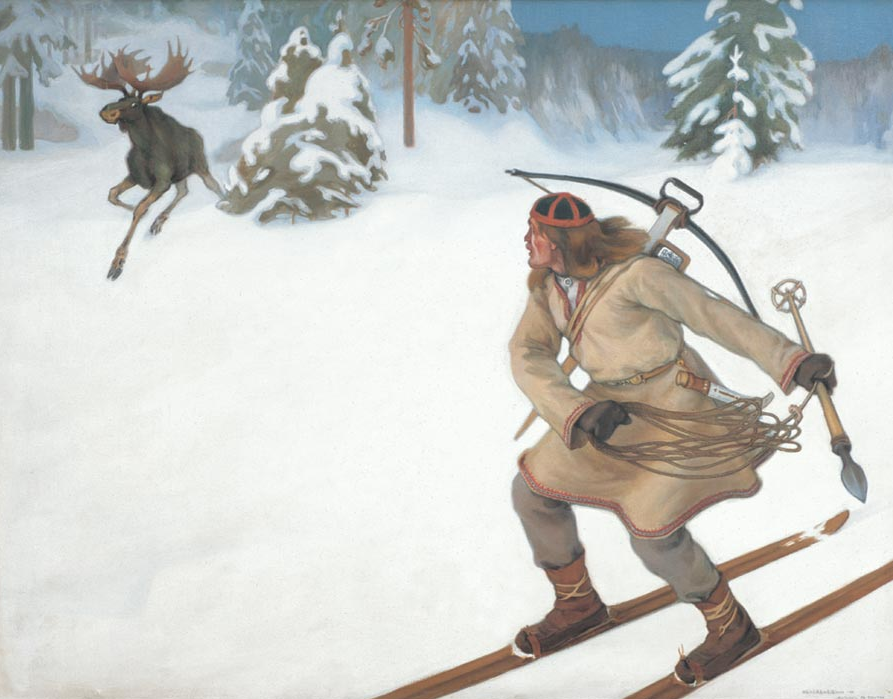
To be fair, the runosong never calls this Lady Louhi, but you'd assume it's her since she is the Lady of this land (called Lapland here).
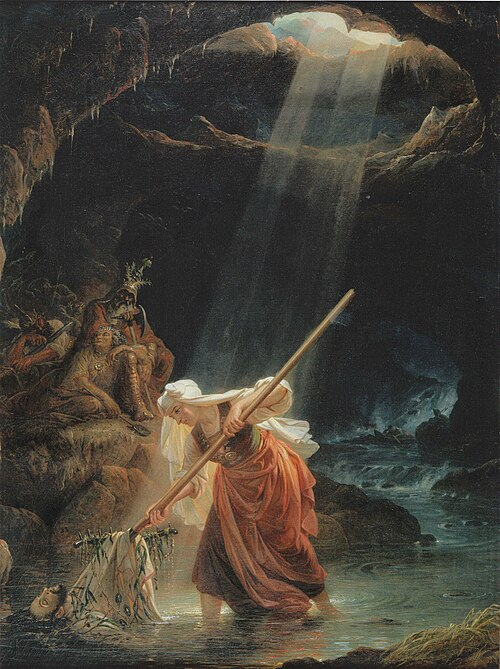
Lemminkäinen's mother knows his son has died when a hairbrush starts bleeding. She then transforms into a bird with shamanistic abilities, creating wings from tow cloth and a tail from a peel. She flies over nine seas looking for her son, asking about his whereabouts. She is told he's in ice cold ashes, but she can't find him there. She's told he's in a fishless lake, but she can't find him there. She asks for a third time, being told that her son is in a river with a rapid. She takes a rake and with it, finds Lemminkäinen's body parts from the river and puts them back together. He "rose" then, and a fiery pint with tar in it was brought to him.
At this point, I'm not sure if it's Lemminkäinen or his mother who "spoke into the pint" creating ten snakes, a hundred frogs and finally, the "bringer of the pint into the Underworld". It would make sense if this was a reference to the snake beer offered to him in the Song of Lemminkäinen.
The story cuts off here, and we can only speculate if he got to strike back at the Lady, or if he got a bride from the Underworld at all. However, another Savonian runosong states that after winning a sword fight against a son of Pohjola (happens in the Song of Lemminkäinen), he did in fact get a bride from the Court of Pohjola.
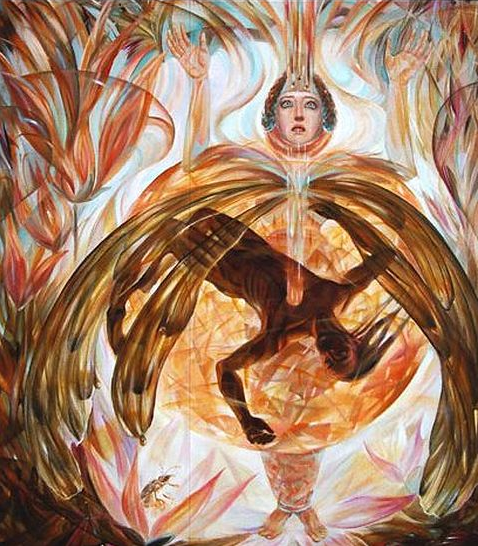
As you can see, with Lemminkäinen's resurrection, fire once again is very much present. If we go with my above theory, this mother who resurrected Lemminkäinen would then be the Sun goddess Päivätär. I'd like to point out here that there are Karelian runosongs which explicitly state that Päivätär warned her son or sons of a dangerous journey. Anyways, Lemminkäinen as a symbol of fire, warmth, and possibly also fertility, goes to the icy Pohjola and is killed there, tossed into a river, possibly the river of Tuoni itself. Then he is brought back to life by the Sun, by fire and its warmth. To me, this sounds like a story of the changing of seasons: while the cold winter kills warmth and fertility, every spring, the Sun herself is there to bring those things back to life.
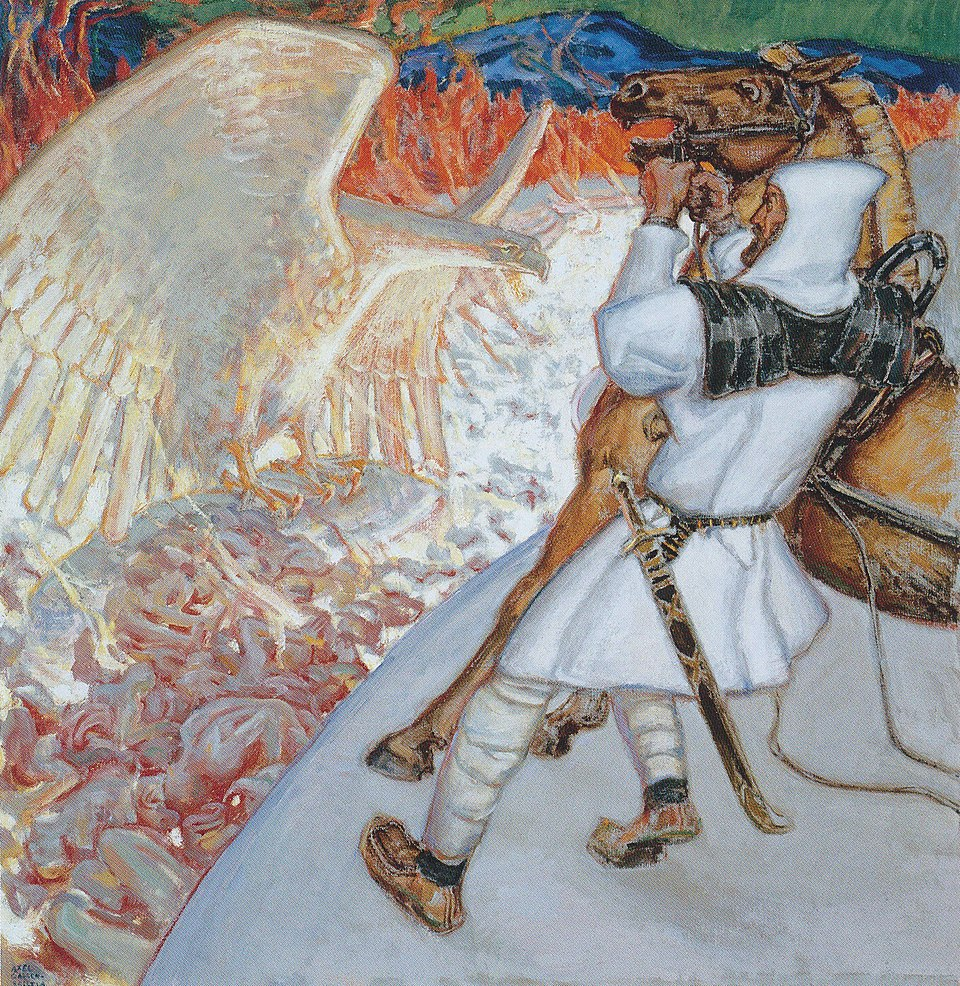
Much more widespread is the runosong called the Song of Lemminkäinen. Lemminkäinen decides to go to Pohjola/Hiitola/Vuotola/Koppola/Lietola to meet his "brother-in-law", but three luonnottaret warn him not to go as there are dangers on the way: a fiery rapid with a fiery birch with a fiery eagle eager to eat Lemminkäinen await him on the journey. Lemminkäinen gets through this by striking blades into the talons of the eagle. Then, there is a fiery island with a fiery sauna with a fiery man eager to eat Lemminkäinen. He gets through this by making atrificial men from alder and pine while himself hiding under the sauna benches. At the gates of Pohjola/Hiitola, there are wolves and bears chaned there, as well as men with swords and women with copper belts. Lemminkäinen gets through this by sending a herd of sheep to go ahead of him. On the yard of Pohjola, there is a fence made of snakes and lizards with an empty stake reserved for Lemminkäinen's head. Lemminkäinen gets through this by bringing the head of a dead man with him and putting it on the stake instead. Then, the Lady or son of Pohjola invites Lemminkäinen to come into the mansion, and Lemminkäinen notes that he doesn't seem to be a welcomed guest since no beer is being prepated to him. The Lady pints out that he should've come a day earlier for that, but brings him a pint of beer filled with snakes.
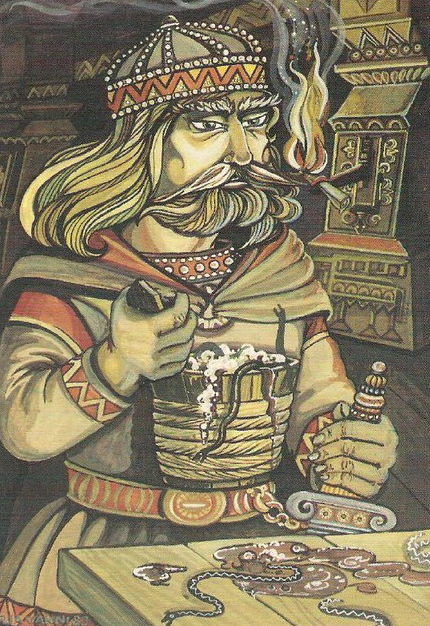
Lemminkäinen takes a fishing hook from his coin purse and fishes out the snakes, then eagerly drinking the beer. He challenges the Lady or son of Pohjola to a sword fight, striking off the head of her/him and, as stated in the runosong from North Savo, got a bride from the Court of Pohjola.
If you are familiar with the stories about Väinämöinen, you may notice that he, too, has been said to have travelled to Pohjola and had a sword fight with the son of Pohjola. While Kainuian versions of the Song of Lemminkäinen don't mention Väinämöinen (having those runosongs of him doing all of this as separate from Lemminkäinen), in the runosong from North Savo, it is Väinämöinen and Lemminkäinen together who make this latter journey to Pohjola. Another runosong from either North Ostrobothnia or Kainuu (likely latter) also puts Lemminkäinen as someone who rows Väinämöinen's boat; they then seem to be friends, even though these references are very rare.
I also kind of want to say... when it comes to the death and resurrection of a "son of God", this concept was not invented in Christianity. Centuries before the birth of Jesus, there was already a salvation religion at the Mediterranean, where the son of God (Zeus), Dionysos, half-divine and half-human, dies and is resurrected by God (Zeus). It was Dionysos who was seen as the saviour, again, centuries before Jesus. Considering that the Finnish word for "god", Jumala, also appears as the name of Ukko, and if Lemminkäinen was originally his son... it truly would make Lemminkäinen the Son of God of Finnish faith.
Lemminkäinen has often been mixed together with a hero named Kauko or Kaukomieli. There is not much information on him in Finnish runosongs, but it is said that he got drunk together with Ahti and Veitikka at a drinking party in Saariala. The Ahti in this context seems to be same wealthy man who looked for Sämpsä and got frozen on the seas on a voyage, though it is not certain if this is the same Ahti as the water god Ahti. Incidentally, Lemminkäinen and Kaukomieli are also mixed with this former Ahti, who appears as a ruler of lord of Saari ("island", hence him also being known as Ahti Saarelainen "Ahti the Islander"). Ingrian runosongs give further context, stating that Kaukomieli was not invented to a drinking party but went anyways, getting drunk and, when someone spills beer on his cape, he kills the offender. He might then go into hiding on Saari, and his mother might show up to save him from the waters after being chased away for the island.
In North Ostrobothnia, sauna steam (löyly) is called the "honeybread of Lemminkäinen".
| Lemminkäinen | Connected to lempo "fire, flame" and lempi "erotic love". |
|---|
❅ Berry Song (The Origin of a Son of Fire/Sun)
❅ The Birth of Panu (Fire Son)
❅ The Death of Lemminkäinen
❅ The Song of Lemminkäinen
Only in Finnish, sorry. This is the source material.