


| Names: | Pellermöinen 
Pellervo
Pellervoinen  
Samps'
Samsa
Sentervoinen
Seutervoinen
Sompsa
Sämpsä
Sämse
Sämsä
Ämssä  |
|---|---|
| Animal: | Vento's ox Uljamoinen |
| Plant: | Wood clubrush, or all clubrushes and woodrushes in general |
Sämpsä Pellervoinen is the haltija of vegetation. Depending on the runosong, he might be called "Sämpsä son Pellervoinen" or "Sämpsä, son of Pellervoinen". Thus it's difficult to know if the second name is supposed to refer to him or his father. Then again, pellervo can originate from words such as pelto "a field", pellava "flax", or pellet "ground, humus", and could therefore only be a symbolic description (for example "Sämpsä, son of the field").
The most widespread myth of Sämpsä describes how he, with the help of Vento's ox Uljamoinen, planted the trees of the world. Though there are other runosongs describing that trees were created by different gods, demons, or Yahweh and Jesus himself, these are usually in context of something wooden having caused harm. Sämpsä's story is more of an origin myth.
Interestingly, there are also multiple narratives of him travelling by boat (or a whole group of them). He also "killed a hundred brown trouts, a thousand giant salmons". One rare runosong from Kainuu puts him in the origin of fire myth: he is sailing around the Neva River when his boat fits a red salmon, and he says he's there to "know fire".
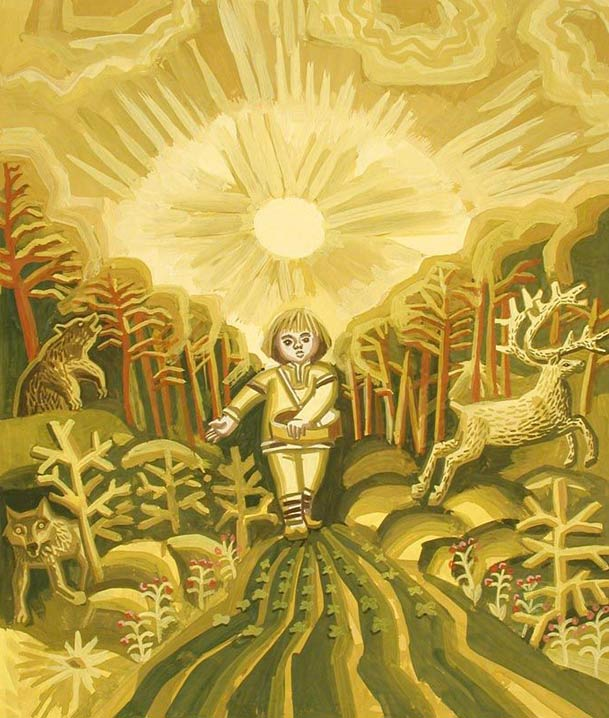
The longest myth involving Sämpsä is "Sämpsä's Awakening". It was sung during the Vakat festival, after spring sowing. A wealthy man named Ahti wanted his field to be more fertile and promised money as a reward to whoever can bring in Sämpsä. A wolf lusted after the money and went to look for Sämpsä, but Ahti disapproved of him as he had eaten Ahti's mother's ewe. Then the summer boy, who had no desire for riches, went to look for Sämpsä and found him on an island, telling him that Ahti wished for him to come and make the fields fertile. Sämpsä thanked the summer boy for when he had been looking for Sämpsä, he had already melted ice on lakes and rivers. He then went to sow Ahti's fields, and despite Ahti's wealth, "Ahti would sooner run out of land than Sämpsä out of seeds".
The Forest Finns used the term Ämssän mätäs "Ämssä's tussock" to refer to the first tussock to turn green in the spring. Similarly the plants his name seems to be connected to, clubrushes and woodrushes, are some of the first plants to grow in the spring. This plants were fed to cows, which is why Uno Harva compared Sämpsä to West Sámi Rana-nieida maiden and East Sámi Raiz-ajk "Grass Mother" who helps reindeer and grows the first grasses/herbs of the spring for reindeer to eat.
In some Karelian versions of Sämpsä's Awakening, it is said that Sämpsä "lied with his step-mother" on a pile of grain. This "mother" is often thought to be Maatar, the Earth Mother. Because of this, it is also assumed that akka manteren alainen "wife beneath the ground" and poika pellon pohjimmainen "son at the bottommost of the field", titles which are mentioned alongside each other, refer to Maatar and Sämpsä.
| Sämpsä, variants | Theories include the origin in sämpsykkä "a plant; a wood clubrush", sämpsä-heinä "a wood clubrush", German Simse "a bulrush", or Christian Saint Sampson the Hospitable. |
|---|---|
| Pellervoinen, variants | Theories include the origin in pelto "a field", pellava "flax", or pellet "ground, humus". |
Only in Finnish, sorry. This is the source material.