


| Names: | Launavatar 
Laviatar 
Loho 
Louhi  and/or and/or
Louhiatar and/or ,
Louhietar
Louki
Loveatar
Lovehetar and/or
Lovetari
Loviatar
Luukka
Pohjolatar
Syvätär
Ähyttär
Ähötäri
Äijötär
|
|---|---|
| Animal: | Wolf |
| Domain: | Pohjola |
Louhi is a goddess of death and disease and the ruler of the Underworld: the Lady of Pohjola (Pohjolan emäntä).
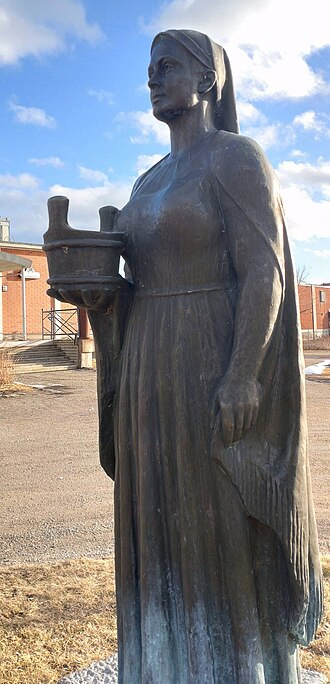
Louhi was the maiden from Pohjola who would not agree to marry any man. When she was suffering from heat, she went to cool off in water. There, she was impregnated by waves caused by a sea giant. She gave birth to nine sons, the Nine diseases, and one daughter (in some versions, Syöjätär). Christianized versions of the runosong here include Louhi trying to get John the Baptist to baptize her children but he refuses, calling her a harlot. Louhi's children were, of course, born outside of marriage, but many researchers believe the runosongs started calling her a harlot and a whore only later due to Christian influence. (: She then proceeds to name them after various diseases and disasters.
As a result of the aforementioned "disaster", she became the Lady of Pohjola. This is also where the way she is described changes: the maiden of Pohjola was beautiful, one of luonnottaret. But the Lady of Pohjola is a hag, a crone, ugly, with gap-teeth, etc. Stories which describe her being impregnated by waves (mostly northern runosongs) describe her as beautiful, while stories where she is impregnated by wind, she is an ugly crone. A Savonian runosinger tried to explain this discrepancy by stating the the Lady of Pohjola had a daughter who was impregnated by waves instead.
This is also the turn Karelian runosongs took, explaining how heroes travelled to Pohjola to propose to Louhi's lovely daughter. However, this doesn't have much backing in Finnish runosongs. Only Lemminkäinen went to the Underworld to propose to a lady, and was killed in the process and resurrected by his mother. Some Savonian runosongs describe that he did still get a maiden from the Court of Pohjola. In some Kainuian runosongs, it is Väinämöinen who goes to Pohjola to propose to Louhi herself, who then gives him tasks to accomplish. Indeed, runosongs for the most part do not support the idea of Louhi having a husband, or Pohjola having a Lord (besides Louhi's eldest son). She did still give birth to at least one daughter when she was impreganted by waves.
Oh, also, in many runosongs she gives birth to wolves (and dogs) specifically when impregnated by wind. In one Savonian runosong, where she is actually the wife of Väinämöinen, she also uses waves on purpose to impregnate herself to give birth to a dog who would protect her son.
Kainuian runosongs do not mention Louhi and Väinämöinen as married, but Louhi helped Väinämöinen out of a lake he was drifting in and gave him food.
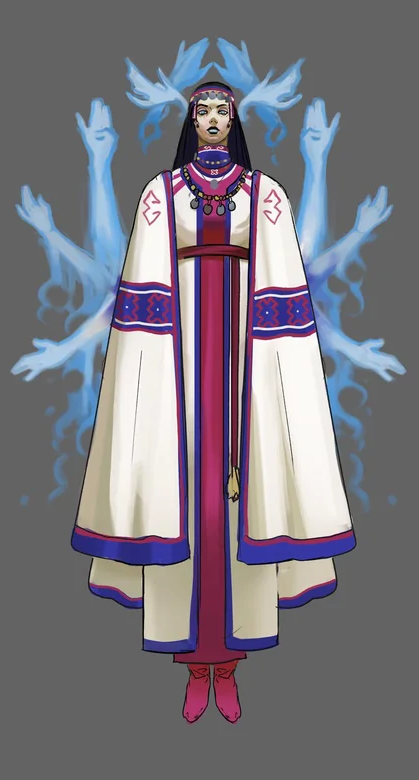
You might have heard of Tuonela and Pohjola as two separate places with two separate rulers. This is wrong, they are synonymous. This would also mean, yes, that there is no such being as "Tuonetar, queen of Tuonela". Not in Finnish runosongs. Usually when the word Pohjola is used, it connects the Underworld to the north, cold and ice. When the words Tuonela or Manala are used, they emphasize more the idea that the Underworld is underground. No wonder then that Louhi has gained epithets that make her sound like an earth goddess (namely, the North Karelian Akka pirtin pohjalainen "wife at the bottom of the cabin").
Louhi's main attribute is that she is icy cold. This is why she is asked to help with burn wounds, for instance. She is the girl of ashes, the familiar to fire, and fire will not hurt the one who is familiar with it (ei tuli polta tuttuansa). She is the woman in hako (where shaman goes in a trance), the Lady of Hiisi (in the demonized sense, so the Underworld). She is a cold girl, a black girl (colour black refers to the Underworld here), a woman of west in addition to north (both north and west are the cardinal directions of death), she is tall, she is beautiful, she is a gap-toothed ugly hag, she is irked, she is a nature goddess, she is a demon, she is sturdy, she is old, she is very, very wealthy. Her riches extend from the golden treasures of Pohjola to the forest animals and their precious furs. Because Pohjola and Metsola got somewhat mixed in runosongs, she is also asked help with, for example, bear hunting just like forest gods.
Alright, I'll admit I'm a fan of her. And I will not stop glazing.
Because she is the mother of diseases and disasters, she can also help with those problems if need be. She is, for example, said to have shot a fiery arrow with a fiery bow, which the runosinger uses to defeat toothache. As a raven, she is asked to come and stop her children.
Louhi is but one of the many figures referred to as the daughters of the Underworld. It is often unclear which one of them is being talked about, so there's no wonder that the Underworld maiden who is proposed to is sometimes Louhi, sometimes her daughter, and sometimes someone completely different. That is not the important part, after all; the point is the cold of the Underworld, the fertility and fire deity Lemminkäinen who gets killed there, and the Sun who revives him, also bringing forth ideas of the changing of seasons.
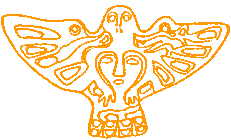
Louhi is, in various ways, connected to shamanism. When a shaman goes into a trance, their soul travels to the Underworld. It is no wonder then that Louhi has truly powerful shamanistic abilities. One of them is transforming into a bird. She travels in raven form, bringing wolves with her. To avoid their cattle being attacked by wolves, Forest Finns set a wood grouse's wing on an altar shelf for Ukko so he'd send the fiery eagle kokko to drive the raven-form Loho away.
In Karelian runosongs, it is said that Louhi herself transformed into the kokko, or a vaaka bird. Coincidentally, a shaman's bird form in Sámi is vuokko. In Savo, this bird transformation scene is given to Lemminkäinen's mother, another skilled shaman woman who may or may not be the Sun goddess.
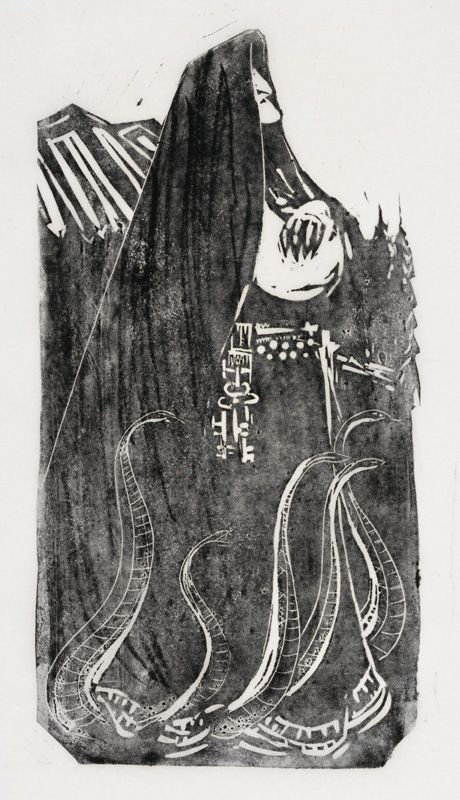
The original ruler of the Underworld in Uralic mythologies was male, often a brother of the main sky god. As this is clearly not the case with Louhi, or Sámi Jábmiidáhkká for that matter, it's been thought that the ruler of the Underworld was switched into a woman as society got more patriarchal to show how, since men rule in the land of the living, the Underworld must be the opposite and have female rulers. Another display of some Finnish dualism.
As to why Louhi is called a harlot and a whore, this is believed to be because Christians started associating her with Herodias. Herodias was the wife of King Herod, but as some sources called her husband Phillip, it created confusion and a folktale according to which Herodias had committed adultery with King Herod. She told her daughter Salome to ask for the head of John the Baptist to be offered to her on a platter, and so happened. I established the connection between Louhi and John the Baptist already.
According to Medieval European folklore, Herodias was sentenced to roam the sky as a spirit, and she's been called the bride of the wind and a mother of demons. By High Middle Ages, she had become associated with Roman goddess Diana. A figure named Aradia appeared in Italian folklore as a witchcraft related goddess alongside Diana, and she is thought to have come from Herodias. It seems so then that Louhi got a lot of negative features attached to her from Christianity, including being a "harlot" and giving birth to a black dog (symbol of the Devil).
The list of names above might make you think that Louhi doesn't seem to have been known in Southern and Western Finland but she was. It's just that she is called ämmä musta, pää keritty "black woman, head shaven" instead of a name in Häme and Pirkanmaa 
 . Some runosongs imply the "blackness" is a reference to her hair colour. The colour black is referring to the Underworld, while shaven or cut short hair could imply that she's an adulterer, or a "harlot".
There is one Karelian runosong which calls her Ilpotar (from ilves "lynx"). Weird but okay. But this is not the only such instance! It seems to have support from Finland as well: one Savonian runosong refers to Pohjola as Ilvola (lynx-place).
| Louhi, variants | Usually connected to lovi, louhi "shaman's trance; gap (into the Underworld?)" (latter meaning would be a Germanic loan). It has been suggested that it could have an origin in the words lovehtia "to spellcast" -> loihtia "to spellcast" -> loihtija "a spellcaster". |
|---|---|
| Äijötär, variants | I see this connected to 1) äkäs/äkäjä "arrow", 2) äkeä "irked", 3) Äijö "the Devil". |
| Syvätär | From syvä "deep". Also a name of Syöjätär. |
| -tar, -tär | Feminine suffixes. |
Only in Finnish, sorry. This is the source material.
The neofolk song "Louhi" by Värttinä (OG by Sari Kaasinen) is about her.