


| Names: | Daughter/maiden of Tuoni: Ismärätär  Isotären Kipuneito  Kiputyttö  Kolmisormi Punahattu Satasormi
Daughter of Hiisi: Hilasatar Hippa and/or Hitu and/or Punaneiti
Daughter/maiden of Pohjola: Hiilitär and/or Porolainen Poropiukka, Porohiisi  Porotyttö Tulityttö |
|---|
"Daughter of the Underworld" is an epithet given to potentially multiple different but loosely defined figures. I will present some such instances here.
Note: Tuoni, Hiisi and Pohjola all refer to the realm of the dead. Tuoni is connected to tuonpuoleinen, "the other side". Hiisi meant a holy place but got demonized by Christianity. Pohjola translates roughly to "Northland", as the realm of the dead was seen to be in the extreme north, in addition to being underground.
See: Kivutar
See: Louhi
The best attested figure with the epithet Tuonen poika "Son of Tuoni" is Panu, fire itself or its spirit or deity. As he is fire, he was created by Päivätär, the Sun goddess. However, its also been said that fire was given birth to by Lemmäs in water. The names Lemmes, Lemmäs, Lemmätär etc are typically references to a fire related female figure who helped with kindling when iron was made. She tends to be mentioned with words often connected to female demons, which has raised the question of if this Lemmätär is connected to the demon name Lempo, or if they are even one and the same. All names have a connection to fire. Fire then is also connected to ferility and love, as Lemmetär is dedicated prayers to in love related matters. In this way, the underworld-related fire deity becomes a love goddess.
The fertility focused aspects of fire can better be seen in Lemminkäinen (lemmin "fire"), possibly a son of the fertility god Virankannos (and fire is described the same). He goes to seek a bride from the Underworld; Panu, however, is never connected to this beyond the fact that he is also fire. Are they two different entities with the essence of fire in them? Or... Lemminkäinen was killed in the Underworld but resurrected by his mother. "Son of the Underworld" could also easily describe his position after this death experience, or after getting the bride. Most stories do not include a conclusion on if he got the bride or not, but there are some mentions in which he does.
A trip to the Underworld to propose to a maiden is a crucial element of Finnic mythologies which cannot be erased; the same story exists in Estonia. This maiden is not given a name, however, so questions over which one of the daughters of the Underworld she is are up for interpretation. The original suitor was no doubt Lemminkäinen, but was replaced by other figures such as Väinämöinen in some places. On one hand, it is said that Lemminkäinen won in a sword fight and "got a maiden from the court of Pohjola" while on the other, a story describes Väinämöinen going to the Underworld to propose to Louhi herself. The best known versions of this tale are of Karelian form: somebody goes to court Louhi's lovely daughters. However, I am firmly of the stand that Louhi herself was the northern maiden until becoming the Lady of Pohjola.
Let's speak more of the female figures connected to fire and the Underworld. Along with the name "Lemmäs", another unclear word can be found: Tuhhuus or Nunnus. Kaarle Krohn interpreted this as originally Tuhnus "soot". Similarly we also see "Tunnutar, fiery maiden" and "Pannutar, burning woman". The latter is likely connected to Panutar, panu meaning "fire". In this context, it is said that she came from the sky (just like fire did, almost like a meteorite). She can "swallow the poison of fire", ergo help with burn wounds. The icy northern maiden Louhi can also help with the same problem because she is cold, but Panutar is the opposite, also fiery herself. It is difficult to determine if the idea of a fiery maiden from the Underworld was born out of Christian influence and Hell-imagery only, or if it already existed in pre-Christian times. Either way, I wouldn't remove it. The good nature of fire in Lemminkäinen and Päivätär, and the harmful nature of fire in Panu and Lemmetär... It's all very fascinating.
"Tuhhuus" and "Tuulus" appear as "fire" which comes from the sky and somehow affects the birth of the common lizard.
| Names: | Lemmes  
Lemmetär , and/or
Lemmäs
Lemmätär and/or
Nunnis
Nunnus
Panotar
Panutar
Pannutar
Punatar
Tuhhuus
Tunnutar
Tuulus
|
|---|
In Kainuu, the "mother of fire" is also called Umo, Uumo and Tuuva, one runosong also including the name Umotar in an incantation about a cowshed snake. Kaarle Krohn's theory was that this would be related to the word uhma "defiance, threat". Based on the context, it is possible that these refer to Lemmäs.
Here we have a daughter of the Underworld who is difficult to figure out. She could be the same as one of the abovementioned ones: she is, for example, introduced with similar terms as Lemmetär, while having the same epithet as Kivutar (Tuonen tyttö). In the origin of the bear, she is said to have made a cabin out of bird cherry trees, which could also make her the same as Tuometar. On the other hand, Ismärätär could be the same as Ismo ilman tyttäriä ("Ismo of air maidens") who is called the mother of fire as well, so I have a tendency to connect her to Lemmätär above. Very contrary to the Underworld is this idea of being an air/sky maiden, but it could be connected to the idea of fire falling from the sky. This or that, with this bear connection, Ismärätär could also very well be the wife of Lemminkäinen: I explain more about that below under the header "Girl of the Night, Maiden of the Dusk".
Furthermore, one name mentioned is Hilasatar connected to metal like copper. Her epithet is, in North Ostrobothnia, used to refer to the wasp: Pitkähapsi Hiien neiti "Longhair maiden of Hiisi". Could it have a connection to Hiilitär (hiili "coal") who seems to be the Northern Maiden like Louhi? Two other names which are only recorded once are "Hippa" and "Hitu". As Pohjola and Tapiola got mixed with each other in runosongs, there's also the possibility that these kinds of names also refer to forest deities despite being called "Hiisi daughters".
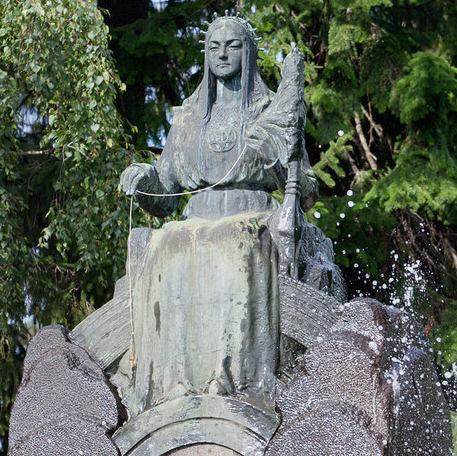
Yön tytti, hämärän neiti "Girl of the Night, Maiden of the Dusk" is a term which appears in runosongs without being attached to a specific name. In some instances, it could refer to Louhi, while in some others, it seems more like a description of Louhi's daughter (who married Lemminkäinen).
In South Ostrobothnia and Central Finland, she is a nightmare (also Pimiän piika, hämärän emäntä "Maid of the Dark, Lady of the Dusk"). However, a South Ostrobothnian runosong also asks for her protection against bears, and in (seemingly) North Ostrobothnia, she is asked to protect cattle from bears. In Kainuian runosongs, she is asked to spin a trap thread for the bear. Kainuian runosongs also mix up Tuometar (forest goddess) and Tuonetar (related to the Underworld), calling her a "daughter-in-law of Päivölä", which is obviously the position of the wife of Lemminkäinen.
In addition to these, she's called luonnon vaimo (so basically a luonnotar), as well as Eine-eukko or Aunen eukko. Eukko means wife, but the first part is stranger. Eine could be a name or refer to food. Eine-eukko is called the "haltija of spirit/henki" and is asked to wake up before any malicious magic user could.
There is one more name for a daughter of the Underworld: Typö tyttö. I don't even know what that means, but by the structure of it, it could have formed from "Kiputyttö" or "Yön tyttö" (appears also as Työn tyttö in Kainuu). She makes some children row and throws wool into water which results in the origin of the ram.
| Panu | Means "fire", a loan from the Baltic languages. |
|---|
Only in Finnish, sorry. This is the source material.