


| Names: | Kirjatar 
Kivun tyttö, Kiputyttö   
Kivutar 
Vaavutar (no region known) Vaivatar
Vaivitar
Vaiviotar (no region known) Vammotar
|
|---|---|
| Domain: | Tuonela |
Kivutar is the luonnotar of pain. Do not misunderstand: her main role is that of a good figure. She is asked to take in the pains, injuries and ailments of humans and put them into her container and/or glove, and throw them into the Underworld river.
She is called a daughter of the Underworld, and she lives in Tuonela on a hill named Kipumäki, Kipuvaara or Kipuvuori (all mean "Pain Hill"), located at the confluence of three rivers or rapids. On this hill, she sits on the rock called Kipukivi "Pain Rock". This location is also called Kipula. She is often asked to move the pain of humans into stones, as stones can't feel pain. In a runosong tradition mainly connected to North Ostrobothnia and Kainuu, she is also described as boiling pains in a pot.
In one of a kind South Savonian runosong, she is born together with three other luonnottaret when a large wind blowed for six years and seven summers and threw branches from an oak into the water.
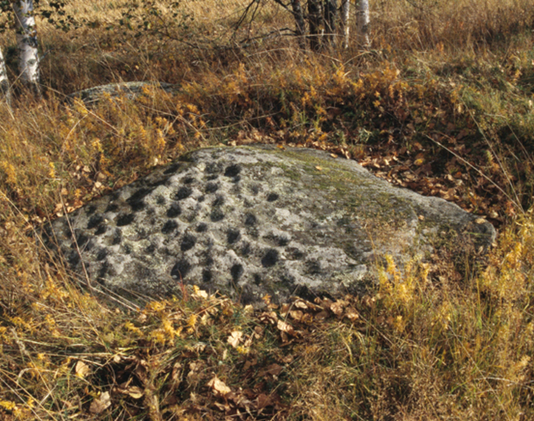
As runosongs sometimes mention the Kipukivi having a hole in it, there is a pretty common theory that this stone is supposed to mean a cup-marked stone. Cup-marked stones are common in southern Finland, though their original purpose is unknown. Regardless of what they were for the original carvers, Finns later considered them sacred and sacrificed to gods and maahiset by placing food and other things into the holes.
In 1789, Christfrid Ganander called Kivutar the "daughter of Väinämöinen". This is based on the fact that she gets called Väinän tytär "daughter of Väinä". While "Väinä" could refer to Väinämöinen, sure, there are other options. In Seto folk poetry (ethnicity related to Finns), the phrase Väänä tütär refers to a woman by the Väinä river (Daugava). Väinä also refers to a streampool in Finnish. I find it more likely, then, that this epithet is not related to Väinämöinen but instead connects Kivutar to water.
Kivutar does, of course, reside on a hill at the confluence of three rivers. Furthermore, runosongs mention the name Väinätär (also Väinötär and Väänätär ) who is connected to demonic figures, as well as the Underworld. There is a group of lines, usually appearing in relation to the origin of a cowshed snake: "Wide cunt of Väinätär, / Like that of a large war horse. / Jutting cock of the son of Tuoni, / Like an oaken mallet." This same "widecunt girl of Väinä" is asked to throw water in order to protect from bullets in war.
| Kivutar, variants | From kipu "pain". |
|---|---|
| Kiputyttö | "Pain Girl". |
| Vaivatar, variants | From vaiva "ailment". |
| Vammotar | From vamma "injury". |
| -tar, -tär | Feminine suffixes. |
Only in Finnish, sorry. This is the source material.
The neofolk song "Kivutar" by Värttinä is about her.