


| Names: | Halli  
Havuhippa
Hiippa 
Hiisi 
Hilja
Hilli 
Hilppa
Hipa
Hippa  
Hippahattu
Hippi
Hippo
Huippa
Hukka
Huuhkana
Hyyppä 
Iivana
Kuihkamo
Kuihkanen
Kuikuli
Kuippana
Kuittia
Kuittola
Kuitua
Kuituri
Kulkia
Rauhio
Tapiainen
Tapio
Vippo
|
|---|---|
| Spouse: | Assumed Mielikki |
| Children: | Tuulikki, Pinneys, Tellervo by the logic of those being Mielikki's children |
| Domain: | Hilltops, Forest, Metsola |
| !! The following with the assumption that "forest god Hiisi" refers to the same figure: !! | |
| Animals: | Moose, rabbits, bear |
| Drink: | Hiiden malja "Hiisi's goblet" at the beginning of the moose hunting season |
| Festival: | In Sotkamo, Kainuu: First Sunday of July in the Hiidenportti ravine |
There is not much one can say about male "Tapio". As you can see, Hippa and variants are much more common names for him! Truly, tapio has originally meant the forest itself and its female manifestation, Mielikki. I use the name Tapio for the male figure sometimes because that is the best known, but do remember that the hi- and ku- starting names are actually more him (even Rauhio sounds kind of badass).
Also, most of the time when runosongs mention the "King of the Forest", they are referring to the bear. That is also what I believe the original concept was. No wonder that in the song Elvenpath by Nightwish (my favourite band!), he is referred to as: "Tapio, bear-king, ruler of the forest". Our male deity Tapio here is often described as having a grey and/or lichen beard, and he has a hat made of needles.
Both tapio and hiisi, which have been used to mean "forest", were also used to refer to forest deities by Mikael Agricola in 1551. Tapio "brought traps from the forest" and Hiisi "brought victory over beasts". This is the reason why I believe that when Kainuian stories describe a giant named Hiisi taking his cattle (= forest animals) with him into the ravine Hiidenportti, it probably mixes the idea of a giant and the forest god together. More on that further down on this page!
Tapio was connected to hunting especially in the context of bears and rabbits. But just like Mielikki, he was also the god of animal husbandry and was asked to protect cattle. According Christfried Ganander, roosters were sacrificed to him.
I explain more about the rituals on the Tapionpöytä, regardless of who its addressed to, on the Holy sites page.
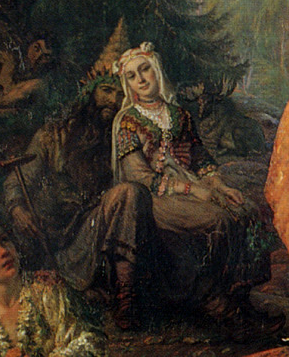
As already established elsewhere on this site, the word hiisi originally meant a holy site, a sacred grove. With the arrival of Christianity, it gained new meanings, such as "a demon" and "the Underworld". Plural hiidet were also often described as giants, or as small underground creatures maahiset, autochthonous pagan inhabitants of the land. They are described to have created various nature formations such as caves, and to have carried large bounders to where they stand. I understand: Finnish nature, shaped by the Ice Age with the melting ice having carried rocks to weird places, truly looks impressive.
Yet still, Hiisi also appears as a name for a forest god. According to Mikael Agricola in 1551, in Eastern Finland, "Hiisi brought victory over beasts". This is very vague, but Hiisi does appear as one of the names of male forest god often called "Tapio". There is another figure called Hiisi with forest deity like features I will be explaining on this page. I think these mighttttt be ultimately referring to the same male forest deity, creator of moose, whose holy sites are on hilltops.
First mentioned in writing by Johan Cajanus in the 17th century, Hiisi came to be seen as a giant and one of the sons of Kaleva in North Ostrobothnia and Kainuu. In many municipalities, there are similar tales how Hiisi had once lived there but left when humans arrived and churches were built. Hiisi hated the sound of the churchbells and tried to destroy the church by throwing rocks at it, but failed. Thus, he had to leave, and on his way out, he might've, for example, created some natural formations like rivers; this is the case in Pyhäjoki, North Ostrobothnia.
In Sotkamo, Kainuu, Hiisi once lived on the Vuokatinvaara hill but hated the sound of the church bells, tried to destroy the church by throwing rocks at it, but had to leave. He took his cattle, the forest animals, with him; this shows a forest deity-like feature to him. On his way, he encountered reindeer hunters who adviced him to move into the Hiidenportti ravine in Sotkamo. That is where he settled with his cattle, and the reindeer hunters promised to come and worship him on the first Sunday of every July. Gathering there went on for a long time, but at some point, it became less about worshipping any Hiisi and more about just having a dance party. And that place was so remote you could drink as much booze as you wanted to, too, without the police getting involved. Nowadays, the place is a natural park.
In Paltamo, Kainuu, Hiisi is said to have lived on the Kivesvaara hill. Once, he wanted to visit Oulu, but the great Oulujärvi lake was in his way. Not wanting to wet his foot, he took land from Paltamo and threw it into the lake. Where he had taken land from formed the Kivesjärvi lake, and where he had throwed it to formed the Manamansalo island. As a son of Kaleva, Hiisi sometimes visited his brother Soini in Liminka, North Ostrobothnia, and vice versa. They created swiddens together and taught humans how to make them as well. When visiting Hiisi, Soini could row the Oulujärvi river rapids upstream, that's how strong he was. Hiisi built his castle Hiidenlinna in an area near the border of Paltamo and Sotkamo.
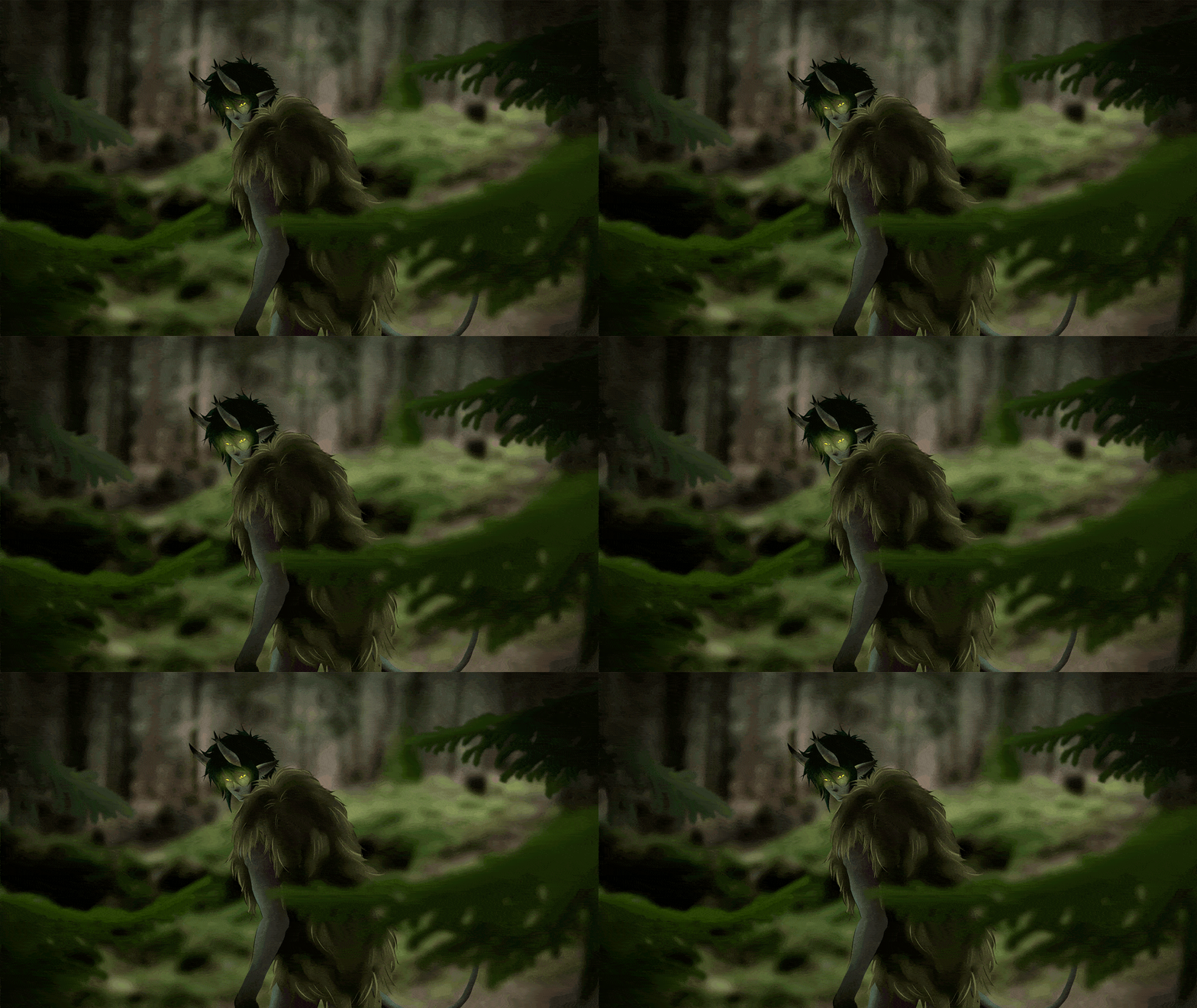
See how Hiisi is said to have lived on various hills? According to my theory, these hills had probably been considered sacred locations (so indeed, a hiisi in its proper meaning) but Christianized folklore interpreted them as locations where someone named Hiisi had lived. I do, then, have a tendency to see Vuokatinvaara, Hiidenportti, and Kivesvaara as somewhat sacred locations. Vuokatinvaara (well, there's actually multiple hills close to each other there) is a total downhill skiing resort now. Still a nice view from the top.
To give further support for my theory, Hiisi's brother Soini is said to have lived in the place where now stands the Liminka church, and it was very common to build churches on top of earlier pagan holy sites.
Addition months later: Well well well, looks like runosongs also refer to the forest god as Kummun ukko "Lord of the Hillock". I am further convinced of my theory of the connection of the forest god and hills.
So, someone called Hiisi "brought victory over beasts". And that could be male Tapio, sure. Or a separate figure. In the myth Hiiden hirvi "Moose of Hiisi", a Sámi hunter tries to hunt said Moose of Hiisi in the north, so close to the Underworld. Therefore, the Moose of Hiisi could mean "Moose of the Underworld". However, there are myths that specifically describe someone named Hiisi creating a moose out different trees in response to a hunter bragging. In the 17th century, in South Savo, it's been said that some man drank "Hiisi's goblet" during Michaelmas. This would line up prefectly with the time when moose hunting season began. Therefore, Hiisi could truly be a reference to a forest deity in control of moose hunting specifically. Now, whether that's same as Tapio or our Son of Kaleva above... Who knows. Though I personally (and this is just my opinion) see this Hiisi closer to the Hiisi who took his cattle with him to the Hiidenportti ravine. But, as I've already said, many of the things assumed about "male Tapio" are not based on runosongs, and he is even called Hiisi in them at least once.
In addition to Hiisi, Agricola also mentioned someone called "Hittavainen" giving rabbits. This name is often thought to have its origins in the word hiisi. In 1761, I.D. Alopaeus specified that the giver of rabbits in North Savo was called "Kuiktilassi". Neither name appears in runosongs, though there have been researchers who considered Kuiktilassi one of the names of male Tapio, as he has names like Kuittia and Kuikuli. There are also mentions of a hunter making a pledge with a demon, or "hittolainen", to get prey in exchange for his soul.
Southwestern Finnish folklore knows a deity or a giant named Halli who lives on high places like hills (sound familiar?) There is a runosong from Satakunta which equates the names Halli, Kalli and Hiisi and calls him a giant who, when speaking to his wife, was verrrry loud: even if he whispered, it was loud enough to make trees fall. When he drank from a river, in order to quench his thirst, he ended up draining it entirely.
Further Southern Finnish runosongs use terms like Hiisi, Halli and Hilli (this one also exists in the north) to refer to the male forest god. In most instances in other parts of Finland, the line is Metän Hippa, halliparta "Hippa/Hood of the forest, greybeard", halli meaning "grey".
I'm kind of starting to see the forest god on hilltops as a more "original" concept for the religion over any idea of a "noble and clean king of the forest" how male "Tapio" is often portrayed.
| Tapio, variants | Uncertain, theories include tapi "rod, staff", tapa "lock of a hunting trap", and tavata "to reach, to catch up to". Also a theory that it's connected to tavata but shifted in meaning to mean "lenient, amenable" much like is the meaning of the name Mielikki; a comparandum to this would be the Proto-Germanic *gadōbiz "suited, fit" becoming Old English ġedēfe "fitting, gentle, kind", as tavata ultimately comes from Proto-Germanic *dabaną "to fit", later gaining positive meanings in various descendants. What I'm trying to say is, I think both etymology and runosongs support the idea that Tapio is actually Mielikki's name. |
|---|---|
| Hippa, variants | It means a pointed cap (see why the art above gives Tapio one) and the chaser in the game tag. Kaarle Krohn theorized all h- and k- variant names (of both Tapio and Mielikki) to come from Christian saint Hubert of Liège. |
| Kuippana, Kuihkanen, Kuituri, Huuhkana, variants | Theorized to originate from kuippa "Eurasian curlew", kuikkana "long-necked", or vuitti "lot, fate". Kaarle Krohn theorized all h- and k- variant names (of both Tapio and Mielikki) to come from Christian saint Hubert of Liège. He also pointed out the word kuihkata "to call in the forest like a shepherd" and huuhkaja "eagle owl". |
| Kulkia | Likely kulkija "traveller", influenced by käyjä "walker" in runosongs related to the bear. |
| Iivana | Straight up just the Russian name for John the Baptist. |
| Rauhio | Unknown, Krohn suggested a connection to the name Raphael. |
| Hiisi | Theories include 1) a connection to Proto-Samic *sijtë "village", which would suggest Proto-Uralic *šijte ~ *šijta, as well as 2) a loan from Proto-Germanic *hīþaz "long, ample" or *sīdǭ "side". Ante Aikio has implied that the Sámic word is potentially of substrate origin. |
Only in Finnish, sorry. This is the source material.