

| Names: | Kalehva  
Kalehvo
Kalerva 
Kaleva   
Kalevo
Kanerva
Sulava
|
|---|
Kaleva is a primordial giant whose sons are known as great heroes, even deities. (Except for the ones that are crazy and unhinged.)
Kaleva, described first as the "ancient eternal giant" and "father of old Väinämöinen" was born out of "Kunotar", whose womb he spent thurty summers in before freeing himself. As he was born, he was already a warrior in full armor with a sword and a stallion. It is not known who this "Kunotar" is, thought according to one theory, it is Maatar.
As the eternal giant, he is called "Iku-Turilas", in which "turilas" stands for "giant". According to Agricola, "Turisas" was a god who granted victory in war. It is a bit difficult to know which giant is intended in different situations: there are also mentions to a Meri-Tursas (sea giant) and tulinen Tursas (fiery giant) in runosongs. According to Ganander, Meri-Tursas who impregnated Louhi with waves, and the Turisas who is a war god, are not the same figure.
Actually, in the runosong of the birth of Väinämöinen's father, he is called Kave ukko Pohjan Herra "Lord Kave, Lord of the North". That is a bit weird, as in literally any other instance, "kave" refers to goddesses; Kave-eukko to the sky maiden specifically.
Like how Osmo is connected to barley, and Vento to wheat, some Ingrian runosongs connect Kaleva to oats; Osmo also appears as a synonym for Kaleva.
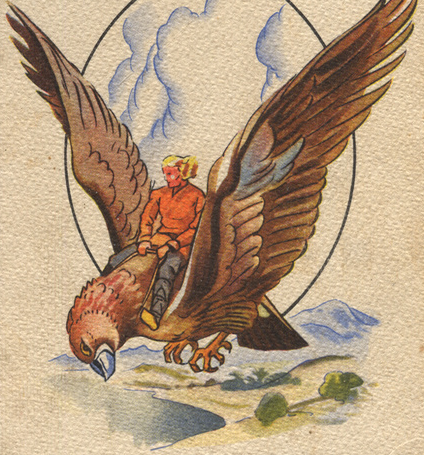
Kaleva is truly a cosmic, primordial entity, as there is a constellation named "Kaleva's sword" (Orion's belt). He is, however, not much present in the myths himself: that role goes to his children, the numerous sons of Kaleva. According to Ganander, he has 12 sons. They include Soini, Kullervo, Kihovauhkonen, Hiisi, and Väinämöinen, and Ilmarinen is also listed among them typically, even though he is not given this epithet in runosongs. As Joukahainen is stated clearly to be Väinämöinen's brother, he might also be a part of this group. Ganander also mentioned "Liekiöinen", but it is unclear exactly who that is.
Though never mentioned in runosongs, folklore also talks of the daughters of Kaleva. They are giants who can carry boulders in their aprons with their massive strength. These giants escaped as human settlements increased.
Kaleva's name often appears in contexts where it is used to give a magical, mythic feeling: for example, Louhi baptized her children in the "well of a son of Kaleva". The lake of the Underworld, Aluen järvi, is also called Kalevan järvi "Kaleva's lake" in Savo.
We can't exactly call Kaleva a very loving father: when Kullervo said he was going to go to war and asked his parents if they'd cry if he died, his father stated he wouldn't as he could just make another, better son. No wonder Kullervo, in the end, ends up such a war-crazed person himself that he dies on the battlefield. There are no runosong mentions of Kaleva's interactions with any other of his sons, though his son Soini was sold into slavery; I'm not sure if he had any say in that though. Some runosongs imply that Soini and Kullervo are the one and the same, but runosongs from North Ostrobothnia and Kainuu imply otherwise.
Old Russian chronicles refer to Tallinn, Estonia, as Kolyvan, while the map Tabula Rogeriana by Muhammad al-Idrisi from 1154 mentions that there is a fortress town named qlwry in Estonia. Johan Cajanus and Christfried Ganander (17th and 18th centuries) wrote that Kaleva was an ancient Finnish king who had, with his 12 sons, once conquered Russia. According to them, seemingly based on Kainuian folklore, Kaleva was from Paltamo, Kainuu, and his son Hiisi lived there as well. Soini lived in Liminka, North Ostrobothnia; Liekiöinen in Savo; Väinämöinen in Southwestern Finland; Ilmarinen in Tavastia; and his daughters in Kemi, Rear Bothnia. Mikko Heikkilä proposed that the original name of Kalanti, Southwestern Finland, would be *Kalenδek, from Kaleva.
As interesting as this all is from a point of folklore and speculation, it has unfortunately lead to some pseudo-historic ideas about there once having been a human king of Finland named Kaleva, and that he and his sons where some great warrior class. This nonsense seems to be especially swallowed whole in Estonia: at the time of writing this, the ENGLISH-LANGUAGE Wikipedia article for Kylfingjar claims they are known as kalevid in Estonian (they are not, and this is also linguistically impossible). I'm not an expert on Estonian folklore, but before this pseudo-historical drivel, the word kalev in Estonian meant "giant".
Finally, I'll display more of Kaleva in the starry sky: Kalevan tähti "Kaleva's star" is the star Sirius; once again, Orion's Belt is Kalevan miekka "Kaleva's sword"; the swirls of the Milky Way are called Kalevan porras "Kaleva's step" or Kalevan kynnys "Kaleva's threshold"; and kalevantuli "Kaleva's fire" means a silent lightning. In addition, a sacred spruce can be called kalevankuusi "Kaleva's spruce", and a sacred tree Kalevan puu "Kaleva's tree".
| Kaleva, variants | Ain't that the million dollar question! One (Finnish) theory suggests an origin in Baltic kálvis "smith", but apparently this isn't very reliable from the perspective of linguistics. An Estonian theory suggests a connection to kale(a) "hard, cool". The newest theory connects the name to Proto-Germanic *χᵃlewaz "sea, sea-god giant", which would also be the origin of the name of the Norse sea giant Hlér. |
|---|
❅ Birth of Kaleva
❅ Nine diseases
Only in Finnish, sorry. This is the source material.