


Maahinen (pl. maahiset) is a creature which lives underground. This name includes a reference to the ground, maa, but another term used for them is hiidenväki "force/folk of Hiisi", and Hiisi probably here refers to the underworld. Apparently in Satakunta, there is a completely different kind of flying creatures called hiidenväki; we're not speaking of them here. Despite the name maahinen, hiidenväki have also been descibed to live in mountains/hills and underwater (former especially in Western Finland). In Northern Finland, the terms vanha väki "old folk" and vanhaset "the old ones" have been used, and for Forest Finns, the term moanpitävät "keepers of the land".
Other terms include: maahiainen, maan väki, maanalusväki, manhon väki, metsän väki, vuoren väki, and veden väki. The last three refer to the forest, hills, and water. Indeed, if a maahinen was in a forest, it could be called metsähinen instead, and if in water, vetehinen. There are also metsähiisi and vesihiisi, or simply the word hiisi can refer to maahiset as well. Vetehinen and vesihiisi have also bee used in context of a water spirit which might not have a connection with maahiset.
By their appearance and way of living, maahiset resemble humans. They are not Christians, they dress and live in old-fashioned ways, they demand clean and honourable living, and they've been offered sacrifices of food and money. They are likely then those who were indeed buried underground: our ancestors. Uno Harva argued that they go even further back, that they'd be those of ethnic groups that lived in the area before the arrival of the current one. You need to ask a permission from maahiset first before building a building, for if they don't like you, they cause illnesses and disasters. They seem to run in the same business, then, as the elves of Iceland.
Jokes aside, maahiset indeed are equivalents to Germanic älvor, huldufólk and vittror. If not initially, they certainly became those. Then again, a belief in underground creatures is very widespread in the world.
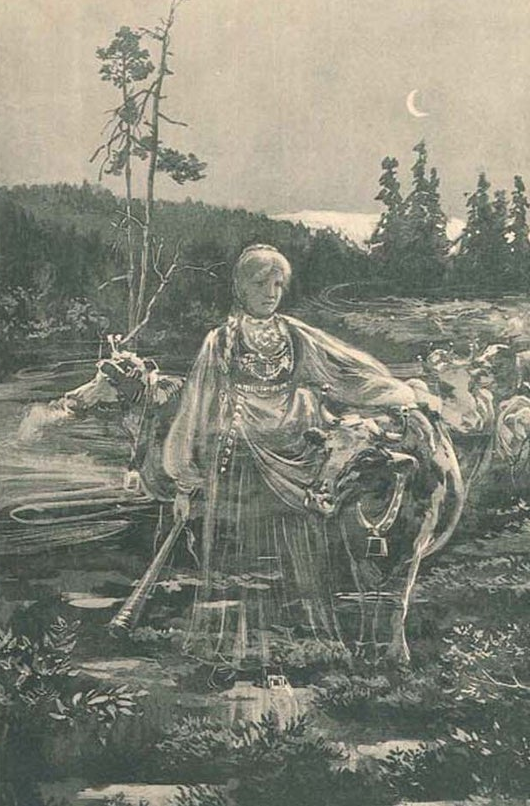
In later folklore, maahiset developed features of household spirits, fairies and gnomes, who could be restricted with steel items. According to a Forest Finnish tale, there had been a maahinen Lady with huge amount of cattle, playing a horn while wearing a glorious golden crown. Indeed, according to Finns near Rear Bothnia and Torne Valley, the owner of magical cattle isn't Vellamo but this maahinen Lady. I guess it's understandable, as those Finns are close to the Sámi, and Sámi folklore puts a larger emphasis on similar creatures they call gufihtar.
The cattle call of the maahinen women Tule, tule pois, Lipakalli Tule, tule pois, Kultaruuse Tule, tule pois, Punahertta! SKVR XII1 229 | Come, come away, Lipakalli Come, come away, Kultaruuse Come, come away, Punahertta! ("red heart") |
Because maahiset caused skin diseases, later on, "maahinen" simply became a word for skin diseases and gained new forms, such as "vesimaahinen" (water maahinen) for skin diseases which came from water, etcetera. Regardless of this, the original meaning of the word is indeed a small underground creature. They are said to live under trees, stones, and thresholds, as well as hills and in wilderness lakes. In forests, signs of them can be seen in mysterious fires which appear. The underground world they live in can also appear upside down, as a reflection on the surface of lakes.
While most of the time, maahiset appear as small creatures, they can also be human-sized and, in fact, the word hiisi is sometimes specifically used of giants. There is a belief that maahiset can manipulate their size. As said, they look like people of ancient times, and they are not fond of church bells at all. "Regardless" of the fact that they're pagans, they are wellbehaved and orderly. They are also shapeshifters, very commonly appearing as ants. They could hide cattle in metsänpeitto ("forest cover") which causes cattle to become lost. In order to get one's cattle back, one could make offerings to the maahiset at an ant's nest; a common location for offerins to maahiset in this, as well as other contexts. Metsänpeitto is also called hiidenkätkö, or it is said that "earth covers" the lost animals. It is also possible for a human to end up there. In this metsänpeitto scenario, the person or animal ends up in the realm of maahiset, the upside down and mirrored underground.
Much like Hiisi can also mean a forest deity, deities and maahiset get sometimes a bit mixed up in runosongs, as both can be called haltijat. When an offer is made at an ant's nest but addressed to Mielikki or Tapio, the lines get blurry. Similarly, the offerings of milk for the wellbeing of cattle were likely originally given to maahiset only, but runosongs also include versions where they are offered to Maatar. It's best not to get too obsessed with "lines".
Paths are very important to maahiset. You must not block their path, for instance, by lying down on it, which is why it is also important to ask permission to set up camp somewhere through incantations and offerings. Failing to respect this will cause restless sleep, nightmares, even being chasen away. As already said, permission has to also asked before building a home somewhere as well. People tried to find good places to build a house by, for example, putting a piece of wood or a log into water and seeing where it will drift. This was also later done to determine where to build churches, but the custom is pre-Christian.
If you want to drive maahiset away from some land, you need to make a fire to "hallow" the land. Another way is to throw a weapon across the "conquered" area. Still, the offerings to maahiset at your house were seen as greeting and pleasing those who had lived there before you. Coins or metal were buried under the building as "payment". If the maahiset are pleased by you, they can even show up to help you with building and maintaining your house. Other offerings, usually given at a sacred tree or stone, include milk, cheese, salt, beer, bread and blood. Pouring hot water on the ground where a maahinen could be is an absolute no-no. In addition to humans' houses, different animal sheds were also built with in specific locations with the purpose of making the underground creatures as kind as possible towards the animals.
While the most common animal form of maahiset is an ant, well known is also the snake. This is where the "pet snakes", who were treated well and nearly worshipped, come from. Other animal forms include frogs, lizards, stoats, weasels, cats, shrews, voles and mice.
The terms menninkäinen, männikäinen, mönninkäinen, männykäänen and männiäinen also appear. Acrigola wrote in 1551 that: "Food was taken to the graves of the dead, / and there was a lot of wailing and crying. / Menninkäiset also got their sacrifices / because widows worried and (re)married." Menninkäinen does, indeed, mean a soul of the dead, a ghost. They often travelled in groups if spotted near graveyards. In Agricola's example, the "menninkäinen" in question is likely supposed to refer to the dead husband of a widow who was about to remarry; his soul had to be kept content with offerings. But as established, maahiset are sometimes understood to be people of the past, so they get called menninkäiset as well. The word menninkäinen is also used to refer to small insects, which is in line with how maahiset are often in the form of ants. Old resources state that menninkäiset, kööpelit ("ghosts"), pikku-ukot ("small guys"), kirkonväki ("church folk"), kalmanväki ("death folk"), manhonväki, etc all refer to one and the same beings. According to Samuli Paulaharju, he got the infromation from Kainuu that one who was able to see these entities was called näkijä "a seer".
Harva also argued that one should make a separation between fairytale-like maahiset, and the ones that are given offerings to (the souls of the dead). The people of the old times made a separation, after all. The Sámi also make a separation between these. This goes to the guy/lady who asked me if I believe in maahiset... well, I do believe that there were people in this world before our current set of humans.
There are multiple theories on the origin of the word menninkäinen. To a modern Finnish person, it sounds similar to mennyt "one who has passed". This would make sense in my opinion, but professionals have suggested connections to words such as Old Norse minning "memory of the deceased" and German mängen "spirits who appear as small people".
Yet one more term for the spirits of the dead is keijunen, keijukainen and keijulainen. They are described as small, flying spirits who appear where there is a corpse (or someone about to die) and kalma, the stench of death, follows them. A variation of this, keitolainen, appears in runosongs in reference to demons. (Christian influence likely). Yet there is also the word peikko, from Old Norse feigr "doomed to die".
If you know any Finnish, you probably already noticed a pattern. In modern Finnish fantasy, fairy is translated as keiju, troll as peikko, gnome as maahinen, leprechaun as menninkäinen, and elf as haltija. I cannot emphasize how important it is to understand that these are not the real meanings of these words. Peikko and menninkäinen are simply souls of the dead, keiju are souls who appear as small and flying spirits, and maahinen refers to underground creatures who are, as well, souls of the dead. The word haltija can appear in reference to maahiset, but it also refers to deities.
Names for maahiset which appear in some folklore by region (only based on SKVR and the material used by Uno Harva and Samuli Paulaharju, and a little sprinkle of Kaarle Krohn):
| Names: | Hiidenväki 
Hiisi, hiidet        
Hiisiläiset 
Hittuset
Joutavat
Kalmalaiset
Kalmanväki
Keijulaiset
Keijuset and/or
Keikkaat
Kirkonväki 
Kyöpelit
Laijulaiset
Maahinen, maahiset
Maahiainen, maahiaiset
Maanalaset, maanalaiset
Maanhaltija
Manalaiset
Manhonväki
Martauskapeet 
Massilaiset
Menninkäinen, menninkäiset
Metsähiisi
Metsähinen, mettähinen
Mettänhaltija
Moanpitävät, moanpitäjät
Mängiäinen OR
Männinkäinen
Männiäiset
Männykäiset
Mönninkäinen
Näkymättömät ("invisible ones")
Pienet ihmiset ("small people"), pieni väki
Peiko
Peikko
Riesat
Ruumiinhaltija
Tonttu
Vanha väki
Vanhanen, vanhaset
Vetehinen
Vuorenpeikkoonen
|
|---|
Sung by the "small church folk".
Hypätkäämme, hyllätkäämme Tanssatkaamme, tallatkaamme! Iso Inna Mahnalasta Maahan tuodaan ensi sunnuntaina SKVR X1 2108 | Let's jump, let's sway Let's dance, let's step! Great Inna from Mahnala Will be brought into the ground next Sunday |