


The figure which was named by Anna-Leena Siikala "the mythic saviour" is never given a name in runosongs. He is only referred to like this: musta mies merestä nousi / uros aalloista yleni "a black man got up from the sea / a hero rose from the waves". In 1789, Christfrid Ganander called him Uros "hero, male", and gave him the title of the "King of Water".
According to Ostrobothnian information, the Secret Son of Väinämöinen is this man's helper. One, but very late and questionable in accuracy, Savonian telling calls him the "brother of Lady Vellamo".
Since I'm speaking to a modern audience, I think I need to point out that the "black" here isn't a comment on skin colour in the way we understand it today. The colour black is often connected to the Underworld, but the depths of the sea are pitch black as well. Still, he does have a very dark appearance with, for example, a big black beard. What I'm trying to say is that the skin colour is not described at all to one way or another.
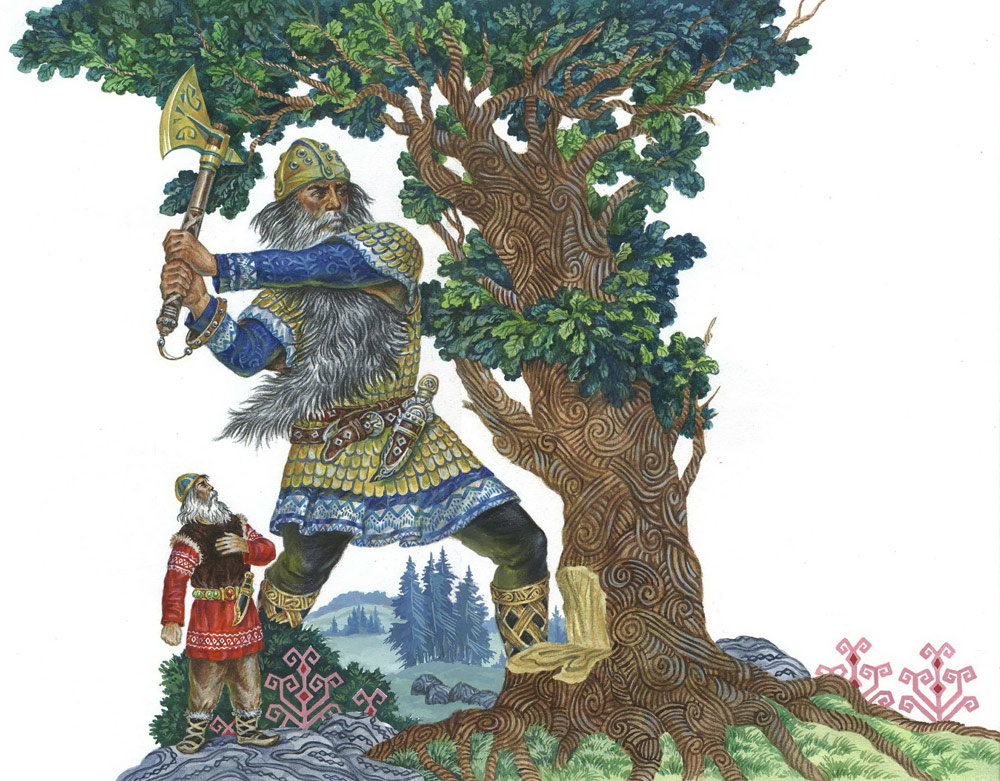
Once, three or four luonnottaret reaped a meadow. However, a "fiery giant" from Pohjola stole the hays, burned them and planted the ashes at the gates of Pohjola. As a result, a giant oak emerged, so large it blocked the Sun and the Moon. The goddesses are trying to find a hero to cut it down and eventually, the only one who is able to do it is this black man from the sea. He carries a gigantic golden axe.
Descriptions of this figure vary. Usually, he is described as tiny, even called "small man from the sea" instead of black. In this case, he is described to be the height of a handspan, with a big black beard reaching to his knees, but his axe is massive, fit for a giant. With ease, he is able to cut down the oak.
Other descriptions include statements such as "hair reaching the heels", "eyelashes covering his mouth", and "a little bit better than a dead person, a little bit more beautiful than an inhabitant of the Underworld".
In some other versions, he is called "a man from Pohjola". Describing the tiny height of this man and the massive size of his axe and the three are very typical mythic descriptions. However, there are also versions where the man himself is also a giant. In fact, there is a line which equates the "black man" to the primordial sea giant Iku-Turilas or Kaleva, who is described as having "freed the Sun and the Moon" in a Forest Finnish runosong which could be a reference to the felling of the Great Oak.
When doing a comparison on skvr.fi, "black man from the sea" returns 74 results, while "small man from the sea" returns 33 or 68 (depending if you use "pieni" or "pikku" for small). (Results include Karelian and Ingrian runosongs). The descriptions of smallness are more common when the topic is the felling of the Great Oak; the descriptions of blackness are more common when describing him as someone cold enough to be able to cut open the fish which has eaten a spark of fire. Still, these are clearly mixed up, understood as the same entity, as the "black man" can also be described as short.
What is the truth? Is he tiny or a giant? I can't tell. Either "exaggeration" could be a simple result of mythic storytelling. He is very often present in various incantations, but a name is never uttered. Being Kaleva himself would make a lot of sense, and there is some evidence to support it, but not so much that I'd feel confident stating: "This is the ultimate truth!"
It would be kind of adorable though. In one version of the runosinging battle between Väinämöinen and Joukahainen, it is said that the fighting only ended when this "King of Water" came to stop it, which in this context would kind of imply that it was the father of Väinämöinen and Joukahainen who showed up to tell them to cut it off, lol. His "helper", son of Väinämöinen, would also be his grandson. However, as the father of Kullervo, he acts as a mega-asshole, not caring if he died on the battlefield. Incomprehensible is the mind of this guy. However, it could be a result of two, initially unrelated traditions (sea giant getting and a brother-feud tale character) getting mixed with each other.
Finally, I guess I should point out that this figure, as well as the one who burns the hays, is sometimes called Pitkä mies Pimentolasta "tall man from Pimentola".
Only in Finnish, sorry. This is the source material.