


| Names: | Annikka   
Annikki 
Annukka
Himmerkki
Hyyperö
Hyypiö
Höytöri
Menninki
Metikki
Mieletär
Mieli
Mielikki  
Mielis-neiti
Mieloitari
Mielu
Mieluneiti
Mielus
Mielutar
Mikikki
Mitikkä
Muurutar
Siilikki
Siivikki
Tapio 
Tapiotar
Tinatti
Tuuvikki
Varvutar
|
|---|---|
| Spouse: | Assumed male forest god |
| Children: | Tuulikki, Pinneys, Tellervo |
| Domain: | Honey, forest, Metsola |
Mielikki is the goddess of the forest. Although the name "Tapio" is nowadays considered the name of a male deity of the forest, Mielikki's husband, it likely originally referred to Mielikki herself. After all, Finno-Ugric mythologies originally venerated Mothers of nature, such as the water mother and, here, the forest mother.
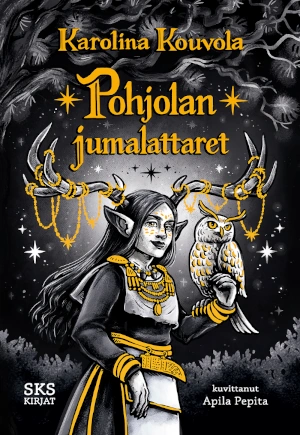
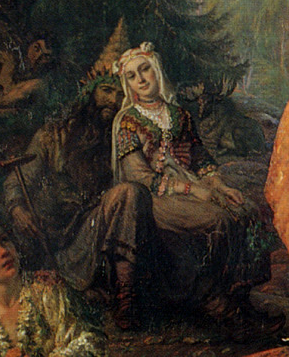
Mielikki was prayed to by hunters. She was specifically seen as very erotic, the forces of the forest being feminized and eroticized in incantations. She was equated with the forest itself (metsä, tapio) when hunters prayed for the forest to "grow fund and become wet" for them. (Yes, in that way.) If she appeared at the hunters' capsite beautiful, dressed in gold, she was indeed favourable towards the huntsmen and gave them a lot of prey. But if she appeared ugly, wearing jewellery and a crown of twigs, she was not going to give much.
Mielikki is called suuri sulkain emuu "the great mother of feathers", and rabbit and birds are called emon vilja "the mother's grain". A spruce without a tree-top is called a Tapionpöytä "Tapio's table" and is a natural altar for worship. Usually it's assumed to mean the male forest deity, but this was likely not originally the case. Here, too, Tapio would refer to Mielikki herself, not her husband. After all, the Forest Finns called such a spruce Mehänemännän tupa "the cottage of the Lady of the Forest".
One of Mielikki's Savonian names, Hyypiö, means an eagle own, while in Kainuu, the Siberian jay was called the Lady of the Forest as it was believed to be the oldest bird.
Mielikki was also the protector of cattle. She was the one brought up the bear beneath a blooming spruce. Therefore she is asked to dull the bear's claws and block its mouth so it couldn't hurt or devour cattle. This aspect of her is equally as important, if not more, than the hunting aspect; after all, people used to rely on cattle for survival. In a way, the wild animals in the forest were considered Mielikki's cattle.
Mielikki is often connected to the colour blue, as she is often described as having a blue cape, maybe socks too. While the parentage over wasps is typically given to Päivätär, there are Central Finnish runosongs which give this role to the Lady of the Forest, even equating her with the wasp (this is why she is called Siivikki from siipi "wing"). In these, she is described as having wings, even blue wings (she is called Sinisiipi lintuseni "my little blue-winged bird"). It sounds odd, but my theory is that as wasps, bees, and hornets are often mentioned together in runosongs, this is probably referring more to bees who make honey, rather than wasps. That is also what her alternate name Metikki implies (mesi "honey", metu "mead").
| Mielikki, variants | From mieltyä "to grow fond", as that is exactly what hunters wanted her attitude towards them to be. |
|---|---|
| Annikka, variants | Influenced by Christian Saint Anne. |
| Himmerkki, Mimerkki | Not certain, but Kaarle Krohn connected them to the Swedish word himmelrik "kingdom of heaven". |
| Metikki | From mesi "honey". |
| Siivikki, Siilikki | From siipi "wing". |
| Mitikkä | Not certain, but Kaarle Krohn theorized a connection to the Christian saint Nicetas. |
| Tapio, variants | Uncertain, theories include tapi "rod, staff", tapa "lock of a hunting trap", and tavata "to reach, to catch up to". Also a theory that it's connected to tavata but shifted in meaning to mean "lenient, amenable" much like is the meaning of the name Mielikki; a comparandum to this would be the Proto-Germanic *gadōbiz "suited, fit" becoming Old English ġedēfe "fitting, gentle, kind", as tavata ultimately comes from Proto-Germanic *dabaną "to fit", later gaining positive meanings in various descendants. What I'm trying to say is, I think both etymology and runosongs support the idea that Tapio is actually Mielikki's name. |
Only in Finnish, sorry. This is the source material.