


| Names: | Histervo (no region known)
Ihdelvis 
Istervö 
Istor
Istori
Kalehvo 
Kilervä
Kulerva
Kulervo
Kullervo
|
|---|
Kullervo is THE son of Kaleva, the beautiful son of Kaleva with blonde, curly hair, who dies on the battlefield.
There is a son of Kaleva who was very strong as a baby, and was sold as a slave to a smith. In many assumptions, including the Kalevala, this son is Kullervo. However, runosongs from North Ostrobothnia and Kainuu call this son Soini, Sollu or Solki, so I will cover this "origin story" on Soini's page.
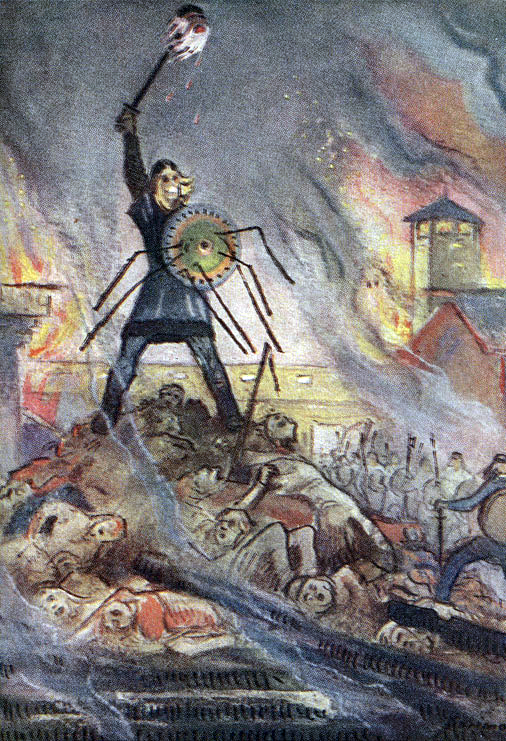
Kullervo goes to war while playing an instrument (= frivolously), and this is a common phrase in Finnish (lähti soitellen sotaan). When leaving, he asks his parents if they'd cry if he died. His father says no, for he could just make another, better son. His mother, on the other hand, says she's cry so much it would melt snow and cause the lands to turn green. Regarless, Kullervo goes and later gets the message that his mother back at home has died. He does not care, too busy fighting, stating he could make himself a new mother from twigs, leaves and a broken cauldron.
Eventually, he dies on the battlefield, but is able to reveal one thing before dying: he still has a yet unborn son in a woman's womb. When he is born, the enemies of his father throw him into a bonfire only to see that he is not harmed by it, able to control fire. This is the Finnish version. There are Karelian and Ingrian versions in which Kaleva is this father who dies, and Kullervo is this fire-controlling son. However, Finnish runosongs are very consistent on that Kullervo son of Kaleva went to wars with his children, not Kaleva.
In many runosongs it is said that Kullervo went to war with his three sons and two daughters and on the battlefield, his war spear split into two or three, falling onto the wet muddy ground. This causes a chain of events where the cowshed snake is born. In some instances, after this part, the genitalia of a daughter of Väinä and a son of Tuoni are described and from this, a snake of the Underworld is born.
For clarity's sake, let's make it known that the spearman in the previous scenario is also called "Pellervoinen's grandson" and even Väinämöinen in some (minority of them) versions.
Though Kullervo's father was kind of horrible towards him, and he didn't seem to care about his loving mother, he wasn't the worst to his own children: when suspecting a nightmare might've bothered one of his children, he performs incantations to drive the nightmare away.
As a bonus, I'll say that based on the little I know from Estonian runosongs, their unnamed Kalevipoeg "son of Kalev" is probably the same as Kullervo (Estonian: Kuller). But what do I know, maybe there are multiple Kalevipoegs running around there and Kuller is but one of them. Still, there is an Estonian runosong of Kalevipoeg sexually harrassing a woman, who then stabs him to death, and this is portrayed as an acceptable reaction. While "sons of Kaleva" are then known as "heroes" often, there are definitely one or more of them who are badly-behaved and even criminal. Kullervo does, in my opinion, in many ways go into this bad-behaved category.
| Kullervo, variants | According to Julius Krohn, from kulta "gold". According to Eemil Nestor Setälä, from Icelandic kollr "rounded top, shaven (slave's) head, male". |
|---|---|
| Istori, variants | A.H. Kallio believed it comes from Russian izverg "monster". Martti Hako suggested this "izverg" in question here would be Longinus. Kaarle Krohn suggested this name was formed from the mixing of Kullervo and Israelin kuningas "King of Israel", as Israel's king Saul fought in wars and had the sons Jonathan, Isvi and Malchisva, and the daughters Merab and Michal. Martti Haavio believed it comes from fisteli "fistula", which could be caused by snake bites. |
Only in Finnish, sorry. This is the source material.