


| Names: | Jompainen 
Jouhkahainen 
Joukahainen   
Joukamoinen
Joukava
Joukavaanen
Joukavainen
Joukkaha
Joukkahas
Joukkahainen
Joukkama
Joukkavainen
Joutavoinen
If he is the same as Poika Pohjolainen: Anterias Joukas
Antti Joopus 
Antti Joukkahainen
Antti Joukos
Lappalainen
Pohjalainen
Pohjolainen
Poika Pohjalainen
Poika Pohjolainen and/or ,
Tattarlainen
|
|---|
Joukahainen is a younger brother, rival and companion of Väinämöinen, in most versions. Though there is also one version where this is probably not the case... I'll explain later. Väinämöinen and Joukahainen are often a duo, but are also often put into a trio with Ilmarinen as if they were three brothers. While Finnish sources call both Väinämöinen and Ilmarinen sons of Kaleva, and Joukahainen Väinämöinen's brother, they don't outright call the trio brothers... But such mentions do exist from Karelia. Possibly this is due to the fact that Ilmarinen was originally not a part of this brethren but got associated into it at a later point.
What is he? He's been called a god, but then he would have no clear domain. He's been called a giant, which is often how Kaleva's sons are described. But he is a tietäjä, akin to a shaman, just like his brother Väinämöinen. It's been said singing is the only thing he cared about.
If he is the same as Poika Pohjolainen which honestly, there is plenty of evidence in support of, that would make him pellon poika "son of the field", maan mahtava isäntä "the mighty lord of earth", noita "the shaman", and Pohjolan isäntä "Lord of Pohjola", the eldest son of Louhi (this figure gets called the son of a harlot after all). And in Christianized incantations, Jeesuksen Ristuksen pyhä korkia nuolenkantaja "the Holy High Arrow Carrier of Jesus Christ". Talk about a promotion.
Before anyone else, the first fight to happen was between Väinämöinen and Joukahainen, who faced each other on a road. Joukahainen challenges Väinämöinen (or the other way around) into a runosinging match: the loser had to step away so the winner may pass. Joukahainen sings, bragging about how he remembers that things had happened in the beginning of the world: the seas had been ploughed, the posts of the sky had been set up, the stars had been attached to the sky, the hills had been turned over, the stones had been gathered together. Väinämöinen mocks him for not having the knowledge of a bearded hero, but that of a child and a woman (wow calm down there mister misogynist); Väinämöinen didn't simply remember that those things had happened: it was Väinämöinen himself who had done all of it. Väinämöinen was older and thus wiser, while Joukahainen was younger and therefore below in the hierarchy of divine tietäjät.
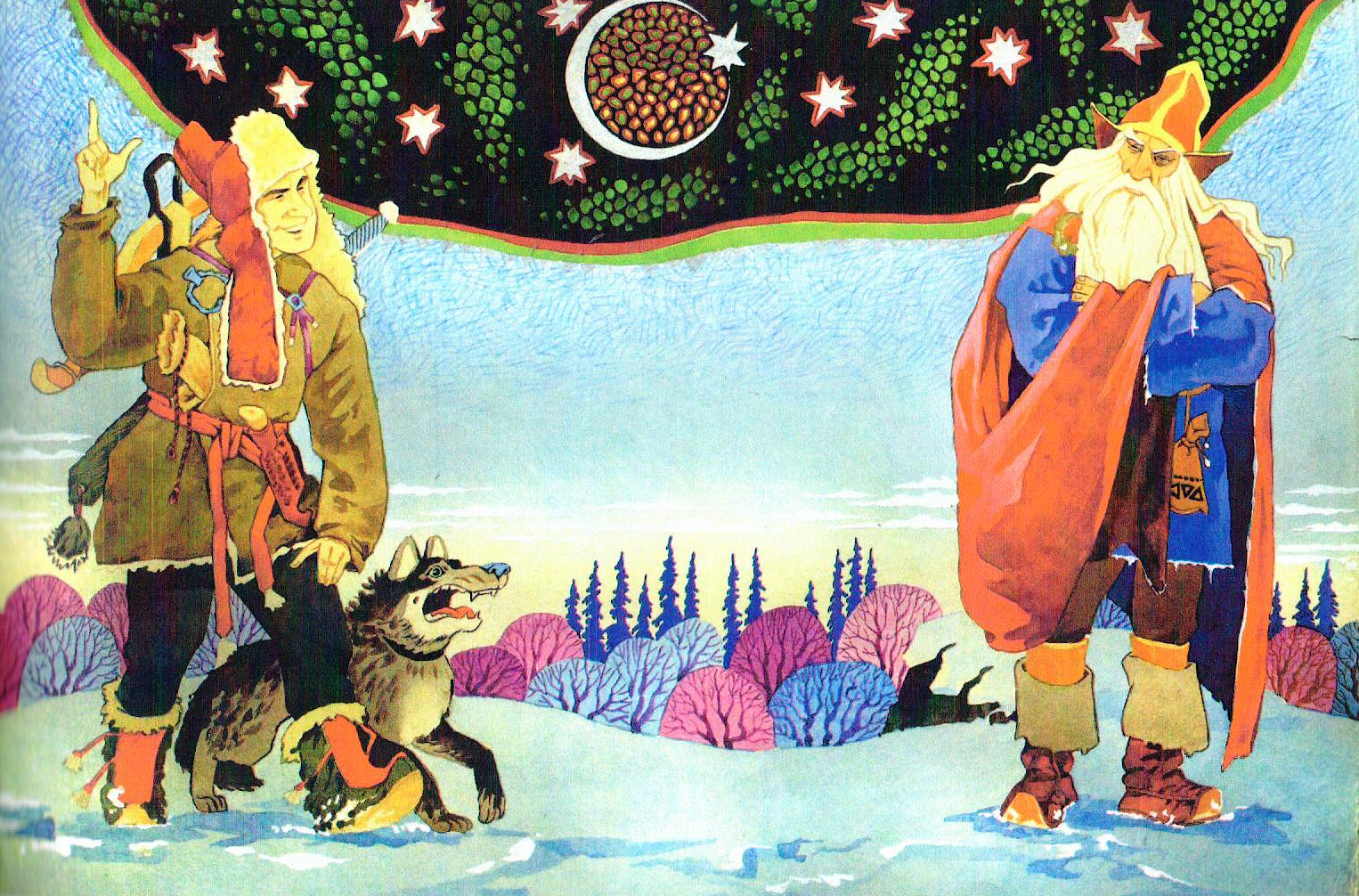
Either the fight is interrupted when the King of Water arrives to stop them, or alternatively, Väinämöinen wins by singing Joukahainen into a bog. This kind of act is actually kind of brutal: the bog symbolizes a path to the Underworld, and this kind of thing also used to be an execution method in Medieval Europe (didn't have to spill anyone's blood if you drowned them. Bible outsmarted!) In the case of the bog, Joukahainen begs to be let free by promising Väinämöinen that he can have Joukahainen's sister as a wife. I guess in this context, they are not brothers...
Indeed, in some instances, Joukahainen is rather presented as an inhabitant of Pohjola. Still, most Finnish sources clearly refer to him as Väinämöinen's younger brother. Is the brother literal though? It can't be in every place since Joukahainen is also equated with Poika Pohjolainen, or Väinämöinen and Joukahainen have different mothers at least.
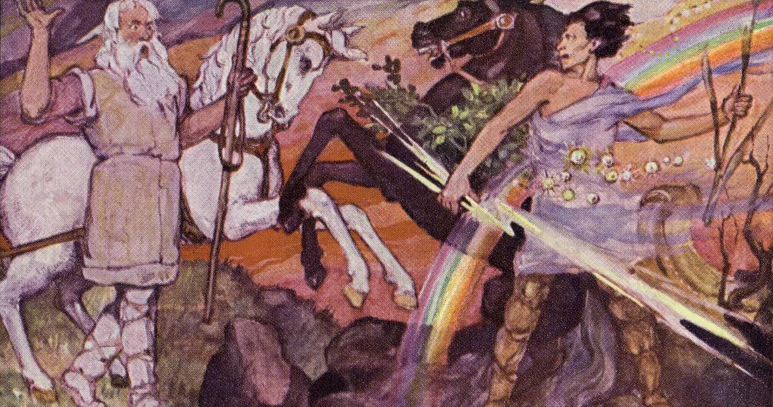
This is by no means the only story of a battle between the two. In a runosong from North Savo, the two fight over firemaking. Väinämöinen makes fire by rubbing pieces of wood together, while Joukahainen by hitting rocks together, which almost makes Väinämöinen's beard catch on fire, and does make his land burn. As Väinämöinen is pretty angry about this, he summons the King of Water to put out the fire. This theme of fire is, according to Anna-Leena Siikala, connected to slash-and-burn agriculture.
In yet another runosong (probably from North Ostrobothnia or Kainuu), Väinämöinen builds a boat of fire, but Joukahainen shows up and strikes down one of its sides. As Väinämöinen is pretty angry about this, he fetches his spear and strikes it through Joukahainen's left armpit, which Joukahainen has to heal with iron incantations. I know this sounds pretty bad, but you'll soon see stabbing into the armpit is probably just how these two communicate with each other.
In a surprising variant from Central Finland, Väinämöinen discovers Joukahainen has made himself a new boat and gets jealous about this, threatening to hit Joukahainen's axe into a rock.
A "son of Pohjola" once shot at Väinämöinen with an arrow (through the armpit, yeah), which causes him to fall into the lake that is connected to the River of the Underworld, where Louhi eventually finds him drifting. This archer has sometimes been presented as Joukahainen. However, I have to mention that this is not certain. There is a son of Pohjola who Lemminkäinen and Väinämöinen encounter, and who Lemminkäinen (originally I think, in some versions also Väinämöinen) defeats in a sword fight, and the shooting of the arrow could be revenge over this. But in these instances, this "son" is not actually ever called Joukahainen, so while possible, it is not certain.
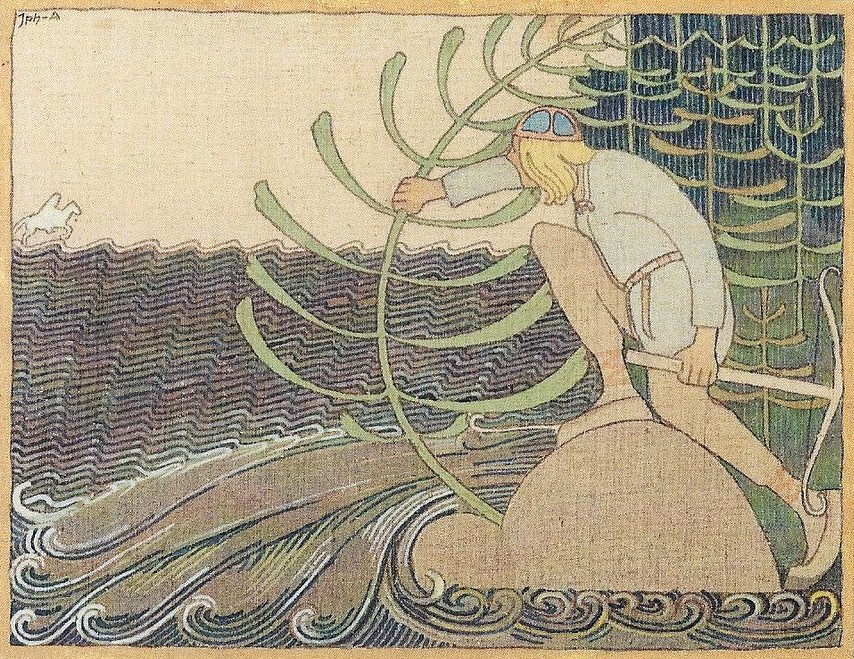
It does present interesting things, however. How has Väinämöinen younger brother ended up as a resident of the Underworld? Maybe he got a good job offer. It is possible that he is a resident of Pohjola AND Väinämöinen's brother. But maybe some people did not know of this brother-connection and presented Joukahainen as an unrelated individual who could then offer her sister, a maiden of the Underworld, as a wife to someone. After all, something you are going to learn about in Finnish myth, if you haven't already, is that maidens of the Underworld are very desired after. Or maybe, like I said, the brother is not literal and they're "only" just "bros", in-laws or stepbrothers, or something else of the kind.
Väinämöinen and Joukahainen are not always antagonistic towards each other. For example, when Väinämöinen requires three magic words from the shaman Antero Vipunen, he asks Joukahainen to go get them for him. However, Joukahainen says that Vipunen is long since dead.
Another adventure the two have together is snatching the Sammas from Pohjola. As they manage to get it into their boat, Joukahainen tells Väinämöinen to sing, but he refuses as the gates of Pohjola are still too close. However, he finally sings, and... a confusing set of events happens.
The Sammas itself jumps up from the boat to the sky and Joukahainen jumps after it, cutting off two of its toes with his sword. One toe fell into the water, making seas salty. Another fell on land, causing wild hay to grow. If only he had been able to cut off the third one, crops would grow without the need for farming.
The Sammas might or might not symbolize the world pillar, the Sun, or a different wealth bringing thing. In any case, it's weird that it flies and has "toes" here. There are two theories: Louhi transformed into a giant bird and chased after the heroes, snatching the Sammas into her toes which were then cut off, the Sammas falling and breaking into pieces; OR, the storm, which is obviously the Storm Bird from Pohjola, came after them and was quite unpleasant as storms tend to be for sailors, and the storm catching the Sammas from their boat is like the storm bird snatching it into its toes, which would've then been cut and the Sammas breaks into three pieces. The former would be more in line with Karelian runosongs, while the latter in line with Forest Finnish folklore; whenever there was a storm, the Forest Finns mimicked this battle against the storm bird by making stabbing motions at the sky.
In either case, this giant eagle from Pohjola is often described as having an army of a thousand men on its back.
| Joukahainen, variants | Theories include an origin in Sámi words related to snowfall and solidifying (giving Joukahainen the element of ice just like Väinämöinen has water), Estonian jõud "power", Finnish joukea "slender, large", and Finnish joukainen "swan". |
|---|---|
| Antti | Not sure but Kaarle Krohn suggested it could come from santti "saint". |
| Joopus | Possibly morphed from Josephus, as Jesus's father is called Joopus in one occasion. |
❅ Berry Song (The Origin of a Son of Fire/Sun)
❅ Runosong competition against Joukahainen
❅ The Song of Vipunen
❅ The Song of Lemminkäinen (+ Väinämöinen's trip to Pohjola)
❅ The Shooting of Väinämöinen
❅ The Theft of Sammas
❅ Lifting Fire Up to the Skies
❅ Origin of Rheumatism
Only in Finnish, sorry. This is the source material.