


Welcome to another grand essay of mine where I express something about Finnish mythology that might be quite controversial! (The first one being this of course.)
In 1551, Mikael Agricola wrote about the Ukonvakat beer festival intended for increasing the fertility of fields. He wrote that the wife of Ukko got horny, which made Ukko "splash nobly from the bottom", and this guaranteed good harvest. Nobody knows what this means, of course, because this is not in the runosongs. HOWEVER.
Runosongs do describe something quite similar with this, only with some key differences. For Ukovakat, first, Ukko is asked for rain. Then, unrelated, there is a description what the vegetation haltija Sämpsä (who makes crops grow) lied with his step-mother (often assumed to be Maatar) on a pile of grains which animals then carry to many places, making them quite the fertile grains as a result. (It is also possible that Ukko is asked for rain after this description.) It kind of leaves me with two possibilities: either there existed a different version of this where the one having fertilizing sex is Ukko, or Agricola completely misunderstood this ritual song and falsely thought that Ukko was involved in the sexual acts.
In a way that is completely understandable, Christfrid Ganander in 1789 connected this supposed "wife of Ukko" to Maatar, assuming then that Ukko in the sky was married to the earth mother, and their sexual intercourse increased fertility and brought rain. It would make sense, as many Indo-European religions indeed do have myths of this kind. It still leaves the hole of the fact that runosongs do not describe sexual relations between Ukko and Maatar, though. Furthermore, Ganander connected the earth mother also to someone called Akka ("vanha akka" = "old wife") who has a vakka container that a bee fetches healing honey from. This Akka was, according to Ganander, a great goddess later connected to Virgin Mary.
I think I've already said it on this site, but the runosongs are, to me, the number one authority. There is just a few problems with Ganander's theory, then: the bee fetches healing honey from the heavens. Why would the Earth Mother be in the sky? It kind of goes against the whole point of being the Earth Mother. It is true that Maatar is also called "Manteren akka", but that epithet "akka" is not unique to her. The "Akka" with healing honey does not have the name "Akka"; it is just a part of the description "vanha akka". We should not, therefore, get too attached to that specific choice of words.

Päivätär is known in the area of North Ostrobothnia and Kainuu as the creator of fire. She is also the mother of wasps and, it seems to me, that runosongs didn't always bother to differenciate between bees and wasps. As fire was created by Päivätär, and fire is the son of Vipunen, and Lemminkäinen is the son of Vipunen who got married in the Underworld, and the wasp is fire and also got married in the Underworld... Well, I tend to connect these together. That would, in a way, make Päivätär the Mother of Lemminkäinen. At least, insofar as he represents warmth and fertility! How exactly did Lemminkäinen's mother resurrect him? According to a Savonian version, with a pint of fire. According to a Karelian version, with healing honey that a bee brought from the heavens. It doesn't even matter which one you go with, it is connected to Päivätär.
So! There is an old woman in the sky who has a little container that the bee (called ilman lintu "bird of the sky") fetches healing honey from (akan vanhan vakkasesta). Are there any other mentions to this old woman? YES! Only it's under the term vanha ämmä "old (honourable) mother". A Central Finnish runosong describes that fire came down by falling from the old mother's container. A reminder that Päivätär in the sky is the creator of fire. Then, the runosong goes on to describe how fire was lulled in a golden cradle on the island in the center of the world. A clear connection to nature goddesses.
I am quite convinced that the great goddess who has healing honey, and who resurrected Lemminkäinen (in a way, her son) is Päivätär. Could she be the wife of Ukko? Yes, Lemminkäinen and fire are also described as the son of "the pillar" (Ukko having a connection to said world pillar). Does this mean that Päivätär got horny and had fertilizing sex with Ukko? No, that description still fits Maatar and Sämpsä better. And I'd also point out that we don't have anything showing that Finnish divinities were thought to have concepts like monogamous marriage etc, as they are more often than not, personifications of natural forces. I would, therefore, not get too attached on labels like "wife". Same goes for age, by the way: many goddesses are called young maidens in one runosong, and wise old mothers in another.
Later addendum: I also found a Karelian runosong explaining how Ukko and Akka decide to create a "son of fire", and a maiden who went to pick cloudberries is the one who gets pregnant and gives birth to him in Pohjola (the Underworld). One does not then need to be literally born from Päivätär to be her son. The fatherless child is doomed to death by Virankannos but begins to magically speak, stating that Virankannos had incest with his mother. However, Martti Haavio has suggested (quite convincingly) that the original line includes the child accusing, in this case Virankannos, of being his father. This could easily describe the origin of Panu who is said to be a "son of the Underworld" while also "created by" Päivätär.
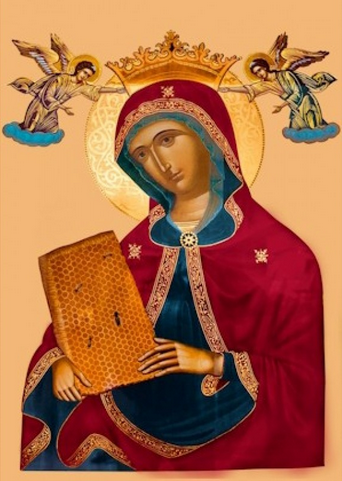
To prove that I didn't pull this all out of my ass, professor Anna-Leena Siikala said in an interview in 2003 that she found it possible that Päivätär had originally been a goddess of life and light who got replaced by Virgin Mary. I think that what I have discovered from the runosongs completely supports this theory. One thing to note about bees, for instance, is that they are also connected to Virgin Mary in Christian symbolism. It is possible, then, that some Mary-like features in Päivätär were actually loaned from Mary to Päivätär during the time period when two religions overlapped each other in Finland. Both Päivätär and Mary are "the mother of the son of God" in Lemminkäinen and Jesus, and it's practically impossible to tell if this similarity was born out of Christian influence on Finnish myths, or if this was already the case before anyone in Finland had got a single whiff of a Christ.
While Päivätär symbolizes the Sun, warmth and life, Louhi as the ruler of the Underworld is icy and cold. They are the opposites in elements, as well as locations. While not being named, by all logic, the one who kills Lemminkäinen is, in fact, Louhi. The cold of winter kills fertility, but the warmth of the Sun resurrects it once again in the spring; that is what I think the whole symbolic meaning of that myth is. But this is not the extent of their "beef".
We already saw how bees could be connected to Päivätär. What about hornets, then? If the bee is called the bird of the sky, the hornet is called the bird of Hiisi (= the Underworld). These two insects are then, too, elemental opposites. In most versions of the myth of the origin of iron, it is simply said that the iron made an oath to Ilmarinen that it was not going to hurt humans, but ends up breaking this oath because a horney brought snake poison into the iron's quenching water. A bee is then asked to bring healing honey from the heavens. However, multiple runosongs from North Ostrobothnia give us further context: the one who enraged iron so it hurts humans was actually Louhi herself. Therefore, it is possible that the hornet in question was working for her.
A final, connecting point: Karelian runosongs describe Louhi transforming into a bird with the specific poetic lines of how she made a tail from a shovel and wings from bathbrooms. These lines of transformation are not given to Louhi in Finland, but to the bee-as well as the mother of Lemminkäinen!
All in all, I have to say: the Sun is SO IMPORTANT in Finnish cosmology. You often hear the sentence: "Finns did not worship the Sun, the Sun was not that important to them". Yes, it is true that there are no runosongs straight up about worshipping the Sun. However, the Sun had a background effect in all the important things like growth of crops, fertility and healing. It is described as a bringer of wealth and health both as a goddess, and as the Golden Wheel. It is therefore ridiculous to claim that the Sun "wasn't that important". I am once again convinced that my choice to name this website after the Sun was a very good decision. I only hope that one day, Päivätär will be recognized as the true great goddess that she was instead of just some young pretty weaving girl. Though not identical to her in all features, in importance, Päivätär really feels like the Finnish equivalent to the Norse Freyja. Fun fact: Freyja is also able to transform into a bird.
Only in Finnish, sorry. This is the source material.