


 Kesät kengitin hevoista Talvet tallikonkaria Valjastin tulisen ruunan Tulisella tantereella ”Emoseni, vaimo vanha Kunpa paitani pesisit Mustan käärmehen verellä Kesäkuilla kuivoasit Emoseni, vaimo vanha Hae sukkani, saa rättini Haepa varvashattarani Lähen Hiiestä kosihin Vuoresta valantehestä" Läksi kohta kulkemahan Astu päivän, astu toisen Päivänä jo kolmantena Jouvun neitosen kotiin ”Anna eukko tyttöjäis Sekä nuorta morsianta!” ”Äsken annan tyttäreni Kuin sie kynnät kyisen pellon Käärmeisen käänettelet!” "Minä kynnin kyisen pellon Käärmeisen käänettelin Anna eukko tyttöjäis Sekä nuorta morsianta!” ”Äsken annan tyttäreni Kuin sie kylvet kuuman saunan Kuuman saunan rautalauan Vastan rautasen keralla!” "Mie kylvin kuuman saunan Kuuman saunan rautalauan Vastan rautasen keralla Anna eukko tyttöjäis Sekä nuorta morsianta!” ”Jo nyt annan tyttärein Sekä nuoren morsiamen Korpillen Kojoin pojalle Itse Iivari Kojoillen” Otti neitosen rekehen Löi ohjalla oritta Helmiruoskalla hevosta Hepo juoksi, tie helisi Kangas kultainen kumisi Reki rautainen rämisi Vemmel paukkui pihlajainen Tuota neitoa vietäessä Kultoa kuljettaessa Ulvoi ukset Uuenlinnan Vinkui Viipurin veräjät Tuota neitoa vietäessä Kultoa kuljettaessa ”Jää hyvästi, Jääsken nurmi! Kuusen juuret, tervaskannot!” Tyttöparka hengäsäkse, huokasakse: ”Parempi ois minun polosen Suen suussa uluaisen Karhun kiljuvan kiassa Kuin tämän Kojosen reissä!” "Älä huoli, Hiien huora! Kuin ma pääsen hiien kankahalle Niin minä sanon miekallen: Tahotkos tuota syötäkses Lämmint’ verta juotakses?" Sormet suorovitsasiks Käsivarret seipäheiksi Pään märkenen mättähäks Tissit leivon leiposiks Noita orsille ojennan Panen parsin lautaisille Vein ämmälle tuomiseksi Ämmä syöpi ja kiittää: ”Enp’ on ennen näitä syöny Uuen vävyn tuomisia Tyttären lähettemiä” Orja lausu oven suussa Oven suussa, pankon päässä: ”Etpäs söis, etkäs kiittäs Kumpas tietäis vähäse Ymmärtäisit pikkaraisen” ”Sano, sano, orja raukka!” ”Enpä sano, emäntä raukka Annapas ainoa poikais” ”Annan kirjokarjasta Parhaan lehmän lievestä Annan ainoan orrin Seitemästä ruunastain Annan ainoan poikain” ”Nyt minä vastan sulle sanon Söit tyttäreis tissit Joita kauan kantelit Viikon vieressäs makuutit” Ämmä tuota itkemään Alla kulmin ulvomaan |
In summers, I shoed a horse In winters, the stable's fine work horse I harnessed a fiery gelding On a fiery field "My mother, old woman If only you'd wash my shirt With the blood of a black snake And dried it during summer months My mother, old woman Fetch my sock, get my rag Bring by footwrap I'll go propose from Hiisi From a cast metal mountain" Soon, he began his journey Walked for one day, walked for another Already on the third day I made it to the maiden's home "Give me you daughter, old mother, And a young bride too!" "I'll give my daughter as soon as You plough a field of vipers Turn one of snakes!" "I ploughed a field of vipers Turned one of snakes Give me you daughter, old mother, And a young bride too!" "I'll give my daughter as soon as You bathe in a hot sauna On a hot iron sauna bench With an iron bath broom!" "I bathed in a hot sauna On a hot iron sauna bench With an iron bath broom Give me you daughter, old mother, And a young bride too!" "Now, I'll surely give my daughter And a young bride Onto the arms of a son of Kojoi To Iivari Kojoi himself!" He took the maiden into his sleigh Hit the stallion with a rein The horse with a whip of pearls The horse ran, the road jingled The golden forest pealed The iron sleight clattered The rowan arch boomed As that maiden was taken As that dear one was carried The doors of Uusilinna howled The Gates of Viipuri whined As that maiden was taken As that dear one was carried "Farewell, grass of Jääski! Roots of the spruces, resin-rich stumps!" The poor girl huffed, sighed: "It would be better for poor me To be in the mouth of a howling wolf In the jaws of a screaming bear Than in the sleigh of this Kojonen!" "Don't worry, Hiisi whore! As soon as I make it to the hiisi forest I'll say to my sword: Do you want to eat that Do you want to drink warm blood?" The fingers into straight twigs The arms into stakes The head I will rot into a tussock The breasts I'll bake into pastries Lift them to the bars On plates on the beams Took them to the old mother as a gift The old mother eats them and thanks: "I've never eaten these Brought by a new son-in-law Sent by my daughter" A slave said by the door By the door, at the end of the oven: "You wouldn't eat, and you wouldn't thank If only you knew a little Understood even a bit" "Tell me, tell me, poor slave!" "I will not tell you, poor mistress Give me your only son" "I'll give you from the colourful cattle The best cow from the shed I'll give you my only stallion From my seven geldings I'll give you my only son" "Only now will I tell you You ate your daughter's breasts Which you carried for a long time Lied next to for a week" Old mother began to cry Howl with downcast brow |
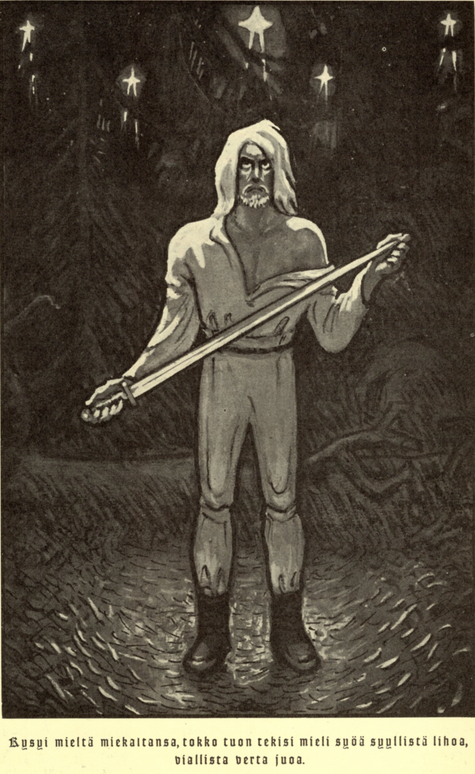
This runosong is of eastern origin, maybe born in Ingria, where the evil protagonist is called Iivana Kojosenpoika "Ivan, son of Kojonen". Iivana or Ivan is obvioulsy a Russian name. Here, in this version that had spread to the west, to Savo, his name has changed to Iivari, which comes from the Swedish name Ivar. I find it very fascinating how the cultural influence areas of Sweden and Russian can be seen even in the first name of this runosong's protagonist!
Now, Iivana is the original form, as this whole name is actually a translation/localization of the name Ivan Godinovich from Ruthenian folk poetry. And in case you're wondering, yes, the original Ivan of those poems is also evil.
Another point of interest to me is his surname. Kojosenpoika, "son of Kojonen", sounds weird because Kojonen is clearly a surname. Why isn't his name just Iivana Kojonen, then? While some runosongs from Savo also use Kojosenpoika, the ones I used in the above version actually avoid this problem. In the first half, he is referred to as "Iivari Kojoi"; this is an older, Karelian fashion of names. If his surname was Kojo or Kojoi, his full name would be Kojoin Iivari, with the surname appearing first (literally "Iivari of Kojo(i)"). However, while Savonians largely culturally (not mainly genetically though, as they are genetically mostly descendent from (Forest) Sámi and Tavastians) descend from Karelians, they later developed their own system of surnames by adding in -nen, which would turn the Karelian "Kojoin Iivari" into the Savonian "Iivari Kojonen". In the old days, a female equivalent of "Kojonen" would've been "Kojotar" or "Kojoitar", but this gender split of surnames is not practised in Finland anymore.
Here, as Iivari is proposing to a maiden in Hiisi, aka the Underworld, the Mistress in question would with all logic be Louhi. However, these elements are taken from Lemminkäinen's story. In another Savonian version of this tale, the maiden Iivari snatches is the Nurmen neito "Maiden of Grass", the first human on the island at the center of the world, obviously borrowed from yet another, different runosong. It is not important where Iivari got his maiden from, nor does it have a deeper meaning on Finnish cosmology. The point is only the despicable nature of the protagonist.
I'm not sure if orja here is supposed to mean like, slave slave, or if it's more like a serf or a servant. "Jääski" was a municipality in South Karelia which was, for the most part, taken by the Soviet Union and is now a part of the fascist dictatorship currently waging genocidal war in Ukraine. "Uusilinna", "New Castle", means the Olavinlinna castle in Savonlinna, South Savo. And Viipuri is, you guessed it, in control of a certain fascist dictatorship.
In Finnish.
Only in Finnish, sorry. This is the source material.