


| Names: | Kaave  Kapo   Kapoi  Kave Kaveh and/or   Kavet
|
|---|
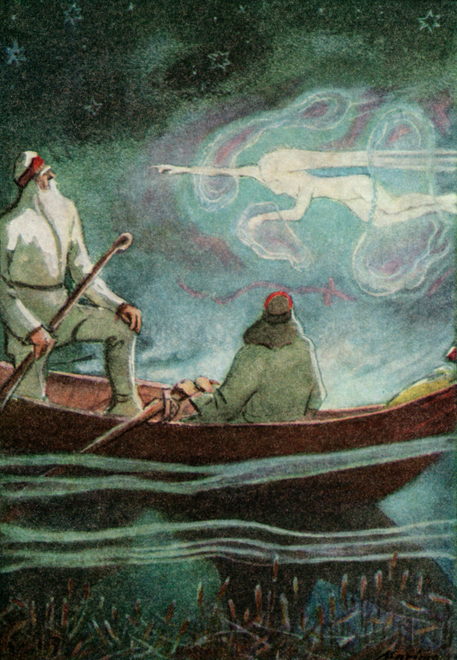
Kavet (and variants) is known as an air maiden, a golden woman, and the oldest of women. In addition to being her name, the word kave/kapo also means a maiden or a creature, and is also used as a general term for goddesses, synonymous with luonnotar. No wonder then that in the Kalevala, the air maiden is instead called Ilmatar who vaguely resembles Kavet.
Her name has been, in many places, erased; you'll find mentions of Virgin Mary instead.
In 1551, Mikael Agricola wrote that plural beings kapeet "ate the Moon". Christfrid Ganander said that kave means a bird, an animal, or a creation of God. It is not unheard of for mythologies to have the Moon being "eaten" by wild animals like wolves. However, Ganander disagreed with Agricola on one thing: he said that is was the singular being Kavet, a helpful spirit, who freed the Moon from an iron cabin a demon named Kuumet imprisoned it to. Evidence from the Forest Finns is mixed: they had a story of kapeet eating the Moon, but also had runosong lines of Kapo freeing the Moon.
Freeing of the Moon has a magical connection to childbirth. Runosongs ask Kavet to help in childbirth by asking that as you freed the Moon from a ring, the long-haired one from trouble, why won't you release me from my pains/the child from my loins?
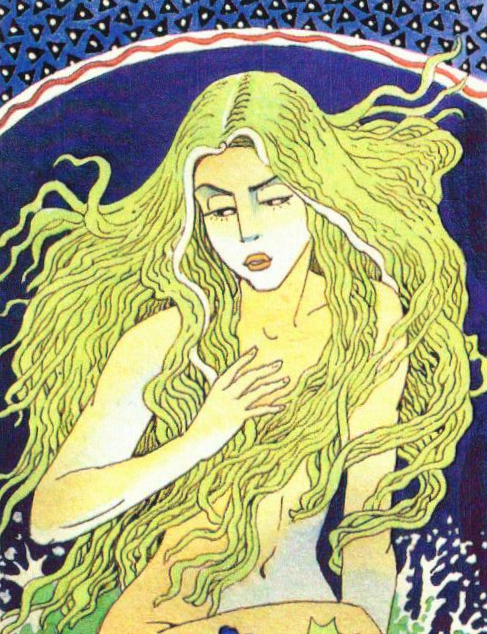
Kavet is emphasized to be the oldest of women, golden and beautiful, girl of nature, an air maiden, but a generous mother as well. To be noted is that while in the Kalevala, Ilmatar gives birth to Väinämöinen, in runosongs it is only said that a "northern maiden" gave birth to Väinämöinen and thus is not necessarily connected to Kavet. No bird also ever lays an egg on Kavet's knee. In modern Finnish, she indeed is called an "air maiden", but in old language, her epithet ilman impi would actually mean "sky maiden".
Kapo or Kave is said to have planted various trees from hair. A runosong from Central Finland says she carried a "fan of hair", while another from Kainuu says she ripped the hairs in question "from her ass" or "tail" (the latter could be a later censoring...). A bit difficult to say, since whoever created trees has been very effectively replaced with God, Jesus, and Lord in runosongs. In this context, a runosong collected by Ganander calls the tree planter Kati, the mother of trees, though this name possibly came from Saint Catherine. One runosong states that humans were "made by Kavo, created by God, created by three luonnottaret, caried by two kapeet". She could also be the same "kapo" who is asked to weave a golden cloth for protection.
Unique to Kainuu is a description according to which Kavet cradled the bear, gave it gums and teeth from forest plants and tree roots, and attached a tooth which fell from the sky to the bear's gums.
| Kavet, variants | From Proto-Finnic *kabëh "creature; woman". Theorized to come from either Proto-Germanic *skapjaną "to create", or *kabisjō "concubine". Possibly a cognate with Proto-Sámic *kuopës "witch" and/or *kāpëk "woman". |
|---|
Only in Finnish, sorry. This is the source material.