


Here are little descriptions of sacred locations and holy sites.
Hiisi, Proto-Finnic *hiite, meant a holy site. It's often been connected to the meaning of sacred grove (pyhä lehto), but many hiidet (plural) were burial grounds on hilltops. Due to Christianity, the word hiisi became demonized, quite literally: it gained the meaning of "demon". It also appears in runosongs as a name of the forest god.
Sacred groves were important to communities and were shared with multiple villages. There were also sacred springs, which were important sources of water. The sacred groves might have been encircled by a fence, or there was a fenced area in the core of the grove where sacrifices were thrown in. Stepping inside this sacrifical area was forbidden. Celebrations and religious feasts were held in the sacred groves.
Many sacred groves were destroyed by Christians. Sometimes, churches were built on the same spots. Any remnants of the sacred groves are still threatened due to climate change and destruction of forests. Sacred groves are the primary type of holy site mentioned from Western Finland, but as said, most of them have been effectively destroyed. The modern state of Finland has limited interest in pre-Christian holy sites, as all other values pale in comparison to maximization of profits (unless they can be used to prop up nationalistic fantasies of course). While law requires such locations to be protected, there is a severe lack of information on them and this law is then often not followed even if on accident.
Examples of sacred springs in Western Finland include Kultalähde in Kiikala, Southwestern Finland; Neulalähde in Pirkkala, Pirkanmaa; Uhrilähde in Jämijärvi, Satakunta; and Laurinlähde in Janakkala, Kanta-Häme.
Kuppikivet or cup-marked stones were considered holy. Grain was sacrificed in their cups, and water gathered in the cups was sacred. The cup marks had likely been carved onto the stones by an earlier human population, possibly for religious reasons that are unknown. Other stones and rocks were also often sacred sites.
A sacrifical stone in Hämeenlinna was moved c. 100 meters from its original spot to a more visible spot from a car store's yard in 2010. This move was controversial, though the Finnish Heritage Agency argues thart after the move, the protection and maintenance of the stone has been easier. Hämeenlinna is extremely rich in cup-marked stones and grooves (carvings in stone intended for sharpening swords).
Karsikko means a marking made in memory of a dead person, usually on a tree (but also on rocks, walls etc). A karsikko tree might have had its lowest branches cut off. This is mostly an Eastern tradition.
A sacred tree on one's yard is called pitämyspuu. Multiple rituals involve sacrificing at the tree or having meals at it. Sometimes, a standing dead pine tree was considered sacred. As far as slash-and-burn agriculture is considered, one tree could've been left standing and not burned, as a place for birds and the sacred tree. Why do this? Because that guarantees protection for your house and cattle.
Other names for a sacred tree include aljopuu, elättipuu and kasvattipuu (all three "fostered tree"), uhripuu ("sacrificial tree"), lyylityspuu ("coddled/luck/sacrificial tree"), pihapuu and kartanopuu (both "yard tree"), and istutuspuu ("planted tree"). As the last name implies, sometimes the sacred tree on the yard was planted by the master of the house when it was built. Maahinen could also reveal the location where the tree has to be planted in a dream. A sacred tree could've been a birch, a goat willow, a bird cherry, a rowan, a small-leaved lime, a spruce, or a pine.
Once offerings for a tree have started to be made, one can't stop without inviting misfortune. Many unlucky things have come to later generations who neglected the sacred tree of their parents and earlier generations. A Kainuian woman forgot to give drops of milk to the tree every morning, so one of her animals got swallowed by the forest. (I do not recommend picking this tradition up if you have OCD :).)
Kallohonka means a pine tree on which bear skulls were hanged on after hunting. This was in order for the bear's spirit to go back to the heavens.
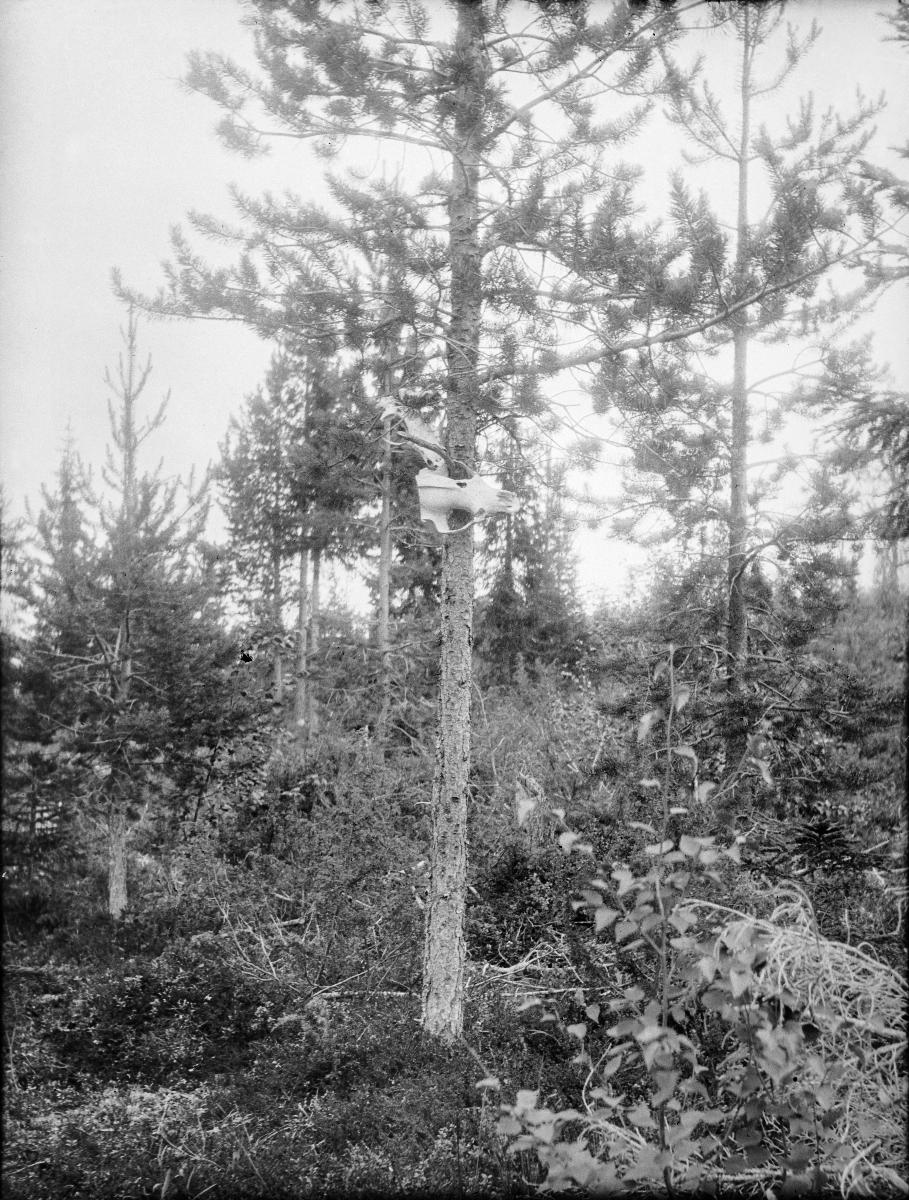
Tapionpöytä, "Tapio's table", is a spruce growing without a treetop. These were altars for sacrifices for the forest god. The name would imply these were for the male forest god Tapio, but Tapio originally meant the female forest goddess, Mielikki. Finns in Northern Sweden called tapionpöytä "the cabin of the Forest Mistress" (mehänemännän tupa) while in Kainuu, if the tree was a pine instead, it was called Tapion mänty "Tapio's pine" or Nyryn näre, "Nyry's pine", Nyry resembling some Karelian names for Mielikki, such as Nyrkytär.
Other names include Tapion kanto "Tapio's trunk" and Tapion tuoli "Tapio's chair".
Sacrifices were offered at the tapionpöytä to bring luck in hunting, in which case the first catch might be sacrificed. However, sacrifices were also given to protect cattle so forest animals wouldn't attack them. In this context, the object of sacrifice in Kainuu was actually cheese.
Special beer was prepared and brought to the tapionpöytä, all hunting weapons and traps set in front of the tree, and runosong prayers to Tapio were sung. Sometimes, a soup made of the first catch, and small rye cakes called Tapion kakkarat "Tapio's small cakes" were offered to the tapionpöytä before singing. Silver and strong alcohol were also common sacrifices.
Examples of sacrifices: In Viitasaari, the blood of the ram butchered on Michaelmas; in Pihtipudas, the afterbirth of a mare; in Kainuu, the first portion of cheese made from the milk of a newly calved cow, as well as the first portion of roast veal.
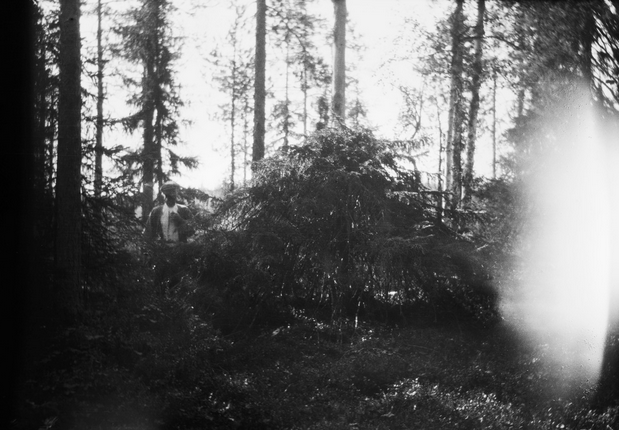
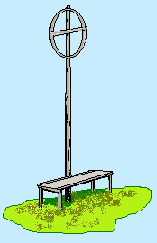
A later era altar featuring a sun wheel/cross on the top. Sacrifices (or their blood) were spread on the altar in question. Despite the sun wheel symbol, they were not specifically for Sun worship. Johan Cajanus, a church officer, destroyed the ristikannat near Kuopio in the 1600s, although these were described more as being remote trees that were sacrificed to. In case of a sun cross with a stone altar, the terms ristikanta and ristinkanta exist, while in the context of sacred trees, the word tends to be ristinkanto (kanto = "stump").
Lykkylauta is a Forest Finnish term for an altar shelf. Forest Finns had these for Ukko worship. They held a wood grouse's wing on the shelf in order to please him so he'd keep raven-form Louhi and her wolves away from devouring cattle.
Eräpyhä means a sacred location in the wilderness, far away from the usual living spaces of people. In 1789, Christfrid Ganander wrote that there was a holy stone specifically called eräpyhä in Orivesi, Pirkanmaa.
There are many unique, local holy sites around Finland. I am not going to list any southern Finnish ones here, because they have been well marked on an online map by Taivaannaula. But as you can see from the map, the northern half of Finland is still fully unmarked by them.
I use the term "Lakeland Sámi" here instead of the historical term "Lapp", which is seen as derogatory by modern Sámi. What does "Lakeland Sámi" mean? People who spoke Sámic languages, practiced hunter-gathering lifestyle, and lived in inland Finland. They do not exist anymore because they mixed with Finnish farmer communities. Genetically, most of Eastern Finns are a result of this mixing (honestly probably also a good chunk of Ostrobothnians). I took the term from Sámi linguist Ante Aikio, who referred to the languages of these populations as "Lakeland Sámi languages".
When visiting Akkovaara in Kajaani, the info text on the site will tell you lies of how the hill was once upon a time a holy hill of A´hkku, the wife of the Sámi thunder god Äijih. Perhaps the name of the hill was once A´hkkuvoara in Kainuu Sámi (Akkovoara in Kainuu dialect of Finnish), but it couldn't have been the holy hill of a goddess who never existed. Modern researchers tend to agree that place names involving "akko" (wife) in the beginning are references to women's resting places. Still, there are Finnish stories of ghosts there, as flames or will-o'-the-wisps appear in the dark on the hill. The caves on the hill have made people think of a giant having once lived there, before the arrival of humans, and there are also fields of stones as the coast of the Ancylus Lake once sat there. It is a beautiful place, and since there are little trees on the top, it would actually be a suitable place to watch the sunrise as a ritual for one Finnish Akka goddess.
One source states that the place was used by tietäjät and largely feared by everyone else, but I can't vouch for the accuracy of that considering the "Ahkku goddess" bullshit going around about this place even in otherwise well researched books.
Let me be clear: yes, there is a god in Finnish Ukko and in Inari Sámi Äijih, and these names mean "lord; husband; old man". And there are locations named after them/him which were used for worship. That does not mean that any random place nearby including the word Akka/Ahkku "lady; wife; old woman" is a reference to a goddess who ~must be Ukko's wife~. These locations have no oral tradition implying anything of the sort, they have no archaelogical evidence of offerings, etc. By saying Akkovaara in Kajaani or Ákkuvaara in Inari (or hell, Akka-Koli in North Karelia) is a holy hill of such a goddess, whose existence there is no evidence for, is just pure fanfiction you've cooked up there.
"Hiisi's gate", a ravine in Sotkamo, Kainuu. As hiisi got demonized with Christianity, it started to be seen as a being; in Kainuu, mainly as a giant. According to a story, this Hiisi who lived on the Vuokatinvaara hill in Sotkamo had to move away when humans arrived, as he hated the sound of the church bells. Reindeer hunters adviced him to make his new home in the ravine and promised to come worship him every July. Thus, this Hiisi also has forest god-like qualities: he takes his "grain" (animals) with him to the ravine.
Hiisi's castle is located in Sotkamo as well, while he is said to have also lived on the Kivesvaara hill in Paltamo and created the Kivesjärvi lake and Manamansalo island.
"Hiisi's church" in Hyrynsalmi, Kainuu, has a story of dance parties (just like Hiidenportti) and even "immoral" sexual behaviour having been held there.
The Porokirkko or "reindeer church" on the island of Ärjä in Kainuu is believed to have originally been a (Lakeland) Sámi holy site, sieidi. After the speakers of Sámic of the area merged with Finnish-speakers, the location continued to be known and used as a holy site. Rituals to increase luck in fishing and reindeer hunting were held there. In the 1883, it was written that there were about 30 stumps in Porokirkko, assumed to be some kind of wooden sculptures. We will likely never know, however: the location wasn't clearly marked by its founder, and despite efforts, hasn't been found anymore in the 20th century. The island was under the ownership of a forestry company for decades and, well, I wouldn't even be surprised if an anti-pagan zealot had secretly destroyed it at some point. That is, if these stumps ever actually existed in the first place. I got some information that Porokirkko could've been on the southern side of the island, and it's been my plan for a long time to once go there and scout the area myself. Imagine being once able to sanctify it again for ritual use...
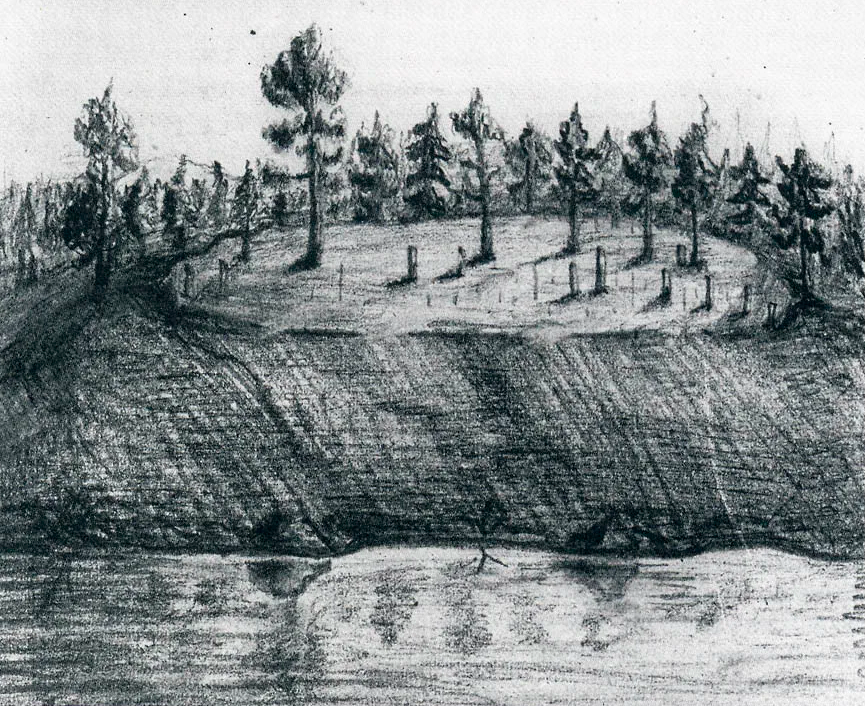
"Gold spring", in Ganander's writing Kulta-kaiwo "gold well", in Kuhmo (Kainuu), resides next to an old road between Kainuu and White Karelia. Travellers sacrificed money there. Nowadays, the border between Finland and Russia (which White Karelia is a part of) is sptrictly supervised, and the road already got cut when the Soviet Union set up its iron curtain. Now, visiting the spring, which is so close to the border, is only possible when escorted by two border guards.
On the northeastern coast of the Kivijärvi lake in Kuhmo, Kainuu, there is the so-called church of the Lakeland Sámi. It has been a feared place, as people have seen strange individuals near it and heard shouting from inside a rock. In the middle of this "church", there is a deep, dark hole. Year 1621 has been carved onto the rock.
"Penna's birch" in Varisniemi, Paltamo, Kainuu is where the great tietäjä Juho Benjam "Ojaniemen Penna" Tolonen (1811-1886) is said to have been buried. He was a famous healer and catcher of thieves, and once, he was called to help with finding missing money. Though the money was found in a barn, Penna threatened to curse the thief. Next night, the thief came to Penna with a knife and a block of wood and beat Penna up so badly that he died to his injuries the next day. The news were reported in papers around Finland due to Penna's fame. It's been said that his body was taken to Penna's birch secretly in the middle of the night.
I noted that multiple sources describe that he died "in service of an ancient ideology" and "with boots on, serving his religion". The graves of tietäjät are, of course, famously locations to seek their power and wisdom. Penna can be found on Photos of tietäjät from the 20th century.
In Jaalanganlahti bay in Vaala (nowadays North Ostrobothnia but historically and culturally Kainuu) there is a large sacrificial stone.
Pyhitysvaara "Hill of Hallowing" resides in Taivalkoski, Koillismaa, an area which is a part of North Ostrobothnia but is in many ways culturally and linguistically Kainuian. The population of the area were Sámic-speaking hunter gatherers around the 17th century before mixing with Eastern Finnish farmers. The rock piles on the hill, assumed to be for ritual purposes, seem to be from a time before the mixing.
"Hiisi's hill" in Pyhäjärvi, North Ostrobothnia, is the home of an old sacred grove and a rock spring used for offerings.
The "cross ruin of Tohninmäki" in Töysä, South Ostrobothnia. According to local legend, there used to be a wooden image of a god with iron earrings there.
Leväluhta or Levänluhta in Isokyrö, South Ostrobothnia, is a site where during Iron Age, there was a lake that worked as a graveyard. Bodies of mainly women and children were "buried" by attaching them to the bottom of the lake with wooden poles. Now, only a small quagmire of sorts is left of this lake, a tiny grove in the middle of fields, but bones have been unearthed around there for centuries. Animal bones have also been found. It's been theorized that these would've been human sacrifices, similar to bog bodies from other parts of Europe, but the remains show no signs of violence. They could also not have been slaves as valuable items were sunked with them, nor could this site be a "mass grave" for a single event as it was in use for centuries.
"Holy mountain" in Alajärvi, South Ostrobothnia, has some oral tradition attached to it, in addition of a possible rock painting (its age has not been confirmed). On the slopes of the hill there is the sacrificial stone (actually a tor) of Lakeland Sámi and Finnish Birkarls (a small group of peasants who taxed the Sámi on behalf of the Swedish crown). According to stories, the Lakeland Sámi sacrificed fish and game, while the Birkarls sacrificed grains from far away, silver, and "even the children of the Lakeland Sámi". Yeah, big doubt on that since, as you guessed it, there is no historical or archaeological evidence of such. Close-by is also a sacred spring.
A man named Jaakko Reipakka (1855-1930) had asked a tietäjä for help with a conflict over inheritance and had in fact won, but refused to pay the tietäjä what he had promised. He got cursed, the curse following him even to other continents when he tried to escape it, so he ended up living as a hermit on Pyhävuori. In addition to him, it's been said that polite and friendly rock maahiset (peikot) live in the caves of the hill, but they became angry if humans bothered them by not behaving well and could in those cases attack back. They could travel in the form of a large black dog.
If the rock paintings are real, the site could've been considered holy for 5000 years, because it was still used as a holy site by tietäjät relatively recently, maybe as late as the early 20th century.
"Cowshed mountain" in Kurikka, South Ostrobothnia, was probably named after having been used as a place to hide cows during the Finnish War. It was a holy site for tietäjä rituals, but mostly it was known as a place for burning Easter bonfires. People also gathered there to celebrate the Pentecost and Midsummer. The Luthern Church started organizing their events there too in the 1930s. The holiness of the place got kind of ruined when it came to be known as a location for drunken dance parties of the youth due to its (at the time) remoteness.
Rillankivi "Stone of Rilla" stands in Pielavesi at the border of North Ostrobothnia, North Savo and Central Finland. Because of the markings on the stone (three Swedish crowns and Eastern Orthodox cross) it has been assumed to have once been the border of Sweden and Russia. If it marks the border of the Treaty of Nöteborg in 1323, its name could come from "Frille", a surname of multiple individuals working on figuring out the border of Häme, Savo and Ostrobothnia at the time.
Borders are, of course, sacred in and of themselves in Finnish tradition. Changing their placement secretly, for example, is a horrible crime. Border areas are also full of supernatural activities, connected to dualism and the concept of "borders" between things such as life and death. Regardless, it is likely that before any border went through there, the stone was a sacrifical stone of hunters. After becoming a border, it became a place for tietäjä rituals because of the strong väki present precisely because it is a border. There is information from 1899 that sacrifices were still brought next to and under the stone.
This spring, named after Vorna, is an old sacrificial spring in Pielavesi, North Savo. Archaeology supports the traditional information: offerings of items with carved magic symbols, amber jewellery, bronze brooches, arrow and spearheads, sword fragments and old coins have been discovered. Apparently also Urho Kekkonen, the closest thing Finland has ever had to a dictator (ruled for years), was baptized with the water of this spring so they might be onto something about the ~power~ of its water. Unfortunately, the forest around the spring has been cut down and the spring has almost been grown in by moss! (: Nothing is holy to the forestry industry...
Pisa is a holy hill in Kuopio, North Savo. It is also mentioned in epic runosongs when Joukahainen says pitkät on puut Pisan mäellä "the trees on Pisa hill are tall". According to Voitto Viinanen, Pisa was a holy hill for three reindeer hunting groups: Savonians, Karelians, and "Kainuians", though I must say I don't know who he means by Kainuian; actual Kainuians, Ostrobothnians, or some other group? Regardless, on the hill there are three sacrifical locations: a cave, a sacrificial rock, and a black-and-white stone altar. The sacrificial rock is also an old border marker. The cave was used by tietäjät for magic to help young women with fertility and luck in getting married. So angry at paganism, a Pietistic Lutheran man tried to destroy the cave with fire in the 1860s. The rock crystals of the cave were taken and therefore destroyed by tourists, while the ironworking company of Juankoski used to mine near the cave, causing damage.
"Black spring" in Maaninka, North Savo, has powerful sacred water, and a powerful haltija too. Small sacrifices of booze, needles, nails, silver crumbs, and other such things have been offered.
In Astuvansalmi, in Mikkeli, South Savo, there is a massive rock which, when looked from one angle, looks to have the side profile of a human face on it (dubbed Astuvanukko "Lord of Astuva"). There are also rock paintings, oldest approx. 7000 years old and the youngest a bit over 3000 years old. Based on archaeological discoveries, the place was a cult site for nearly 2000 years around 5000-3300 BCE. Three pieces of amber in the shape of the face on the rock have been found, as well as one piece in the shape of a bear. The paintings include around 20 moose and humans, images of palms and paws, 8-9 boats, geometric shapes, as well as assumed dog and small fish or a small bear. Some researchers have suggested that the boat and moose imagery is connected to the same, Northern Eurasian idea of a cosmic moose or reindeer which also appears in the runosong Moose of Hiisi.
Neitvuori in Mikkeli used to be known as Hiidenvuori "mountain of Hiisi", which would imply it had a holy status. Regardless, nearly by there is a location where "snakes gathered to hold their council", and a stone bit by a snake during such a "council" is considered a strong magic item.
"Cold grave" in Central Finland contains healing water. Considering the water is rich in iron, it probably is helpful for iron-deficiency issues (no basically I need to go there). Warning: quick sand. You might actually need those noble quick sand survival skills we all learned from cartoons as kids.
Saraakallio in Laukaa, Central Finland, is a rock, or rather two rocks, with rock paintings. Over 200 images were painted between 5000-1000 BCE, featuring saltires, humans with hooked knees, boats with some of them having moose heads in the front, moose, reindeer, palms, a snake, a lizard, and other unclear animals.
When the site was first reported to the Museum of Central Finland in the 1970s, it was not taken seriously, because it was known that a tietäjä named Kuuvalon Jussi (Johannes Valkonen, 1834-1932) had used it as his ritual site. The first expert comment on the site was: "Jussi painted them when he was drunk". However, turns out they are very much real, ancient rock paintings. It is not known if the site had been used by other tietäjät before Jussi.
The name of the site comes from saraja, which could mean a "boat shelter" or "inhabitants of a town", but to be noted is also that in runosongs, Saraja means the lake of the Underworld.