


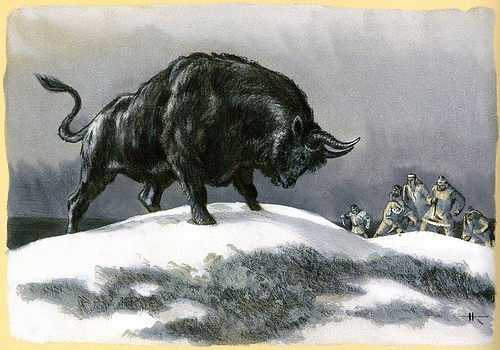
The Great Ox is a widespread runosong, also existing in Estonia. It has been considered a ritual song for Kekri and that in its spirit, an ox was sacrificed. Interestingly, the one who attempts to slay the ox is Ukko himself! (And they claim he makes no appearances in myths, bah!) In the Savonian version, the name Pajainen also appears. This is another name of Ukko himself, it is widely considered so. It is partially because of this that I consider Rauni and Virankannos to be his names as well; after all, there are versions that use variants of those names as Ukko's synonyms as well! Everyone agrees that Pajainen means Ukko but as soon as the other names are brought up, everyone forgets they just made that conclusion, curious. But yes, although it looks like as if Ukko and Pajainen were two separate beings, they mean the same god.
   Härkä kasvoi Kainuhussa Sonni Suomessa sikisi Lihoi mulle liioitenki Peä heilui Hämehen moassa Häntä tuolla Torniossa Toinen sarvi maata viili Toinen taivasta jakasi Päiväkauen lensi peäsky Hännän peähän häpeheltä Kuukauen orava juoksi Härän sarvien väliä Haettiinpa tappajata Etsittihin iskijätä Löyettiinpä lappajakin Ukko kuusen kengän alta Pajainen pajuin alta Ukko peähän iskemähän Pajainen pitelemähän Härkä peälle ryömistihen Ukko kuusehen kapusi Pajainen pajuhun nousi Ukko kuusesta toruupi Pajainen pajusta lausuu: "Voi sinä härkä häijy eläin Ois' sinussa kun oisikin Verta seihtemän venettä Sata soavia lihoa" | An ox grew up in Kainuu A bull was bred in Finland It grew too fat for me Its head swung in Häme lands Its tail over there in Tornio One of its horns grazed the ground The other split the sky For a day, a sparrow flew To the tip of its tail from its nether regions For a month, a squirrel ran Between the ox's horns A killer was looked for A striker was sought A slaughterer was found Ukko from under the shoe of a spruce Pajainen from under a willow Ukko went to strike the head Pajainen to hold it The ox charged onto him Ukko climbed up a spruce Pajainen got up a willow Ukko scolded it from the spruce Pajainen spake from the willow: "Oh ox, you vicious animal! In you, there sure would be Seven boatfuls of blood A hundred tubfuls of meat" |
Ukko seems to fail here? But it is also widely told that the ox was indeed slayed. In Estonia, in a common fashion for them, the slayer is the anonymous female singer's brother. As for Finland and Karelia... typically, Ukko either tries again and then succeeds, or Uros from the sea shows up to slay it (but I believe this was probably loaned from the Greak Oak runo).
| Mies musta merestä nousi Uros aallosta yleni Kolmen sormen korkuinen Neljän peukalon pituinen Syli oil syttä hartehilla Voaksa santoa selässä Peässä poasinen kypärä Koska oil eränsä nähnyt Oli lyönyt niskahan Härkä kaatui polvillensa Siitä sitten kyljellensä Siitä siirsi seljällensä Kustoil saatu soalihiksi Sata soavia lihoa Kuuta kuusi tynneriä Verta seihtemän venettä | A black man got up from the sea A hero rose from the waves The length of three fingers The height of four thumbs Had a fathom of charcoal on his shoulders A span of sand on his back And a helmet of rock on his head For he had seen his catch He had struck it on the back of the neck The ox fell onto its knees And from there, to its side There, he moved it to its back From it, they were able to get A hundred tubfuls of meat Six barrels of fat Seven boatfuls of blood |
For some reason, the Great Ox is not known in Ingria, and instead they have the Great Pig. It was assumed that this was just a local variation of the myth, but that was proven wrong when it turned out that the Forest Finns too have the Great Pig and no ox! The Forest Finns moved from North Savo to Sweden and Norway so early that they could not have, say, learned the version from Ingrians (who didn't even really exist yet). Therefore, the Great Pig version must've also once been known in a larger area in Finland!
But why even change animals? I have my own, NOT CONFIRMED, theory. If researchers are right to assume that the original concept was a sacrificed ox for Kekri, then... In Western Finland, influences were increasingly Scandinavian. Even prior to Christianity, the Norse celebrated Yule by slaying a boar and eating ham. This could be a reference to Freyr's Gullinbursti, or Sæhrímnir. Even today, Scandinavians and Finns eat ham on Christmas, a remnant of this Yule sacrifice from Germanic paganism. With increased Norse influence with Yule, maybe the Great Pig could be a variant of a familiar myth for Finns, changed to suit the new cultural influences better while keeping the original ritual song, regardless of which animal it is about in which month?
  Sikki, sikki Suomessa Kasvoi kaltti kankaasta Joll ol' kärsä viittä kyynäröö Selkä seihentä vakolengnoo Saparo sata syltä pitkä Tulipa Ukko tappamaan Visakanta viittasemaan Ryönikkä repäsemään Kultaisella kurikalla Vaskisella vasaralla Niveräisellä nuijalla Kun se korviaan lotkautti Kerran silmiään räväytti Sillon hyppäs Ryönikkä raitaan Ukko säikäht että hyppäs kuuseen Visakanta vaahtereeseen Muut jumalat muihin puihin Savesta on sikasen synty | Was bred, was bred in Finland A boar grew from the heath forest soil That had a snout of five cubits A back of seven [??] lenghts Pigtail the length of a hundred fathoms Ukko came to kill it Visakanta to [wave?/raise his hand?] Ryönikkä to rip it With a golden mallet A copper hammer A curly grained club When it turned its ear Blinked its eyes once Then, Ryönikkä jumped up a sallow Ukko was so startled he jumped into a tree Visakanta to a maple Other gods to other trees The origin of the pig is from clay |
The line about the pigtail is actually from Savo. The last line can be found from North Savo and North Ostrobothnia. It is a standalone line, not originally a part of the Great Pig runo, but I added it in because both are ultimately listed under the topic of "Origin of the Pig".
Fun fact: A Catholic origin of the pig has also survived in North Savo and Kainuu! In Kainuu, the originator of pigs is called Santta Kynönen, and in North Savo, the mother of pigs is called Tynimys. Both names come from Saint Anthony the Great, but in proper creolized Catholicism+Finnish paganism fashion, he has become a mother goddess of the animal.