


Incantations for different haltijas.
 Mene kiville kiekkumaan Ett' mie hienoja jauhoja saan! Sulle kivi, mulle jauhot Sulle kova, mulle pehmeä! SKVR XII1 3703 | Go sway on the stones So I can get fine flour! You get the stone, I get the flour You get the hard, I get the soft! |
On Michaelmas, bring a rye bread and prepared pig's hind leg to the ceiling of the granary and while leaving, yell:
 Sian kinkku, leipälimppu Sulle aitan orren päässä! SKVR VI1 3082 | The ham of a pig, a loaf of bread Is there for you at the end of the beam of the granary! |
Riihi: Grain drying and threshing cabin.
Tonttusiikko, a rye sheaf, in the corner of the riihi, is venerated as the haltija:
 Isohin taloihin jyväin vahinko Tänne kaikki jyvät | To great houses, the loss of grain Give here all the grain |
(Reminder that tonttu means a homestead haltija.) While creating (tying) this sheaf in the first place, chant:
 Pysy patsas paikoillasi Toimi tonttuna talossa Oman vakkani varaksi Älä kulje kerjustellen Älä varkaissa vaella Saata suureks viljan sato Oman pellon antimista Älä anna toisen tontun Tähkiäni tuhota Varistella viljojani Eikä ottaa omiksensa Varjele vaan vainioni Liialta veden vaivalta Poudaltakin paahtavalta Kuivalta kuihduttavalta Lisää riihen rikkautta Poista poijes ukonilmat Suojele tulipalolta Kolme ompi korkeata Kirkko, riihi sekä sauna Meidän tonttu korkeampi Olkoon iänpäivän aamen | Hold still, statue Work as a tonttu in the house To be an asset of my own container Don't go around begging Don't wander around stealing Make my harvest large From the fruits of my own field Don't let any other tonttu Destroy my spikes Shed my grain Or take them for themself Protect only my field From too much water And the burning sunshine From wilting drought Increase the wealth of my riihi Remove thunderstorms Protect from fire There are three high ones The church, the riihi, and the sauna May our tonttu be even higher Forever amen |
This is at a seita (Sámi holy site) in Särkijärvi, Kittilä, specifically. Put offerings into the hole in the holy stone:
or  Vesi vanhin veljeksistä Anna kalajumala kaloja Tälle vuorokaudelle! | Water is the eldest of brothers Fish god, give me fish For this day! |
Leave the offerings there for a day. Burn a fire next to the stone and pray:
| or Tuli nuorin tyttäristä Anna päivän paistaa Että kala pysyy Liikkehellä järvessä! SKVR XII1 3708 | Fire is the youngest of daughters Let the Sun shine So the fish will remain Moving in the lake! |
The originally Sámi population of Kittilä became Finnicized during the 17th and 18th centuries. Despite the Sámi origins of the population, the Sámi Parliament of Finland does not consider this population Sámi, but Finns. To the Sámi Parliament of Finland, the only Sámi people now are the populations that did not become Finnicized. Whether these Finnicized individuals, who call themselves "Forest Sámi", are "real Sámi" or not is a massive controversy in Finland. Having Sámi ancestry is not exactly rare for Ostrobothnians, Kainuians and Savonians. Therefore, to the Sámi Parliament, the line is drawn at the specific families that were marked as Sámi-speaking in 19th century censuses. There are individuals who would not be considered Sámi in Finland, but would be in Norway, for instance. Like I said, this is a very big controversy which also holds back Sámi rights in Finland.
In my opinion, as an individual who certainly has some Sámi ancestry from many, many centuries ago like many of us Finns... We need to chill maybe? One of the points of controversy is the term "indigenous". Sámi are indigenous to Northern Finland, which would imply that Finns are not, but that they are some colonizers. This is a ridiculous claim, of course, if you take in the fact that many Northern Finns are descendants of the Sámi who became Finnicized centuries ago. Who are we supposed to be angry at if we are the children of the colonizers and the colonized? But the definition of indigenous includes that the population is in the minority in their traditional homeland, which you can not argue for Finns of Northern Finland, who are the majority.
This matter is not very important in North Ostrobothnia and Kainuu, but in the region of Lapland, it's a different story. The matter of who is "real Sámi" became important when it turned so that the indigenous Sámi could get some special "land rights" in their homeland which not all Finns in the region liked very much. I can't simplify this issue too much, as there are people who truly want to emphasize their "Forest Sámi" family history, but there are also political and economic players who want to use the situation to get power stronger than the Sámi in their own homeland.
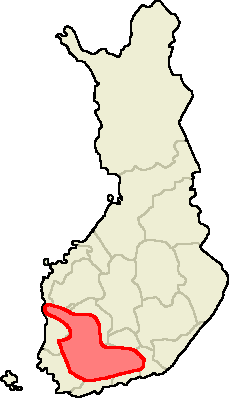
In Loimaa, Southwestern Finland, at the meadows of Muso, a border was agreed to go by the Muso ditch. However, someone had wrongly testified and moved the border, taking an ox as a bribe. Because of this, the haltija of the border yelled:
 Täsä on raja: Muson oja Härk' on annettu Ja väärin vannottu! | Here is the border: the ditch of Muso An ox has been given And a false oath sworn! |
Poika pyyti Pohjanmaalla Nähä tontua totisesti Vesihiittä hiuksinensa Mies mettään mennesänsä Otti kepin pihlajaisen Löi kärmehen kuoliaksi Kiven päällä kihisevän Sai tietäjä sauan hyvän Jolla kierti lammin rannan Joss' on vesi liikkumaton Kierti kerran vaston päivin Kaksi kerta myötä päivin Sano: sauvalla tällä Nostan veestä nuoren neijon Piikanaisen jaksavaisen Kauniin neitsen katsovaisen Kuin sauva vetehen sattu Vesi kuoho kiehuvasti Nousi neiti alastoinna Kivisellen rantehellen: Terves poika puhuttaja! Terves tänne tulemasta Puheilleni pälo piika! | A boy asked in Pohjanmaa To truly see a tonttu A water hiisi with her hair When going into the forest, the man Took a rowan stick Struck a snake dead On a hissing rock Got a fine staff of a tietäjä With which he went around the pond's coast Where water is unmoving Went once around counter clockwise Went twice around clockwise Said: "With this staff I'll raise a young lady from water A much-enduring girl A watchful beautiful maiden" When the staff touched the water The water started to foam A naked lady rose Onto the rocky coast: "Hail, speaker boy! Hail, for coming here To speak to me [?] girl!" |