


The partially prose-fied Theft of Sammas is as unclear as any other Sampo-myth. Karelian runosongs imply that the Sampo is the sky itself, forged by Ilmarinen. However, the word Sammas or Sampo means the world pillar which holds the sky up. In Kainuian runosongs, the thing freed from the rocky mountain of Pohjola is the Sun itself. Due to these reasons, I've assumed that the Sammas is some kind of a wealth bringing "motor" at the root of the world pillar. By stealing it from the Underworld to this world, Väinämöinen and Joukahainen are trying to bring this wealth to our world. However, they are not entirely successful: we get wild plants and salt in seas, but we do not get the crops growing without farming.
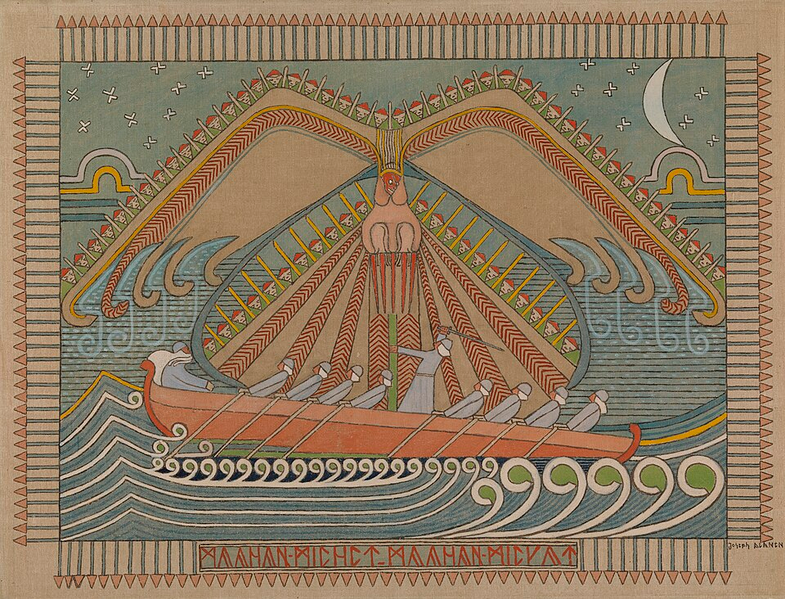
    Vaka vanha Väinämöinen Sekä nuori Jompainen Lähättivät Pohjanmaalle muinoin Sammasta hakemaan. Sieltä saatiin Sammas kiinni, lähettiin merelle. Sanoi nuori Jompainen Vanhallen Väinämöiselle: ”Alota jo virteis Laula, laula Väinämöinen Hyräile hyväsukuinen!” Tuopa vanha Väinämöinen Varmon kyllä vastaeli: ”Varainen on laulamaksi Aikanen ilon teoksi Vielä Pohjolan portit näkyy Tuvan uunit kuumottaa” (Vaan viimein laulo hän, että:) Järvet läikky, maa järisi Linnat liikku, hongat huoju Vuoret vaskiset vapisi Kivet rannalla rakoili Paaet paukku kalliolla Portit Pohjalla repesi Ilman kannet katkeili Väinämöisen laulaessa Läksi kokko Tyrjänmaasta Laskikse Lapista lintu Sinisulka, rautahöyhen Jonka siipi vettä viisti Toinen taivasta jakaisi Sata miest' ol' siiven alla Tuhat purston pyörtimessä Kymmenen kynän nenässä Yheksän persesulassa Lensipä Sammas pilveen. Löi nuori Jompainen miekalla Sampaalta kaksi varvasta poikki. Yksi lensi merehen, toinen saatiin maalle. Joka lensi merehen, siitä tuli suola mereen. Joka saatiin maalle, siitä tuli heinät maalle. Kun ois useet poikki saanut, niin ois vilja tullut kylvämättä. |
Steadfast old Väinämöinen As well as young Jompainen In time immemorial, went to Pohjanmaa to fetch the Sammas. There, they caught the Sammas and went to the sea. Young Jompainen said To old Väinämöinen: "Begin your song already Sing, sing Väinämöinen Hum, you of good kin!" That old Väinämöinen Replied with certainty: "It's too early to sing Too soon to make merry The gates of Pohjola can still be seen The ovens of the house radiating heat" (But finally he sang, so:) Lakes spilled, earth rumbled Castles moved, pines swayed Copper mountains trembled Stones on the coast cracked Boulders banged on the bedrock The gates of Pohja ripped The lids of the sky snapped As Väinämöinen was singing Kokko left from Tyrjänmaa A bird landed from Lapland Blue plume, iron feather Its wing grazed water Another one split the sky A hundred men were beneath its wing A thousand at the root of the tail Ten at the tip of a quill Nine in a tail feather The Sammas flew into a cloud. Young Jompainen struck off two of the toes of the Sammas. One flew into the sea, another one on land. The one that flew into the sea gave us the salt in seas. The one that flew on land gave us hay on land. If more had been cut, crops would grow without sowing. |
Here, it looks like as if the Sammas itself just "jumps into the clouds": the Sammas is a bird with toes. However, once again Karelian runosongs imply that it is the kokko eagle which comes from Pohjola and snatches the Sammas and is struck in the toes, thought the Sammas does break into pieces. Karelians also think it is Louhi herself who transforms into kokko and gives chase to the heroes. However, Finnish runosongs don't support this much, always giving this transformation ability to Louhi's exact opposite, the Sun goddess Päivätär. Väinö Salminen did therefore also suggest that the bird here is a storm, which was seen by Forest Finns as the storm bird from Pohjola. I must also point out: In Savonian riddles, the description of kokko here is a riddle, the answer to which is "a ship".