

| Names: | Sammas 
Samppi 
Samppu
|
|---|
Sammas is best known by people as "Sampo", even though this name has not been recorded from Finnish runosongs, only from Karelian ones. Just so you know. There are differences on what the Sammas is in different contexts so I'll cover a few here.
While Finnish runosongs usually speak of the World Tree, in Estonia we can see the World Pillar Sammas being mentioned instead in some runosongs. Just like the World Tree, the Sammas stands in the center of the island in the center of the world and reaches to the heavens.
We don't have to rely on the Estonians to describe this pillar, however, as Finnish descriptions also exist. At the bottom, it is connected to a copper mountain, aka the rocky hill, the World Mountain, of Pohjola, the Underworld. It's even said to have roots (see, another tree connection). It is often said to reach "9 syli" underground, which would be about 16 meters, but it probably isn't so literal. Through the center of the earth it reaches to the sky where it is connected to the Polaris. It turns around which has likely reminded people of grinding, explaining Sammas's later mill associations.
Like luonnottaret often live on the island in the center of the world, the Forest Finnish tietäjä Kaisa Vilhuinen described that the home of the Moon Maiden was, or had at least at some point been, on the top of the Sammas in the Polaris. She also described that the Sammas divided into three "branches" at the top (wow that's almost like a tree). Travelling between the upper and center layers of the world was possible with the golden cradle at Sammas; aka, the rainbow. She also has some very interesting details about the root: there'd be a golden treasure protected by Tuokkoi, Pajas and Ruoskakup. Well, Pajas is probably Ukko, but all those others? Completely strange and unknown names. My question is, why is the sky god Ukko hanging out protecting a pillar in the Underworld? Although, from a certain perspective, Ukko is called "the one who holds up the world", and there are signs that the world pillar could symbolize his penis (bringing fertility) in some ways, though it's never literally spelled out in runosongs.
In the runosong "The Theft of Sammas", Väinämöinen and Joukahainen travel to Pohjola to steal the Sammas. This is odd, why would they steal the world pillar? That would make the sky collapse, no?
It seems that in this context, Sammas is not the world pillar at all, despite the name. White Karelian runosongs say that it was forged by Ilmarinen, and that it is the "iridescent lid"; aka, it's the sky! But when asked, the runosingers had various ideas of what the "Sampo" is: an iron kantele, the Sun and the Moon, a mill that grinds wealth! Many of these features no doubt got mixed into the story. Finnish runosongs do mention Ilmarinen as the forger of the sky, but do not mention him as connected to the Sammas.
It seems that the reason why Väinämöinen and Joukahainen had to steal the Sammas, and why they are heroes in doing so, it the wealth bringing abilities of it. Pieces of the Sammas caused there to be salt in the seas and wild hay on the ground. If Väinämöinen and Joukahainen had been fully successful, we wouldn't need to farm but everything would grow on its own. Therefore, this runosong works as a kind of ritual song of the birth of agriculture.
What is something that would need to be brought here to us from an icy place for plants to grow? Why, the Sun, of course! Indeed, runosongs from Kainuu mention no "theft of Sammas" from the rocky hill of Pohjola; instead, Väinämöinen frees the Sun and the Moon from said hill by forging. Therefore that explanation is not far-fetched either.
Runosongs from Kainuu and White Karelia also describe Samppi/Samppu as something which has a nearly endless amount of "words" in it, no doubt referring to words of myths and incantations. When asked about this, the White Karelian runosinger Jaakko Huovinen explained that "Samma" is the thing where all runosongs and sorcery originate from. Therefore, it is not only a source of wealth like grain, but also of magical power. Understandable why they wouldn't want to leave this device into Pohjola then, even though the world remains imperfect because they weren't fully successful.
If I wanted to get creative and compare these elements, maybe the "Sammas" that is stolen is more like the wealth bringing "motor" of the pillar at the root of it instead of the whole pillar itself? In that way, one could explain why the sky doesn't collapse... Though interestingly, it almost does when Väinämöinen sings while in the process of stealing the Sammas!
In the theft of Sammas, Väinämöinen and Joukahainen take it into their boat. Joukahainen tells Väinämöinen to start singing his spells but he refuses, pointing out that the Gates of Pohjola were still too close. When he does sing, however, rocks start cracking and the dome of the sky almost breaks. A Giant Bird from Pohjola comes to chase after the heroes... and the narrative turns confusing. The Sammas itself is like a bird, jumping out of the boat and Joukahainen jumps after it, striking off two of the bird's toes with his sword. One fell into the sea, making it salty, and the other on land, making wild hay grow.
So wtf is up with that bird. In White Karelian runosongs, it is Louhi herself who transforms into the Giant Eagle and chases after the thieves. She takes the Sampo into her talons but someone cuts them off, causing for the Sampo to fall and break into pieces. Because of this, some have seen the other version as one where Louhi and Sammas have "fused" together. However, Väinö Salminen also pointed out a different possibility: the Forest Finns thought that the storm was actually a giant storm bird from Pohjola. It could've then been that it was this storm bird who chased after the heroes and, when Joukahainen slices its "toes", the Sammas broke into pieces and fell.
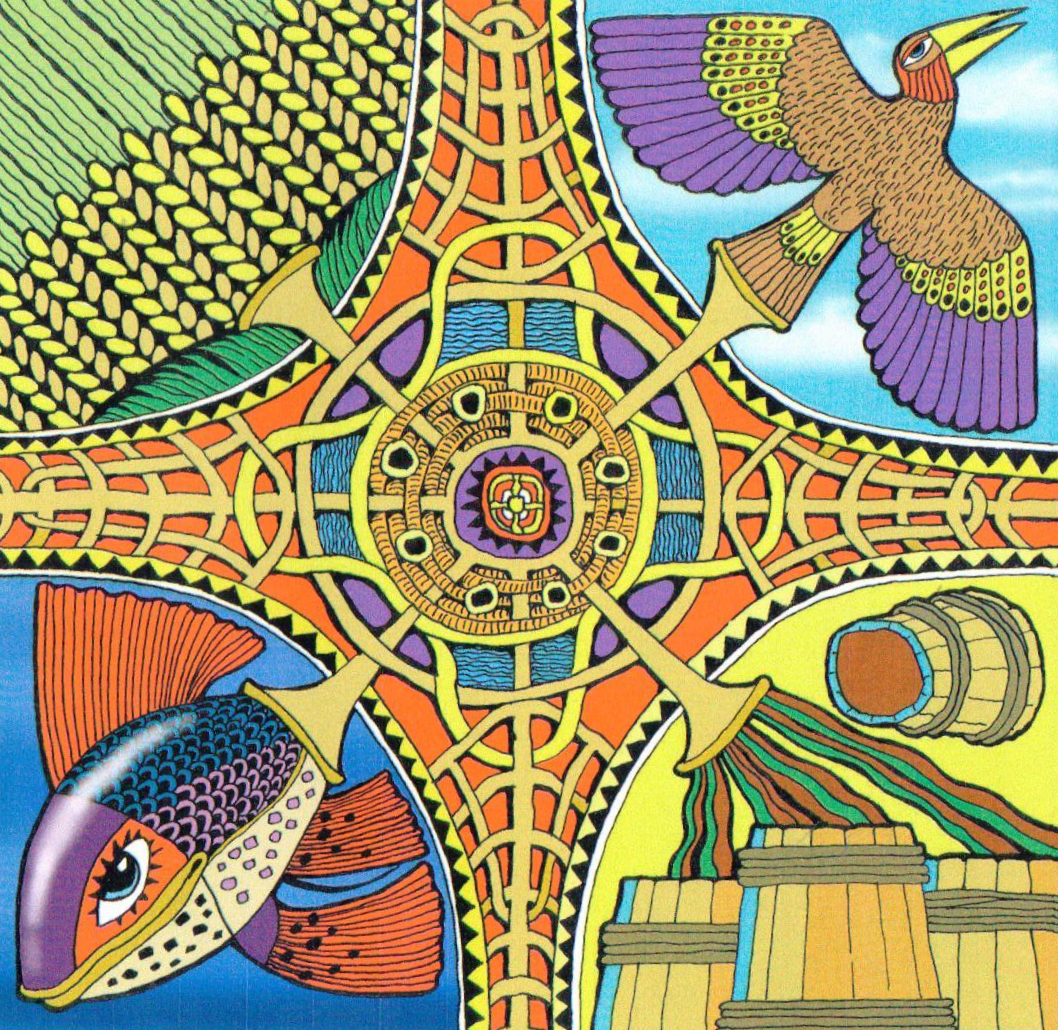
| Sammas, variants | Suggested to be related to the Indo-Iranian word *skambhá "pillar". |
|---|
Only in Finnish, sorry. This is the source material.