


There are multiple different references to the freeing of the Sun and the Moon, and I think they are referring to various different circumstances.
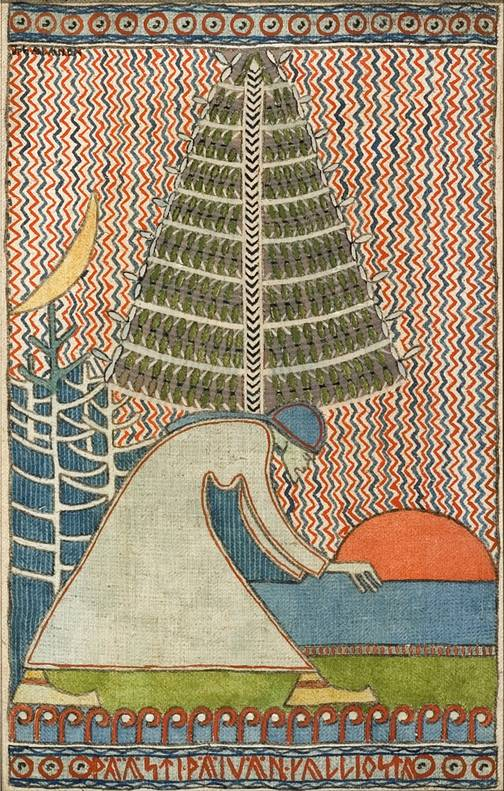
 Minne, sano, meiltä päivä pääty Kunnas meiltä kuu katosi? Päivä peäty kalliohon Yöllä synty Väinämöinen Yöllä synty, yöllä kasvo Läksi päivällä pajaan Tako herran tarpehia Kyy lenti kynnykselle Takohissa Väinämöisen Ite vanha Väinämöinen Sanan virkko, nuin nimesi: "Mitä kyy olet kynnyksellä?" Kyy taiten vastoapi: "Tuota minä lienen kynnyksellä Sanomata soattamassa: Jopa nyt kuu kivestä nousi Päivä peäsi kalliosta Takohissa Väinämöisen" |
Where, say, did our Sun end up in Where did our Moon disappear? The Sun ended up in a rock Väinämöinen was born during nighttime Born during night, brought up during night During the day, he went into a forge Forged men's tools A viper flew onto the threshold As Väinämöinen was forging Old Väinämöinen himself He spake, thus he stated: "What are you on the threshold for, viper?" The viper skillfully replied: "For that reason I'm on the threshold To bring a message: The Moon rose from a stone The Sun was released from a rock As Väinämöinen was forging" |
It's a bit odd. The "rock" in question is the rocky hill of Pohjola, the world mountain. It is not said that anyone specifically put the Sun and the Moon there. The setting is the same as with the theft of Sammas which had to be stolen from the rocky hill of Pohjola and which brings various kinds of wealth just like the Sun. In Kainuu, no versions of the theft of Sammas have been collected, but instead this freeing of the Sun and the Moon with forging. I think it's a valid interpretation to think that they could have some kind of a connection in the ultimate meaning.
and/or  Kuumet ennen kuun kehitti Kavet kuun kehästä päästi Riihen rautasen sisästä Kavet päästi päivän paistamaan Päästi kuun kumottamahan Pääsi ennen päivän poika Päivättären päästäessä |
Kuumet once put the Moon in a ring Kavet released the Moon from a circle From inside an iron threshing cabin Kavet let the Sun shine Let the Moon glow Once, the Son of the Sun was released When Päivätär released him |
I think this is a reference to the natural cycles of the Sun and the Moon. Kavet releasing the Moon from a "ring" means releasing it from a halo of light which sometimes appears around it (in Finland, this has been a sign of coming sunshine). Kavet's act of releasing the Moon also has a magical connection to childbirth. In my opinion, Päivätär releasing the Son of the Sun is a reference to the resurrection of Lemminkäinen and the changing of the seasons. In either case, this is an incantation used for alleviating pain.
 Ikuinen iku-turilas Joka päästi päästön Päästi kuun kehästä Pääst' päivän teräisen juoksemaan |
Ancient eternal giant Who released the release Released the Moon from a ring Released the edge of the Sun to run |
I think this is a reference to the felling of the Great Oak. In either case, this is also an incantation for alleviating pain.
There lived a luonnotar named Hepleija Jenuveeva in the Polaris, which is connected to the world pillar. Once, when she was returning home, Louhi stopped her. Väinämöinen showed up to help the luonnotar by helping her escape to the Milky Way where she became the protector of the Sun and the Moon. She is the long-haired maiden of the Moon who can cause lunar and solar eclipses when bathing in a sauna and brushing her long, long hair.
The cycles of the Moon are attributed both to wild animals "eating" the Moon, or to Rahko painting it with tar.