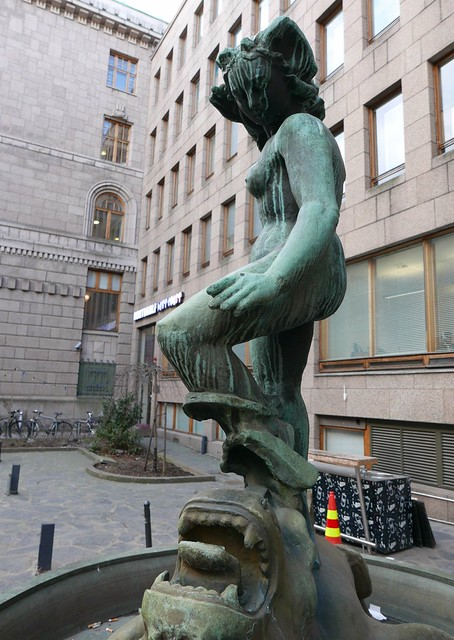
The fishing of a fish who turns out to be a water maiden is a concept that appears in runosongs all the way in Estonia as well. The term "Maiden of Vellamo", with which this maiden is best known in Finland, actually comes from Karelian runosongs: in Finnish ones, the term in question is rare. In Estonian runosongs, the maiden reveals herself to be a water maiden only when she has been taken home and is about to be cooked. In Karelia, the fish escapes and Väinämöinen cries after his missed chance of getting a wife. In Finnish runosongs, however, the maiden could very well be Kuohutar/Kosketar, the haltija of rapids, and have a son out of wedlock with Väinämöinen as well. Or at least out of a union that was not considered legitimate by the church.
And, as is common, there is a version in which the protagonist is Ilmarinen. Do not be confused, then, of his name randomly appearing in the runo below.
  Venet kivehen kimahti Huovatessa Väinämöisen Nousipa kalanen karihin Sitte seppä Ilmarinen Vetävi venehesensä Talmitalla purtehensa Se oli seppä Ilmarinen Otti veitsen huotrastaan Päätä poikki pannakseen Lohi haasto longotteli Hauki haasto harvaisesti: ”Oi sie huima Väinämöine! En minä sinulla tullutkana Lohi viiplon viilläksesi Tulinpa minä sinulle Ikuiseksi orjaksesi Polvuiseksi puolisoksi!” |
A boat hit a rock As Väinämöinen was rowing A fish rose onto the islet Then smith Ilmarinen Pulled it into his boat With [?] into his vessel It was smith Ilmarinen Took a knife from its sheath In order to cut off its head The salmon chattered The pike unusually said: "Oh, you fierce Väinämöinen! I did not come to you To be salmon slices I came to you To be your eternal slave Forever spouse!" |
Yeah I don't think slave means like, slave. Different kinds of servants have also been referred to as orja. Funny enough, it comes from the word "Aryan".
The transformation of Aino in the Kalevala is based on this myth, but Aino is not a figure in actual mythology, nor has this water maiden been in any way pressured by Väinämöinen.
The Fishing of a Maiden of Vellamo is often considered a White Karelian runosong, as most recordings of it are from there. However, not only does it resemble the Estonian runosongs mentioned earlier, versions also exist from Kainuu, and another from North Ostrobothnia or Kainuu. These all have different endings, however: it's very well possible that the ending in which the maiden escapes from Väinämöinen is only a White Karelian thing. It is also quite likely that the original fisher of the water maiden was not Väinämöinen at all but someone anonymous. Maybe Väinämöinen could've been attached to the tale later because of his association with a water maiden?
The Maiden of Vellamo has been described to be a mermaid (merenneito), but I'm not so sure about that. A mermaid specifically has a fish tail but we do not know what the Maiden of Vellamo looks like, only that she can transform into a fish. The Finnish term vedenneito "water maiden" does not include specific implications of her physiology. Nationalists and other such romanticists have been eager to see the mermaids of Catholic Medieval Finnish churches, and even one from Viking Age Gotland, as the same as this mythological Maiden of Vellamo, but it's more likely that those are simple Catholic mermaid-imagery that was common all around Europe without having any connection to this specific water maiden.