


An instance of people confusing Norse and Slavic style "totem" god idols with Finnish paganism got me thinking: were there some kinds of idols in ancient Finland? I started digging into the Finnish Heritage Agency's findings for clues. I have to point out that idols do not seem to have been super important: natural formations often fulfilled this purpose.
According to a folk story, in Tohninmäki, South Ostrobothnia, there used to be a "wooden image of a god" that had "metal earrings". Whether or not this is true, however, is another matter.
Also side note: these are archaological findings from Finland, but obviously the people of the stone age didn't speak Finnish or identify as "Finns", for instance.
From the Neolithic Stone Age, we have discoveries of clay and amber idols. When it comes to amber, notable are the sacrifices at the old holy site of Astuvansalmi, South Savo. From the side, the rock is shaped kind of like a human face, which is probably why it was a holy site for the neolithic humans of the area. And maybe the human faced rock itself was seen as a god: there are rock paintings on it, and two small pieces of amber shaped like the face on the rock (as well as an amber bear) have been discovered to have been sacrificed at the site.

Another amber face has been unearthed from Lieto, Southwestern Finland.

Another common archaological discovery is tools (such as clubs) with animal (and even human) heads. They have been assumed to be seremonial, maybe also status, items based on the fact that many of them are made out of materials too soft for actual tool use.

One of the most wonderful neolithic discoveries is, however, wooden. Puujumalainen "little wooden god" was discovered from Pohjankuru, Uusimaa. It is very similar to the Shigir Idol from Permia, the oldest known wooden sculpture in the world, despite being several millenia younger. Based on those other examples, we can see that the head once belonged to the head of a long pole. While we don't know the purpose of this idol, later in Finland, kinds of "poles" of trees cut from the middle (the roots still being in the ground) have appeared on holy sites. No proof of them having ever had any heads though.

A bear claw from Southwestern Finland.

Finns had strong trade connections to Permians, Finno-Ugric peoples near the Kama river, which can be seen from the various Permian-style artifacts unearthed. Below, a figure of a man or deity from Pirkanmaa.

Some Permian casts seem to depict mythological elements or deities, but there is no certainty about, well, anything. Still, the prevanace of eagles in runosongs, and in Permian casts, makes one wonder if the people of the old saw a religious connection to the items. Especially since some eagle figure have human faces on their stomachs, one of them claimed to be a sun goddess. Such eagles could be shamistic or totemistic, and according to Russian researchers, jewellery used by men. Below, two three-headed eagles from Pirkanmaa.


In graves, various items with jingling bells have been unearthed. They are not just toys, but appear on wealthier people and on items that have been also later associated with magic. They seem to have then been protective against harm. This kind of belief is very widespread in the world. In the image, two bird bells from Pirkanmaa and South Savo. I think the birds only emphasize a potential magical meaning in relation of animism.

In addition to actual bear teeth, people also used bronze bear teeth copies as protective items. Below, from Southwestern Finland, Satakunta, and an unknown place. Notice that the first two also seem to have eyes carved on them.

Such a bear tooth could be tied to fine jewellery like this:

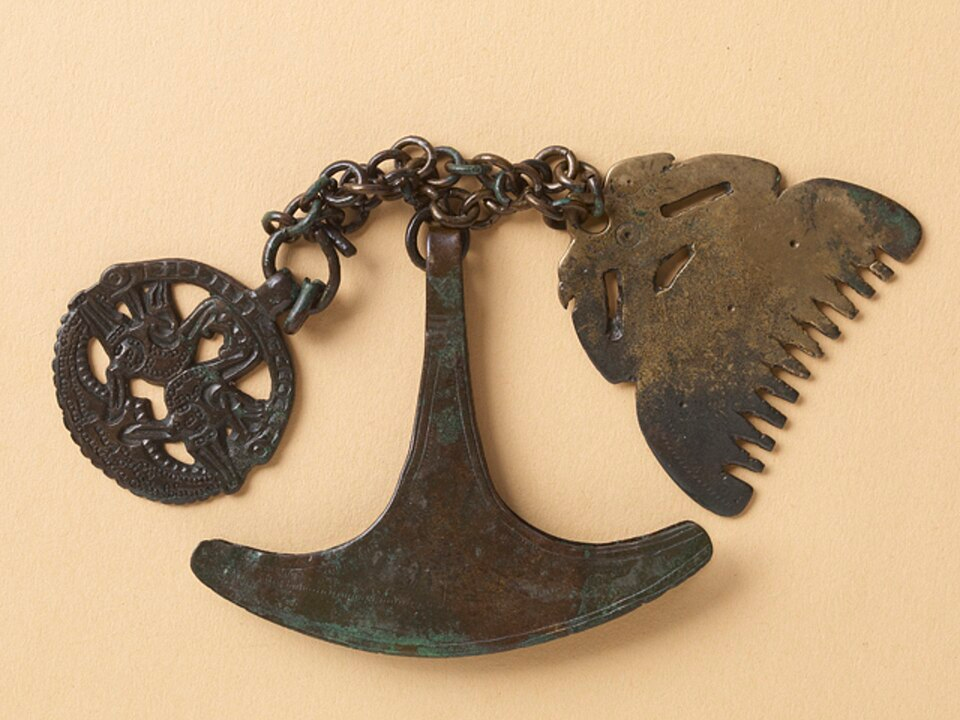
Multiple pendants dubbed "Thor's hammer" have been discovered from Finland. However, the style common in Finland differs from the style common in Scandinavia with its curved "hammerhead". Because of this, the style common in Finland has often been called Ukonkirves "Ukko's axe". Below are from Pirkanmaa and Southwestern Finland. The latter seems to include a cross, but the pendant is centuries older than Christianity in Finland. Perhaps the Christian cross was simply seen as a common protective magic symbol in Europe for Finns.

Same explanation as above goes for this Southwestern Finnish "cross within a sun cross" pendant.

An object which is assumed to be the head of a votive staff is clearly of Scandinavian origin when looking at the art style. Indeed, the man carved is listed as Odin. Now, whether the figure was seen as the Norse god Odin by whichever person that had it in Nokia, Pirkanmaa, is an entirely different matter.

In the spirit of animism, we have these: a bird and a horse from Pirkanmaa.

If you are wondering about Finnish paganism, this age is already very relevant to the world of the runosongs (as explained by Anna-Leena Siikala).
During the Middle Ages, Christianity was brought to Finland. At first, it was Catholicism mainly until the Protestant Reformation, when the Kingdom of Sweden, and Finland as a part of it, were made officially Lutheran. Lutheran churches have little decorations in comparison to Catholic ones, but the Catholic churches of Western Finland had plenty of wooden statues of saints, as well as reredos and such. Some where locally made, others were imported from elsewhere in Europe, like Germany.
Despite the fact that these are saints and not gods, they have been called "wooden gods" (puujumalat) informally by the folk. In the creolized Finnish folk religion combining paganism and Christianity, many of them were gods, after all. Below, I've chosen pics of Saints Catherine and Anne: Catherine was included in the pantheon as a goddess of sheep and cattle and on her feast day, a sheep was sacrificed to her. Saint Anne, on the other hand, took the role of the goddess of the forest, in original paganism Mielikki.

Below is a wooden doll from 1600-1890, from Teerijärvi, Coastal Ostrobothnia. It is called a riihiukko "grain drying and threshing cabin man" which, according to folk stories, was placed inside such a cabin in order to provide good luck with crops. Similar traditions have been recorded from Estonians and Setos.

Below are... wait a minute, that looks like the Stone Age little wooden god fellow! Both of these are "fish gods" (kalajumalat) from Rear Bothnia, the latter dated to the 18th century. At the time, there were both Finns and Sámi living in the area, so it can't be said with certainty who made the sculpture. The first image, on the other hand, has the carving 1828 on it and if it is the year it was made, it would seem Finnish. It wasn't originally detatched but connected to the ground with the stump's natural roots. In Northern Finland, hunters and fishermen, Finns and Sámi, sacrificed at the same holy sites, though the sites would've originated from older Sámi tradition. Wooden sieidi (Sámi holy sites) are called keropäät in Finnish.
