


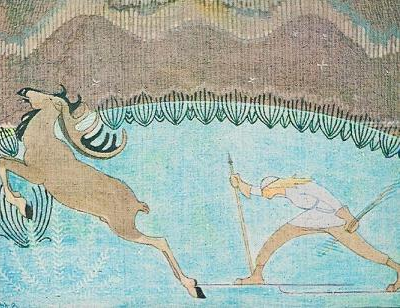
  Missä hirvi synnytelty Karin poika kasvateltu? Tuoll’ on hirvi synnytelty Nevan tuulisen selällä Tiheillä tuomikoilla Paksuilla pajupehuilla Otavaisen olkapäillä Taivaan tähtehin seassa Selkä koivun konkelosta Sääret väärästä lepästä Karvat karvakorttehista Pää on saaren juurikasta Raato muu lahoa puuta Nahka kuusen koskuesta Korvat lammin lumpeista Silmät lammin pulmukoista Juokses tuonne Hiien hirvi Kotapoikahin puroille Lapin lasten tanterille Mitäpäs täällä koirat haukkuu Mitäpäs tääll’ on lapset itki Täällä juoksi Hiien hirvi Keikahutti keitinpuuta Kolahutti korvakkoa Liemen kaati lattialle Lihan tuhkahan tuherti Joutu hirvi juoksemassa Lappalaisten kovan eetek Eipä lasta Lapiss’ ollut Jok’ ei pessyt kattilalta Ja ei veistänsä hionut Oino kiinni ottamahan Sai lylyn lukarretuksi Kepin suoveroitelluksi Kuin kerran potalsi Silmän sintämättömähän Toisen kerran kuin potalsi Korvan kuulumattomahan Kolmannen kerran Jopa Hiien hirven tapasi Kelpovaispa tuossa maata Hyvän neitosen keralla Hiien hirven lautasella |
Where was the moose given birth to Son of Pohja raised? There, the moose was given birth to: On a windy swamp In thick bird cherry forests In dense willow bushes On the shoulders of the Big Dipper Amongst the stars of the sky Back made out of a fallen birch Cannons out of a false alder Hair out of hairy horsetails Head is out of island roots Carcass out of other rotten trees Skin out of spruce bark Ears out of pond lilies Eyes out of pond spatterdocks Run over there, Moose of Hiisi To the streams of kota boys To the fields of the children of Lapland What are dogs barking over here? What are children crying over here? Through here, ran the Moose of Hiisi Tipped over the cooking wood Knocked the maiden on a spinning wheel Spilled the broth onto the floor Mixed the meat with soot The moose ended up running To the front of the kota of a Sámi There was not child in Lapland Who didn't wash their pots Who didn't sharpen their knives (Oino went to catch it / To catch the ram?) Managed to get a ski made A pole gathered When he kicked once He went further than the eyes can see When he kicked a second time Further than the ears can hear For a third time He reached the Moose of Hiisi It would be nice to lie there With a good maiden On the croup of the Moose of Hiisi |
How very Sámi of a story. Indeed, this "Moose of Hiisi" ran into the middle of a Sámi village, siida, specifically. Kota means a goahti. The culture where the story happens, then, is among the "Forest Sámi": the hunter-gathering Sámi who lived in inland Finland before mixing with Finns and turning to agriculture.
This runosong includes the very, very rare Origin of the Moose. The hunt is clearly happening in a mythic place; a northern location would imply near the Underworld. However, the beginning part seems to instead actually describe a being named Hiisi creating the moose. After the Hiisi mention, one Savonian version includes the line "Volkas gave something to drink to his lambs", but this name "Volkas" could come from the Russian word for wolf and be therefore unrelated to the rest of the runosong. In many Northern Eurasian cultures, there is a myth of a celestial moose or reindeer hunt happening in the stars. For Eastern Sámi, the end of the world comes when the sky god Tiermes shoots down the heavenly reindeer with his fiery arrow. Therefore it has also been suggested that maybe the Sámi hunter here chases the moose all the way to the heavens. I'll elaborate on that later.
It seems that the reason why Hiisi created this moose to challenge the hunter is because the hunter was too smug, bragging about being able to hunt any animal. "Challenge accepted", said Hiisi. This runosong also describes the Origin of Skis. When the hunter caught the moose, he thinks about """lying""" (sexually) on the moose hide. The Finnish version does not show it, but in Karelian versions, the moose is quite offended at this and escapes. When the hunter tries to follow after it, his skis break or he falls into a hole on the World Mountain. (Falls into the Underworld?) Risto Pulkkinen suggested that as the sky is mentioned along with the mountain, this hunt could've happened high on the mountain in the heavens.
You can probably see the humbling message of "don't count your chickens before they're hatched". Do not fantasize what you're going to do with the prey, how to divide it, or anything, before you've actually caught it. For both Finns and Sámi, hunting is also a very male focused activity. A woman steps over a hunting weapon? It's ruined! And don't even think about having intercourse before going hunting. It took away the force of man from the man, as women were filled with the force of woman. I guess this is some yin and yang tier stuff again.
The runosongs of hunting moose are very rare in Finland, but very common in Karelia. Likewise, the songs of hunting bears are very rare in Karelia, but very common in Finland. This has awaken theories of totemism, that there would've been a tribe that considered the moose their ancestor, and a tribe that considered the bear their ancestor. This would explain why Tacitus wrote that east of the "Finns" (Sámi of Sweden) lived peoples called helluseios et oxinas, with helluseios referring to the moose and oxinas to the bear. This is fully speculative, mind you.
According to Matti Sarmela, the Karelians would've been the people of the bear, not hunting bears who they considered their ancestors, instead opting for moose and reindeer. Finns would lack moose and reindeer hunting songs then because they were the people of the moose and avoided hunting them. Risto Pulkkinen argued the opposite: Finnish bear songs specifically state that the humans and the bear, the hunter and the prey, are related. This has to mean that at least in Central Finland, the people did consider the bear to be their ancestor. The difference of the areas where these runosongs exist is very interesting, but making simple statements like "this part of land had a bear cult and this other part had a moose cult" is a statement that has not been sufficiently proven.
In later runosongs, such as the Death of Lemminkäinen, hunting the Moose of Hiisi is one of the impossible tasks Lemminkäinen has to clear to be able to get an Underworld maiden as his wife.
Only in Finnish, sorry. This is the source material.
Heikki Laitinen sings this runosong, but it's a bit different: it does not include the Origin of the Moose from the beginning, having Karelian parts instead and a different description how plural "hiidet" made mooses. It doesn't use the exact same words. (Oral tradition is a bit like that.) Still, the story stops at the same point.