Our Chthonic Lady of Crops
8 May 2026
I titled this post in a very un-Finnish way, but that's fine. Referring to Greek words seems to be pretty familiar for English speakers.
I've got quite far from my initial theories when I was looking at Louhi and Loviatar, seeing them to be the same and wondering if a daughter of Louhi exists at all. After all, many references to the icy Maiden of Pohjola are clearly references to Louhi herself, not any daughter. Still, I've come to find this daughter elsewhere in the runosongs, in the night and dusk. Maybe her name could even be Ismärätär.
Forest Finnish runosongs mention a mysterious viljan eukko "old woman of crops". She is called Katariina, but this name obviously comes from Saint Catherine. Is there someone then who could've been in Catherine's place originally? In Karelia, she is mentioned in hunting incantations, as well as in relation to protecting cattle. This way, her role is very similar to that of Mielikki and the forest goddesses, one of whom is known as Tuometar (after tuomi "bird cherry"). Something that becomes clear from even the oldest runosongs written down is that the concept of Tapiola (forest) and Pohjola (as northern forest instead of the Underworld) became mixed at some point. That's why we can have instances of incantations asking Louhi for prey, especially if it's about "northern" animals like reindeer. Of course we know that Louhi is wealthy, so in this way, it is the wealth of the forest, the furs, which are also hers.
In Karelian runosongs, viljan eukko is connected to a cold wind (called Vihuritar), to earth (mentioned alongside "Lady of Earth"), to cattle (a "shepherd of cattle"), to the Underworld (asked to bring milk from the Underworld), as well as bears (mentioned alongside Hongatar). In both Karelian and Forest Finnish runosong, she is called vihanta "verdant, fresh", and the Forest Finnish runosong is also in context of protection against a bear. Maatar, the Lady of Earth, has no connection to these concepts in a bigger picture, which is why I don't exactly consider her a viable holder of this position (Maatar's primary connections are to stones and snakes).
The mixing of Tapio and Pohja is so evident, it makes me wonder... As said, a forest maiden Tuometar is also asked to protect cattle (against bears too) and might have been involved with the creation of the bear. But! In various places, this name appears as Tuonetar (tuoni "death"). In many instances, this could easily be written of as a misunderstanding or a typo, but there is at least one instance where this does not quite fly. In a Kainuian bear hunting song, along with Mielikki, the forest goddess Tuometar is also asked to help... Except that in the eldest manuscript, the name appears as Tuonetar, and she's given the epithet Päivölän miniä "daughter-in-law of Päivölä". And that's not something connected to a forest goddess; that's the role of the Underworld maiden, daughter of Louhi, who married Lemminkäinen!
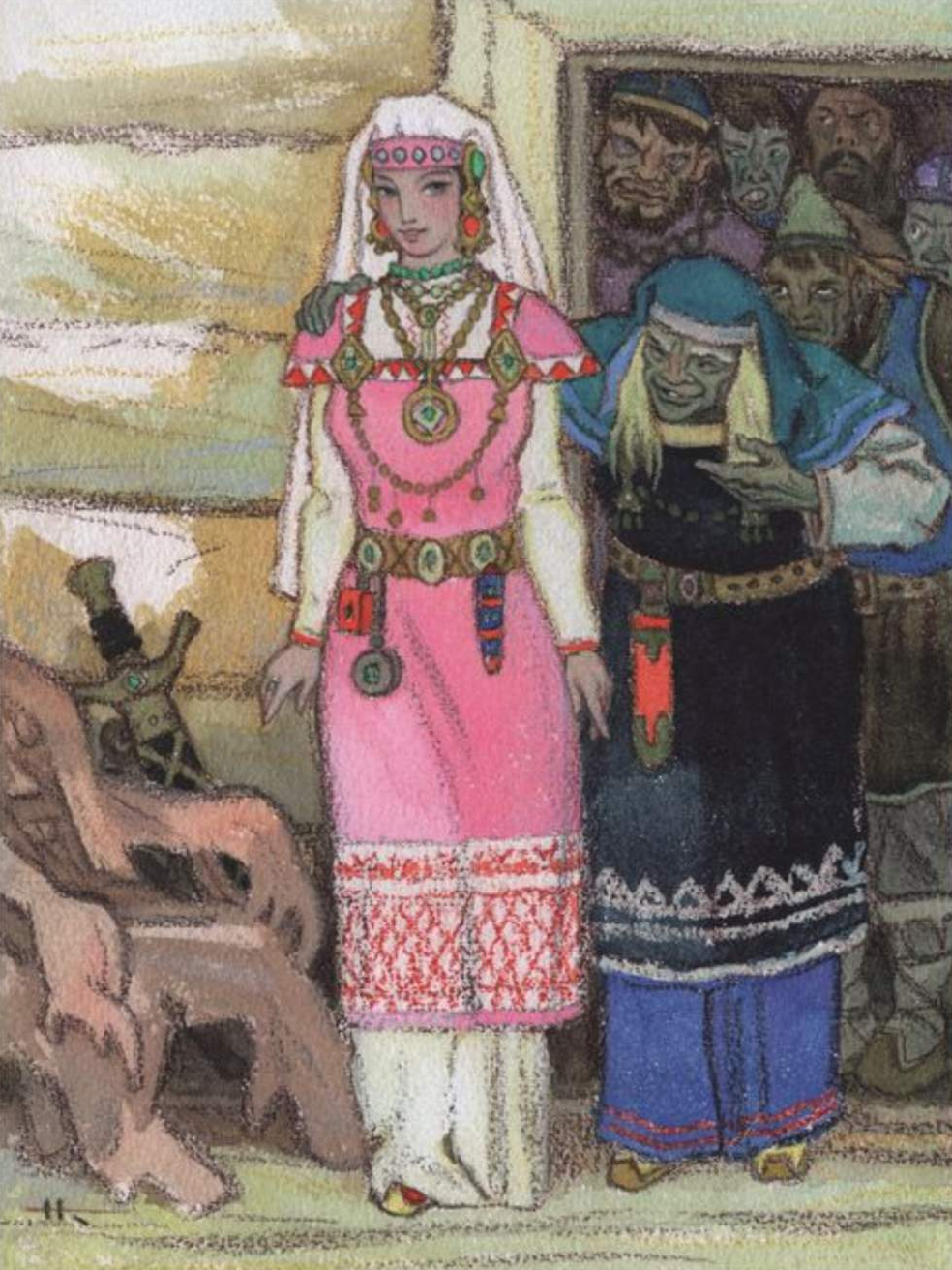
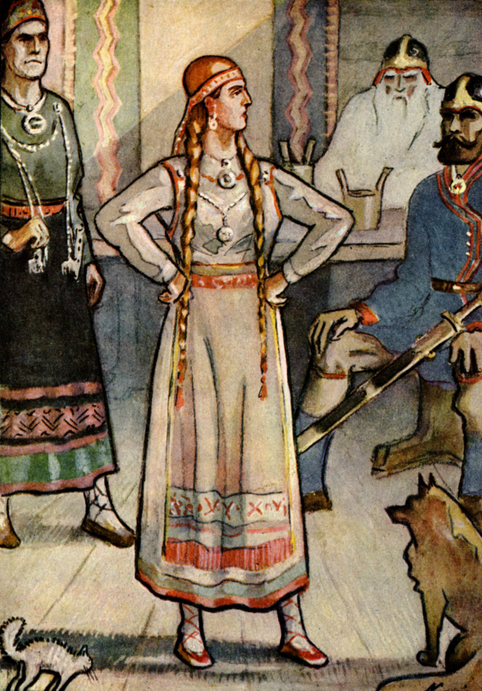
On the left, Louhi's daughter by Nikolai Kochergin; on the right, Louhi's daughter by Aarno Karimo.
This wouldn't be the first time that an Underworld figure gets mixed with bears alongside forest deities. Hongatar, the mother of the bear, is multiple times called "Lady of Pohja"; Ganander wrote this meant a northern forest. In a Kainuian runosong, Ismärätär, an Underworld maiden, made a cabin out of bird cherry and cradled the bear. If that wasn't enough, an Underworld maiden called Yön tyttö, hämärän neito "Girl of the Night, Maiden of the Dusk" is mentioned in multiple instances as a protector of cattle (in North Ostrobothnia), as well as asked to help with bear hunting (by spinning a trap thread, in Kainuu). In a Karelian runosong which does not appear in Finland, she is the Underworld maiden which Väinämöinen and Ilmarinen compete over. From Savonian runosongs, we can see that she is the same as "Eine-eukko". While "Eine" could be a name, it also means "food" and based on this, you can probably see why I find a connection to viljan eukko possible. Of course, sometimes forest animals are called "crops", in which case addressing forest deities is understandable.
Mentions of an Underworld maiden along with forest deities is so prevalent it can't be ignored as an exception. Some connections to Maatar also exist, as I stated, since one Savonian runosong sees Dusk Maiden's thread as an origin of snakes rather than a trap thread. Eine-eukko is also seen as protective of humans, just like Maatar is. I still find their differences too great to connect the two, especially since Maatar has no connection to bears or hunting. But it works as one of the many elements that show the connection between the Underworld and the physical underground.
I guess, to differ from some of my fellow practitioners, I see the Underworld goddess connected to Earth more as Louhi's daughter instead of Louhi herself. (The take that Louhi is the earth goddess exists, though I do not agree.) Since Louhi is sometimes said to be the mother of things like frost and cold wind, this information would not contradict my theory on the Dusk Maiden. Oh, and the cold wind is also called Tuonetar in North Ostrobothnia, by the way. In Kainuian runosongs, the one asked to protect cattle is usually Etelätär of south wind, and a North Karelian runosong pairs up Vihuritar (cold wind) viljan eukko with a strange cowherd, "Kahuritar" (word does not appear elsewhere). Could Etelätär then be connected to Läävätär, the warm haltija of the cowhouse? Ijätär, "Lady East", appears as an east wind protector of cattle in Karelia, but the name does not appear in Finland. Except that... Kainuian Ismärätär appears once as "Isätär", which opens up a possibility for a connection between the two. However, the east is the cardinal direction of life and warmth, so having east wind being called a maiden of death seems contradictory in every way possible. Then again, Karelian runosongs also equate Ijätär to Luotehetar (northwestern wind) which is, in fact, connected to the Underworld. To make this all more confusing, Karelian runosongs also call Läävätär a "verdant/fresh woman".
It's easy for me to deem Louhi's daughter as the north wind, but the bigger question is if Etelätär, the south wind, is the same figure and there is but one wind deity, appearing as good or bad depending on the direction of the wind, or if they are rather opposite equivalents of each other (one for north+west wind and another for east+south wind). In we connect this all to the Dusk Maiden... The most beautiful part of it is that she is not an enemy of humans, life or fertility. She is cold, from the realm of the dead, but she married Lemminkäinen (son of fertility deities) and became the daughter-in-law of the Heavens. And maybe her name is Ismärätär (in addition to... Tuonetar, Tuuletar, Turjatar?).
As for the Maatar connection... Läävätär or Etelätär is similarly described as being underground as Maatar, but one Karelian runosong actually specifies that she is an employee of the Lady of Earth, not the Lady herself.